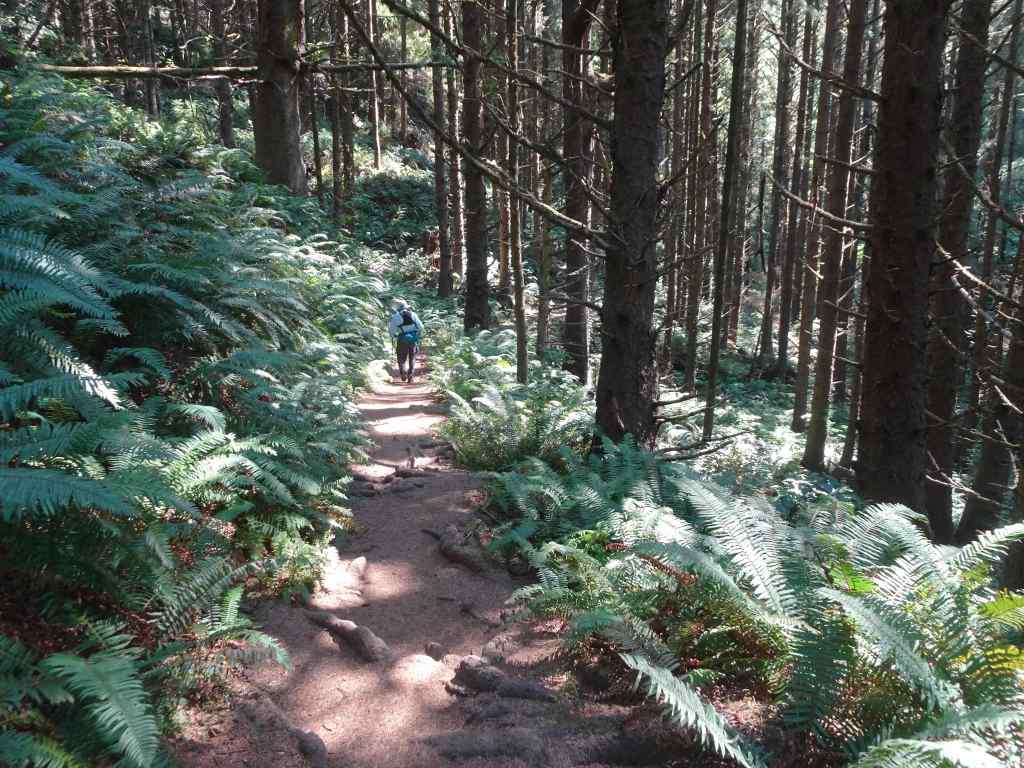
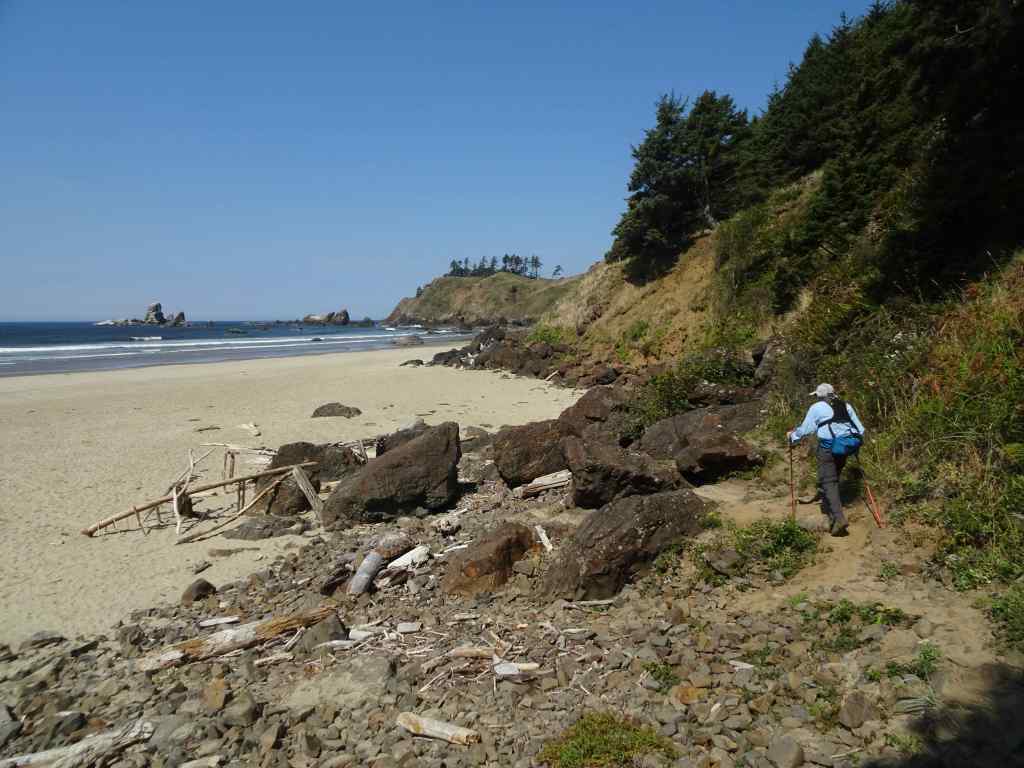
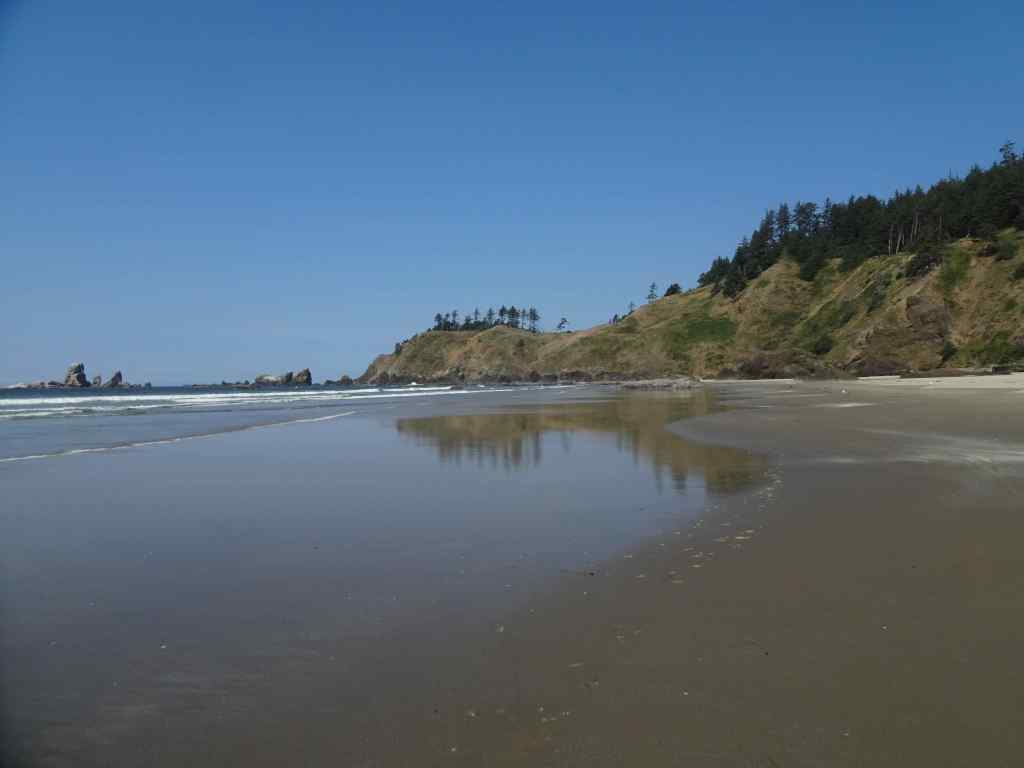
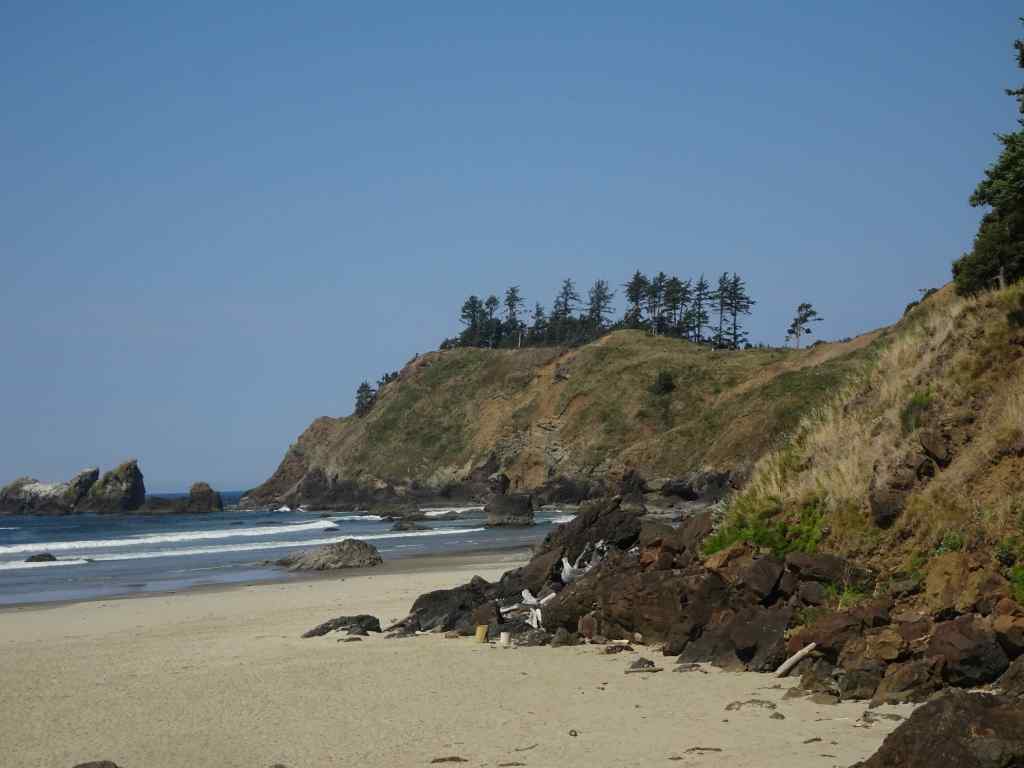
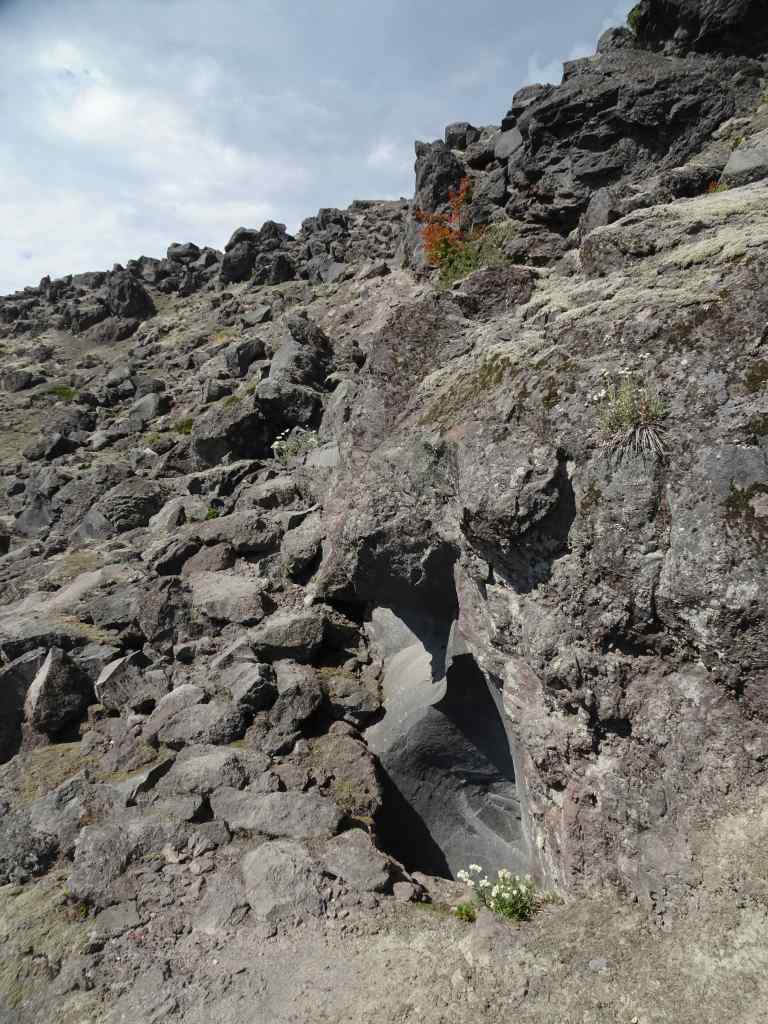
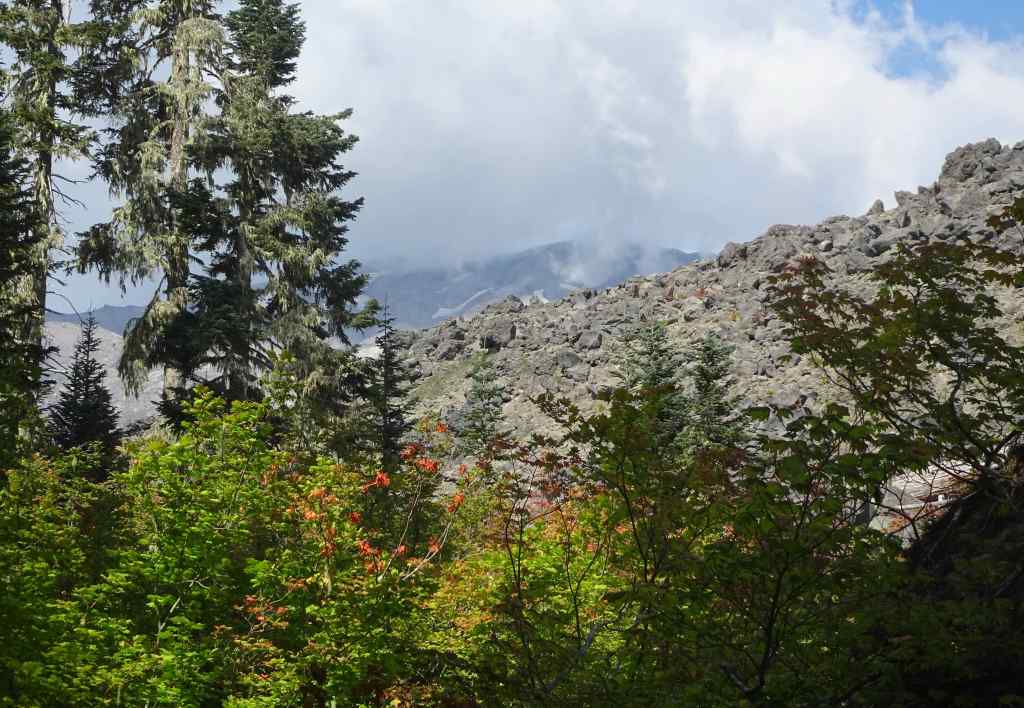
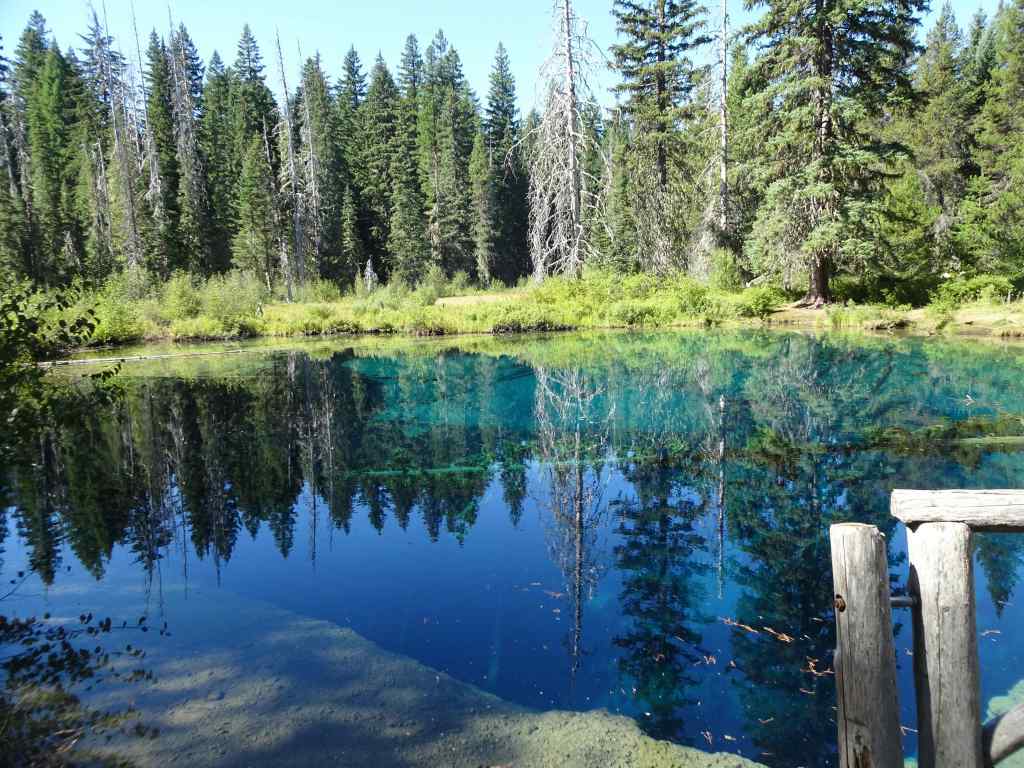
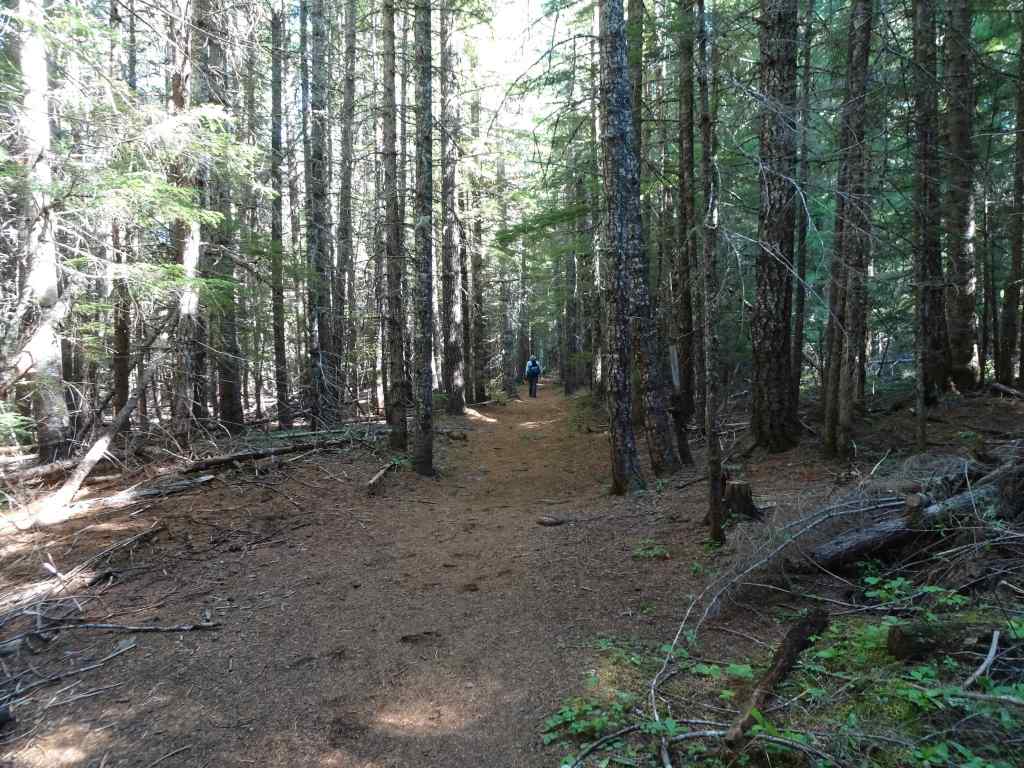
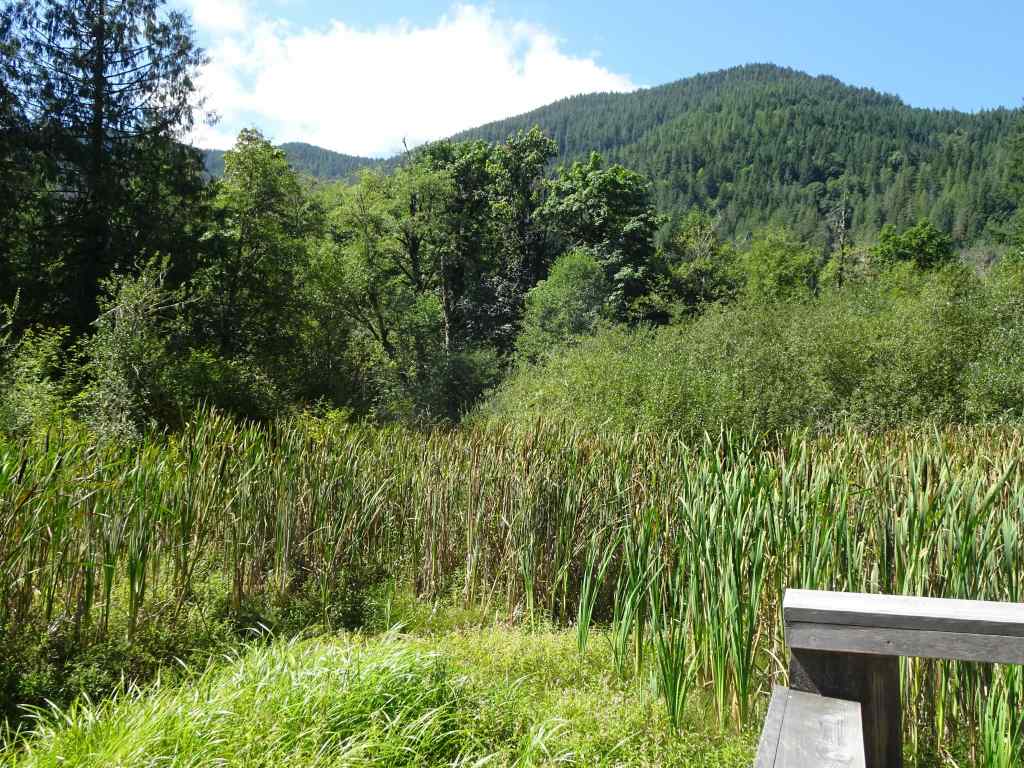
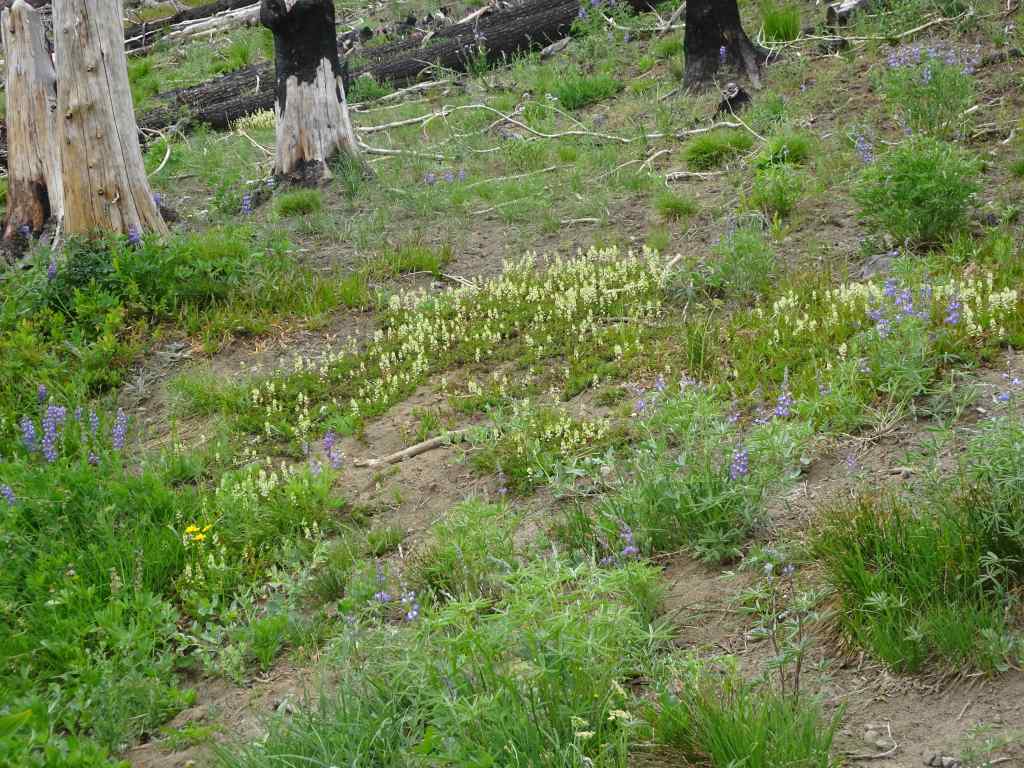
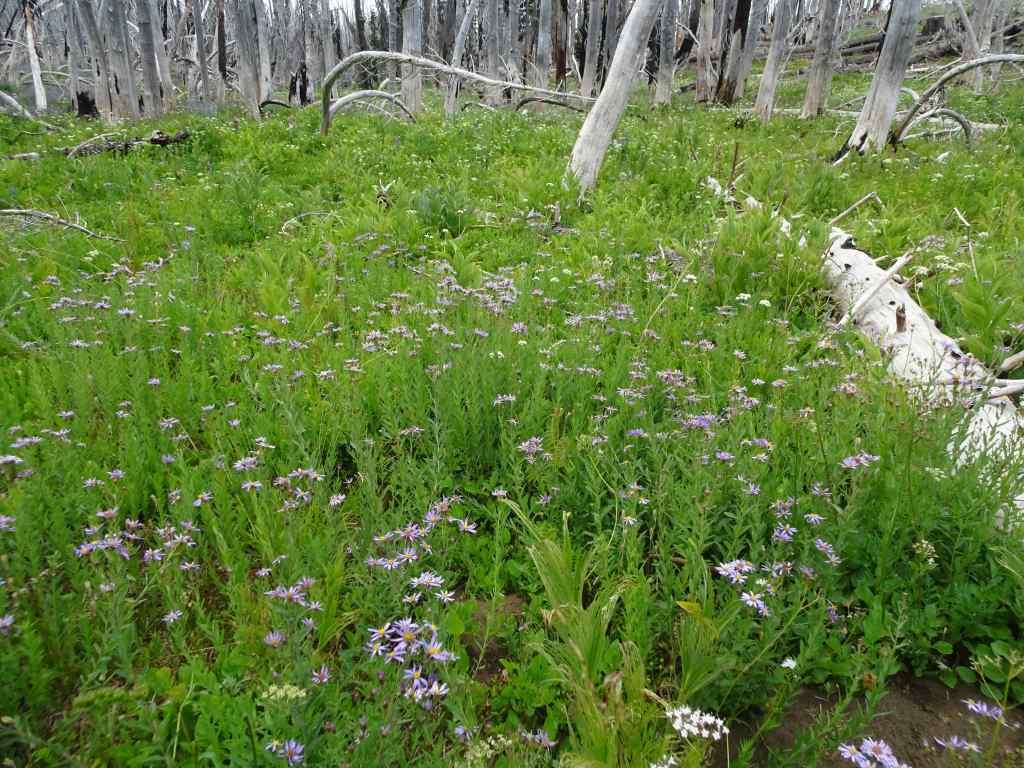
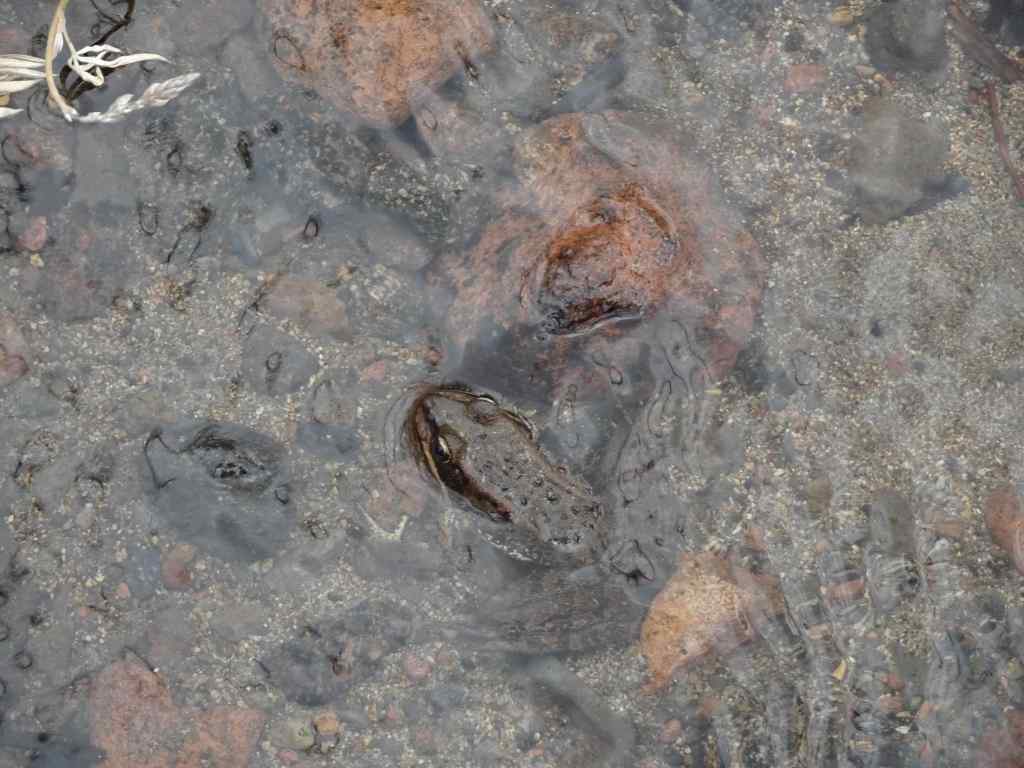
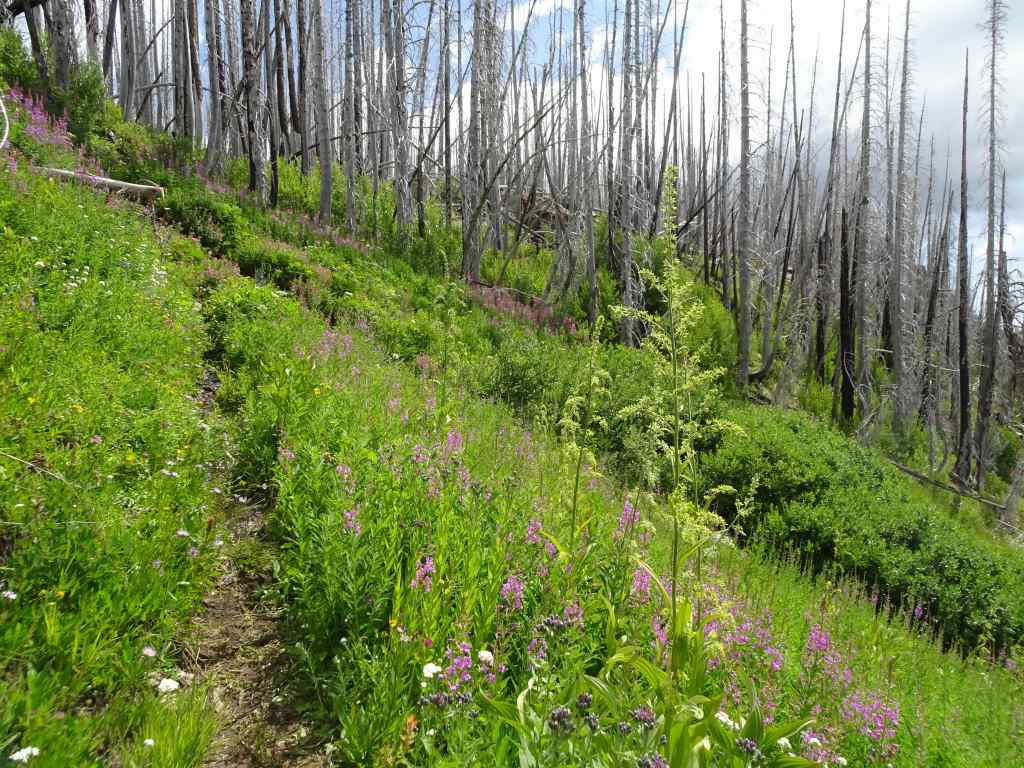
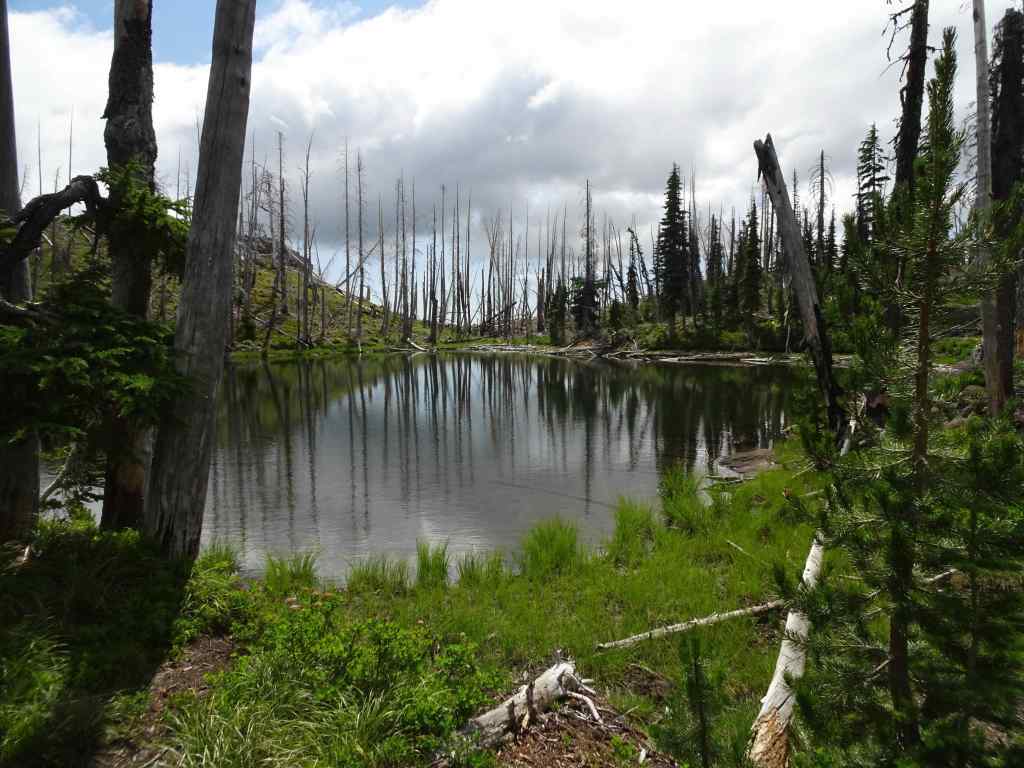
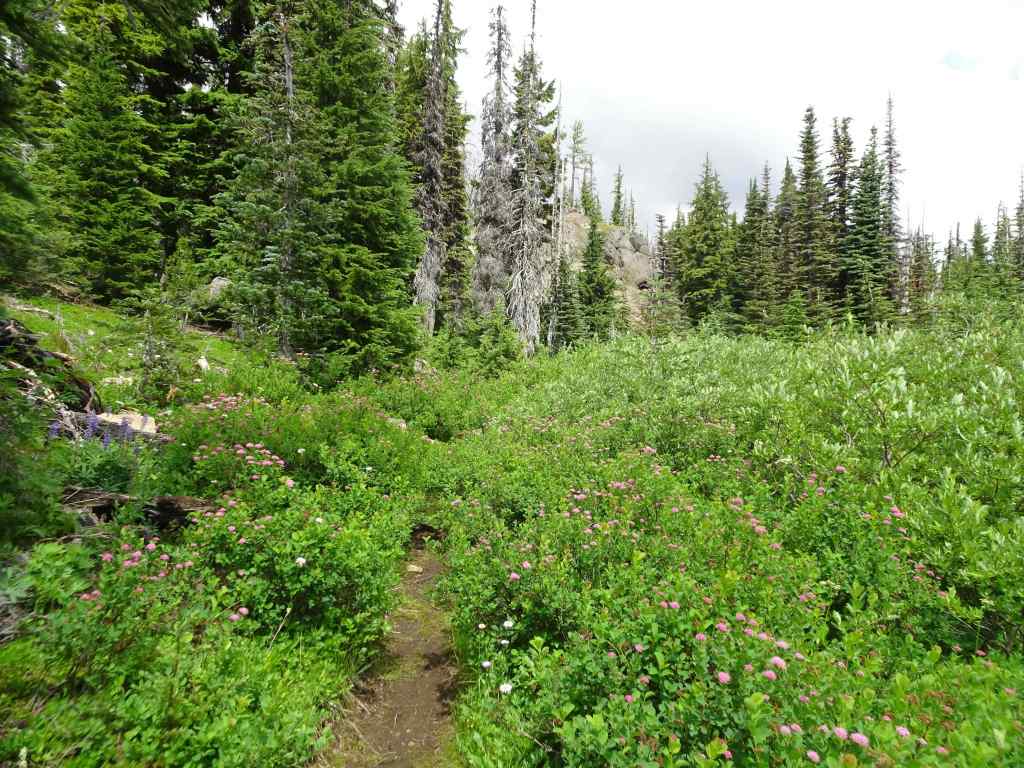
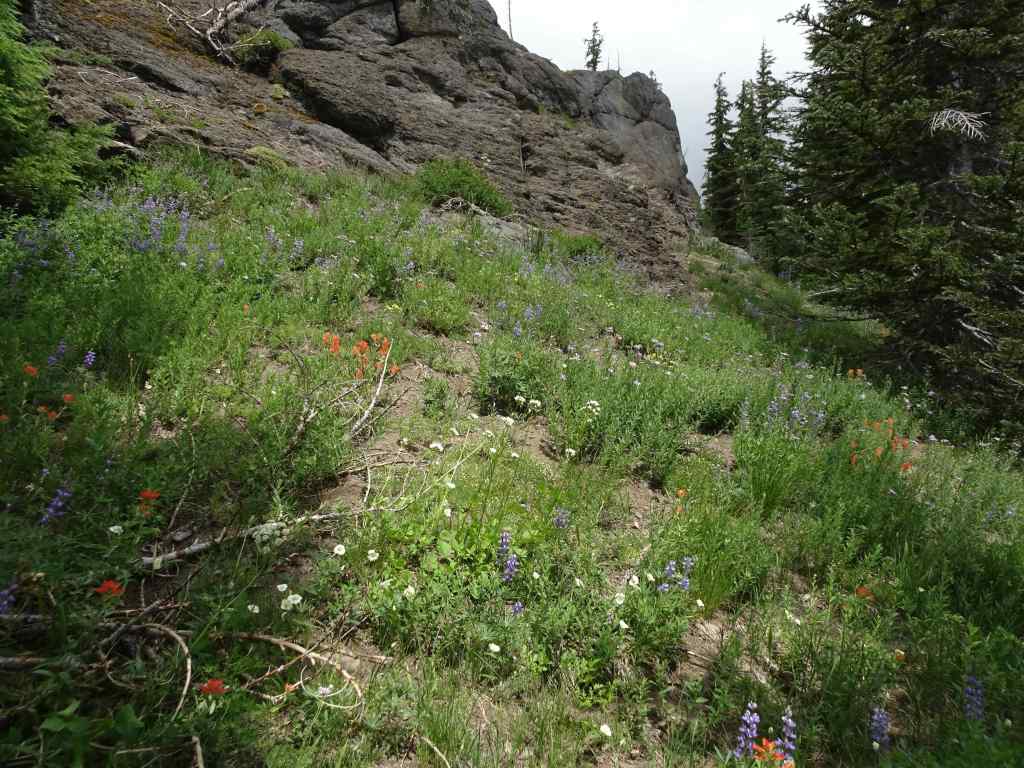
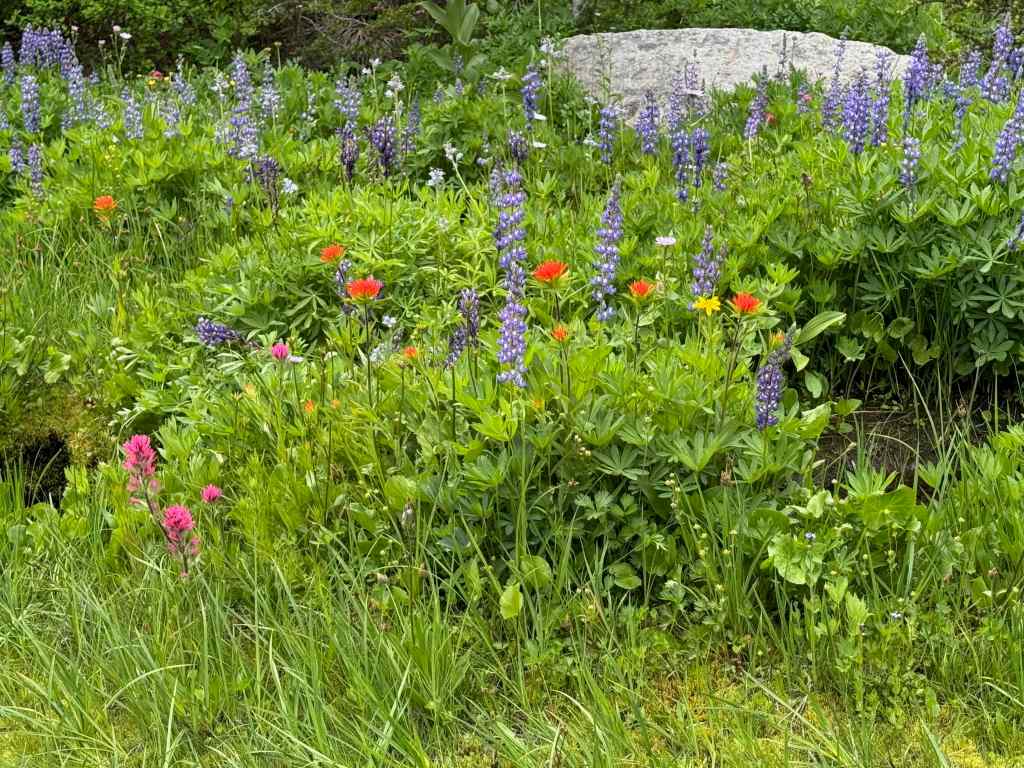
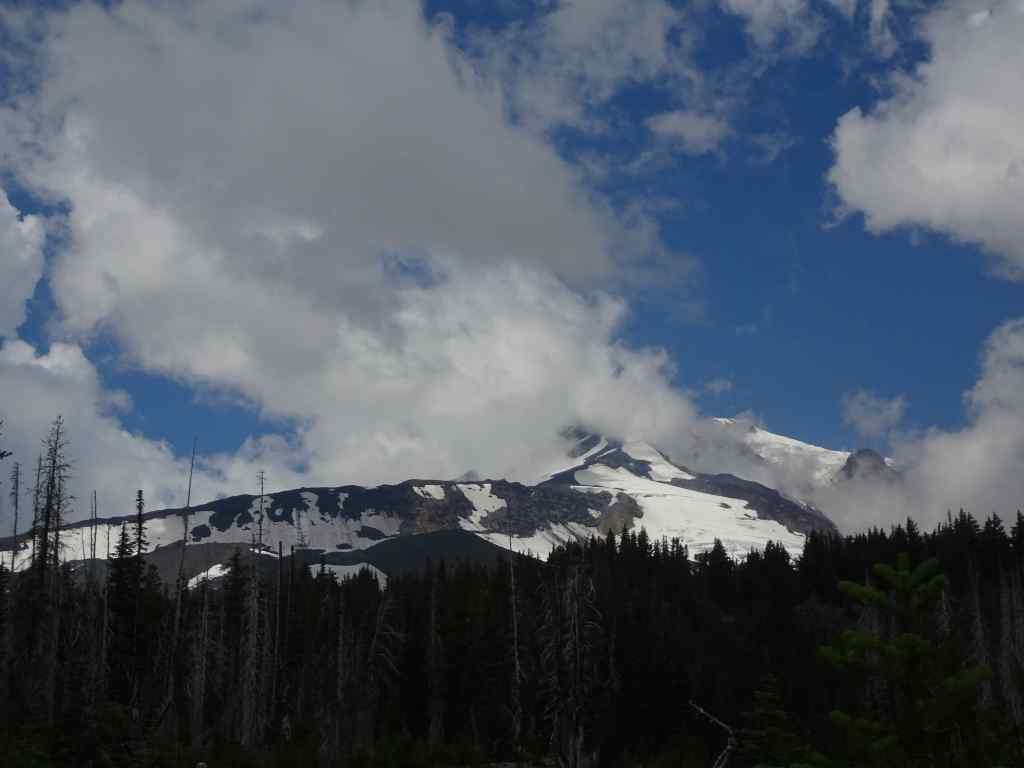
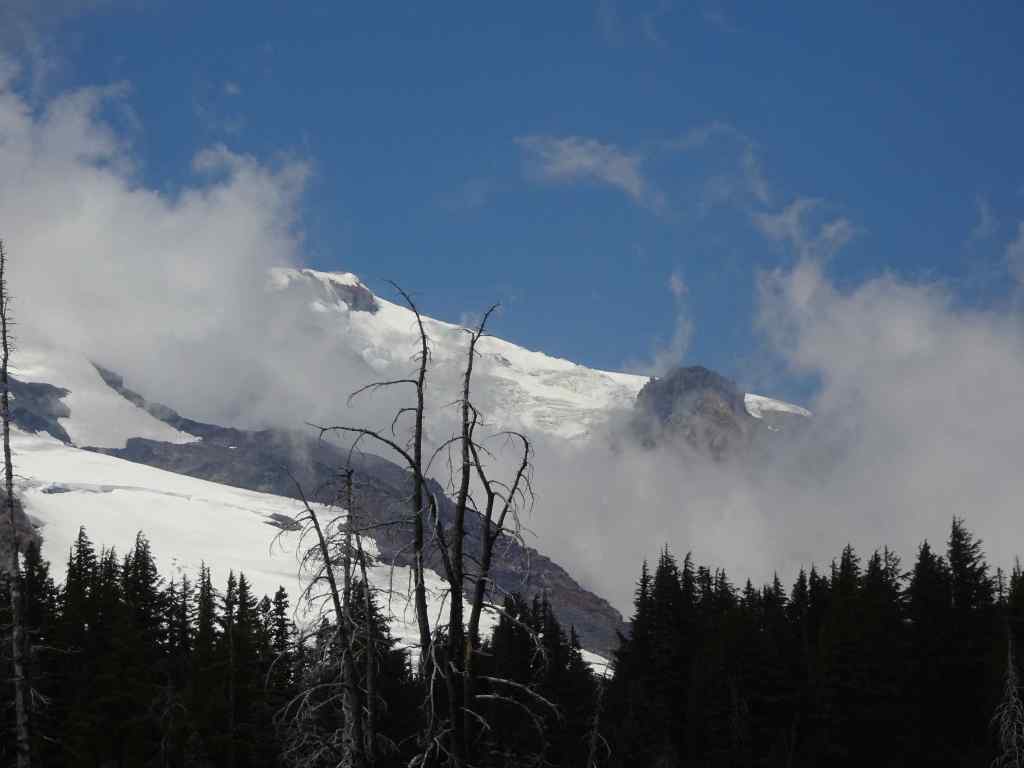
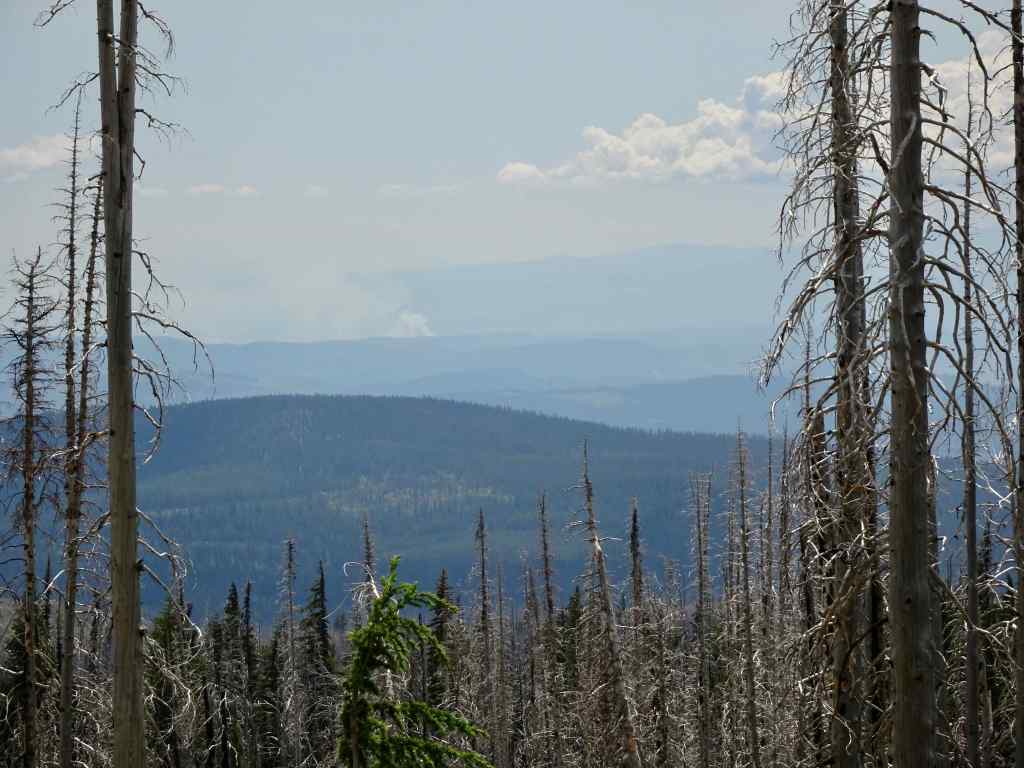
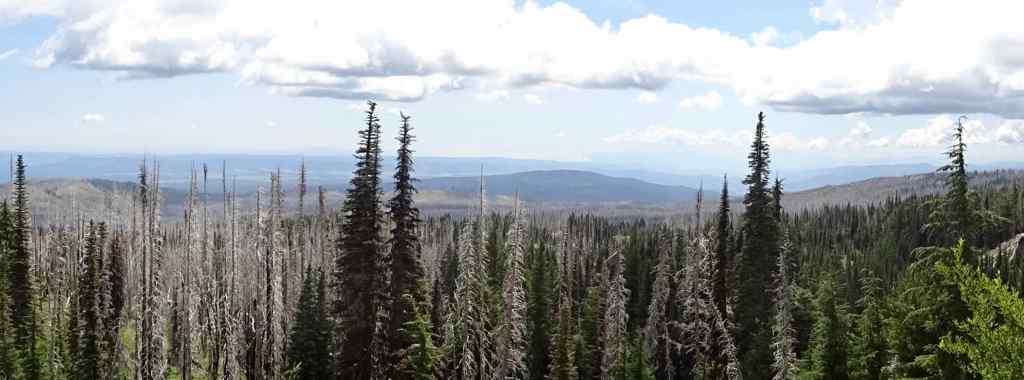
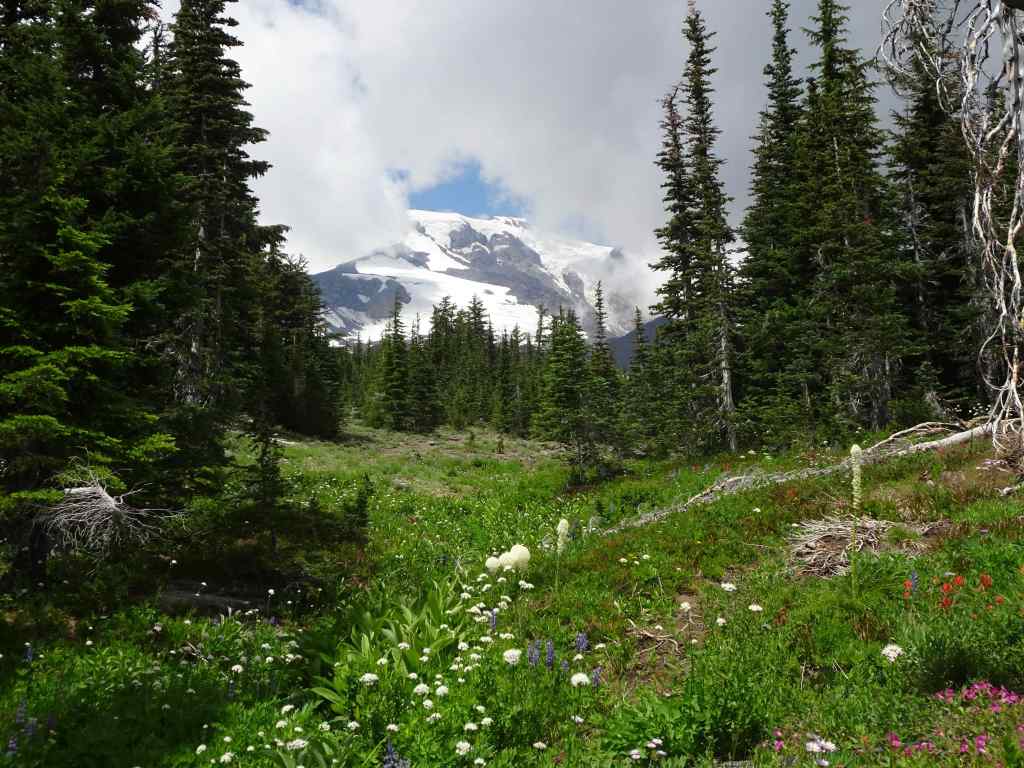
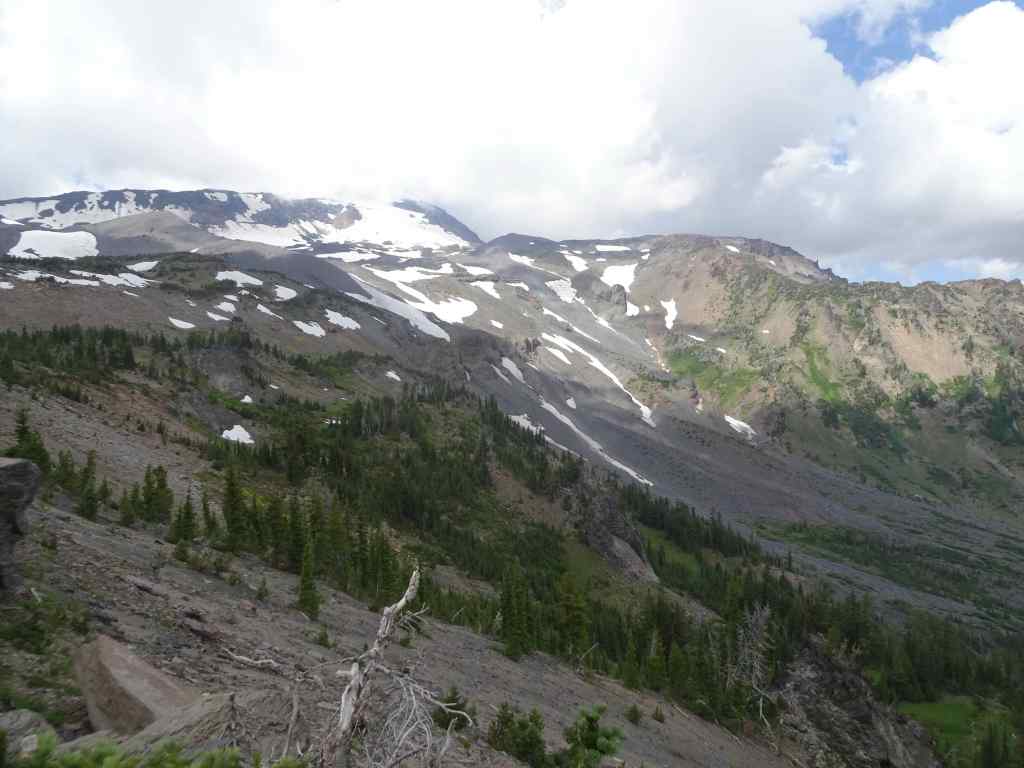
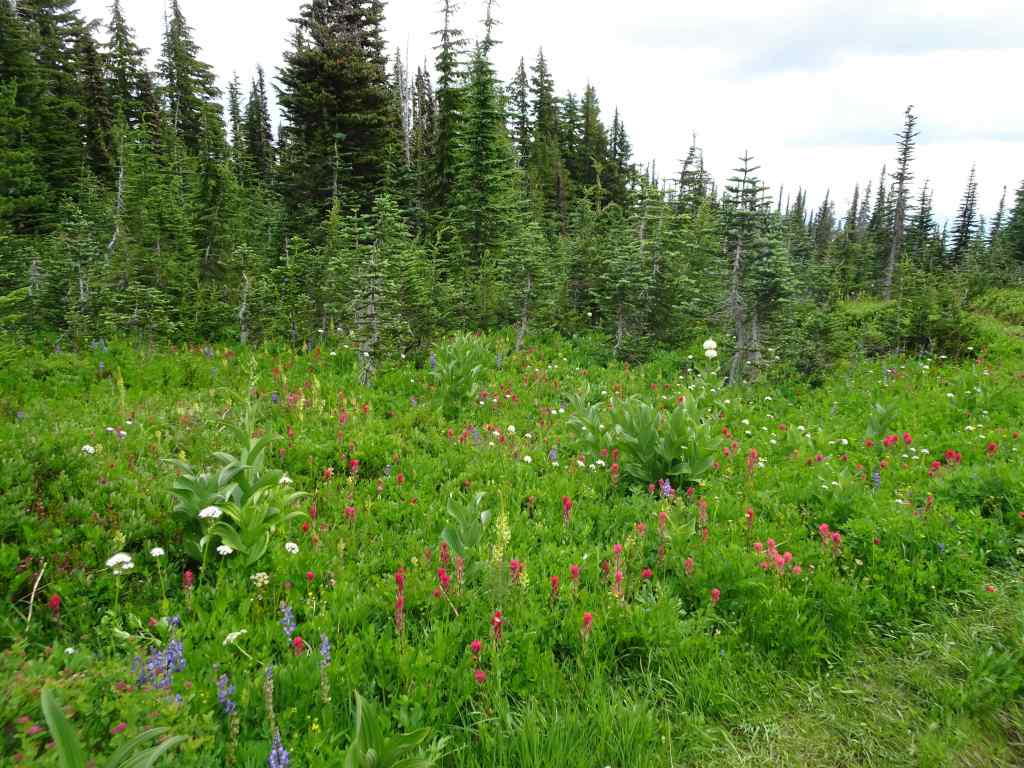
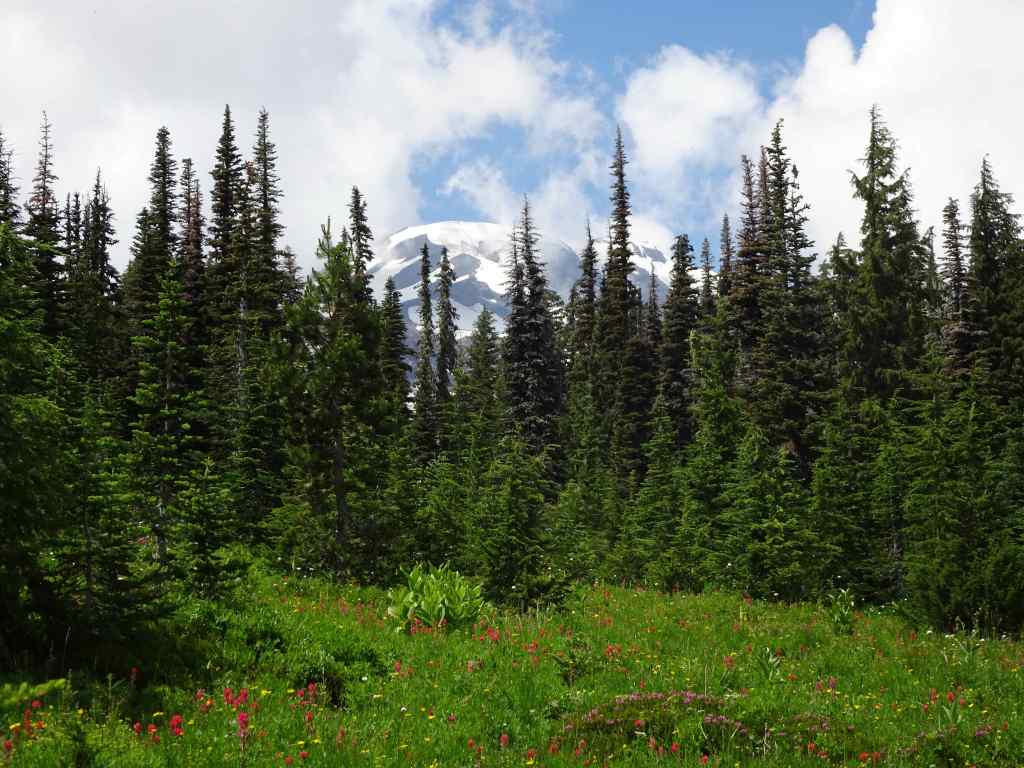
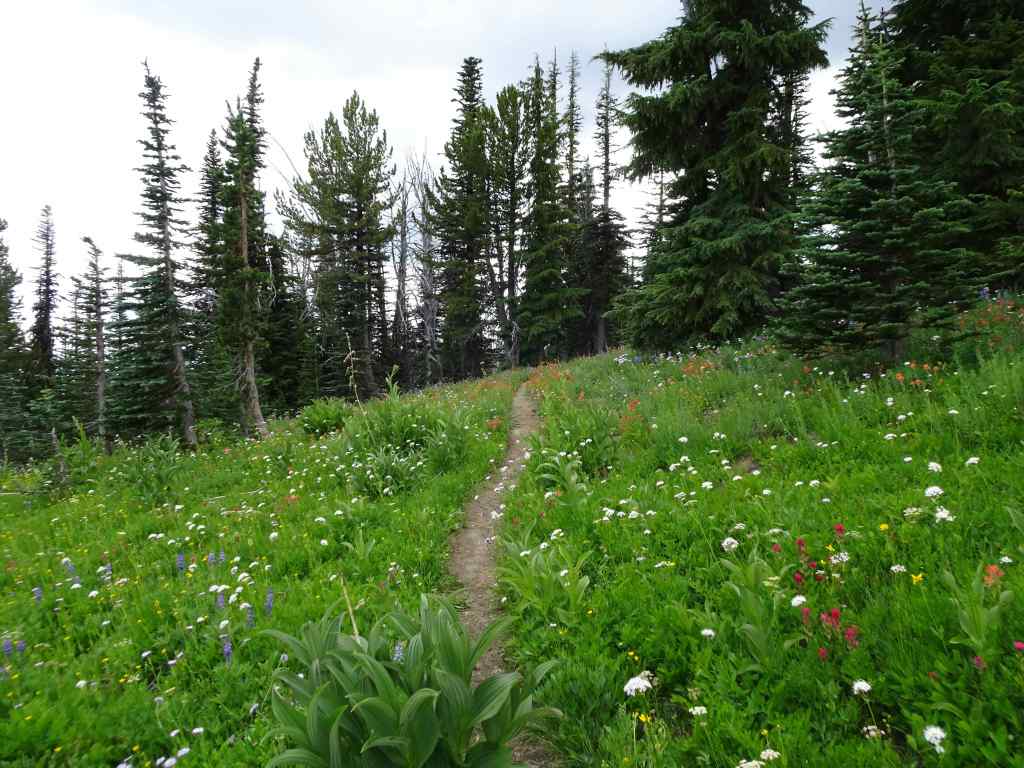
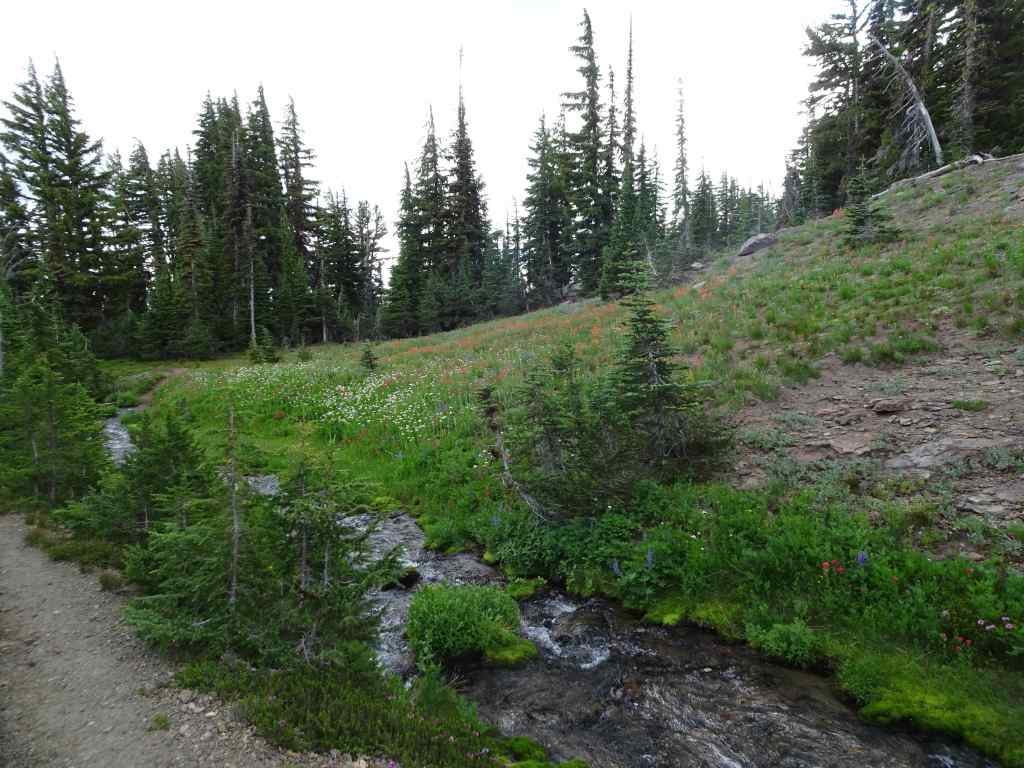
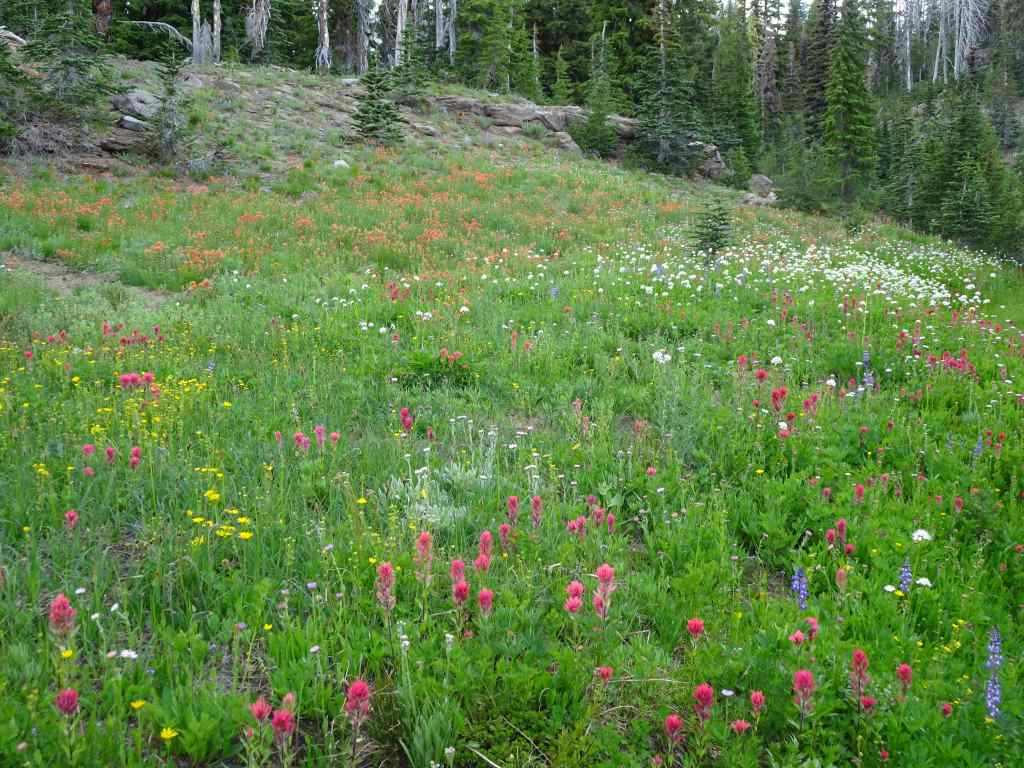
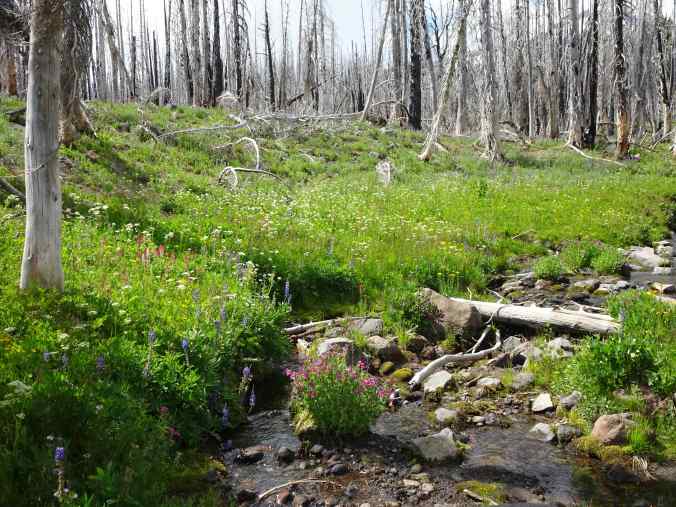
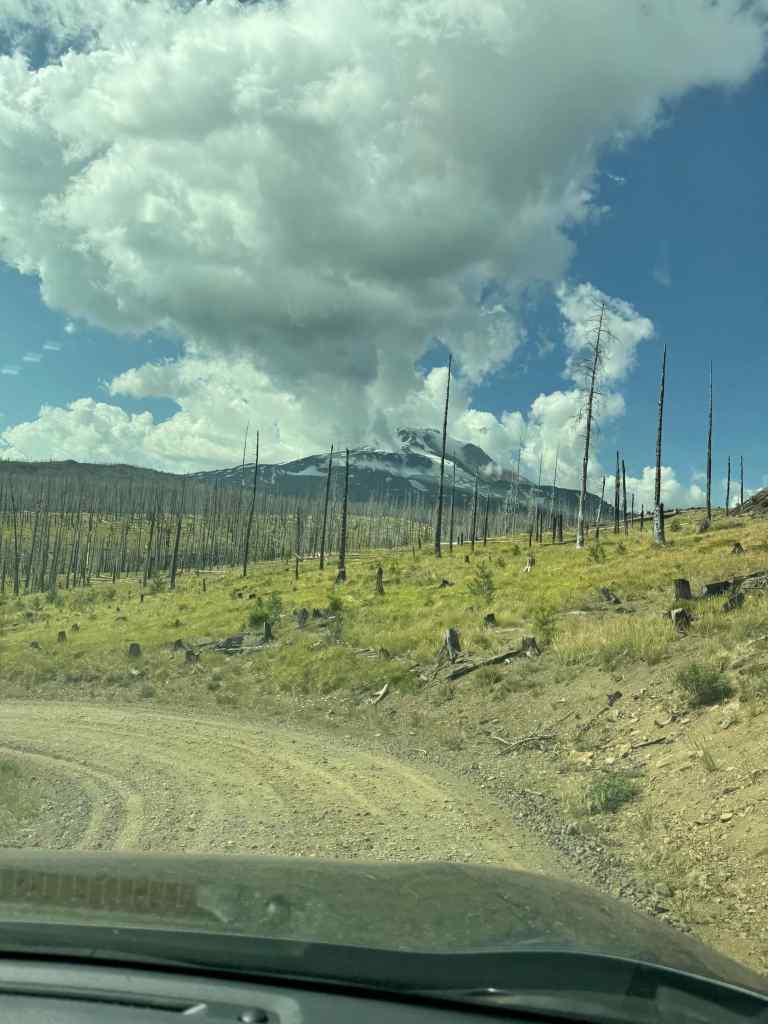
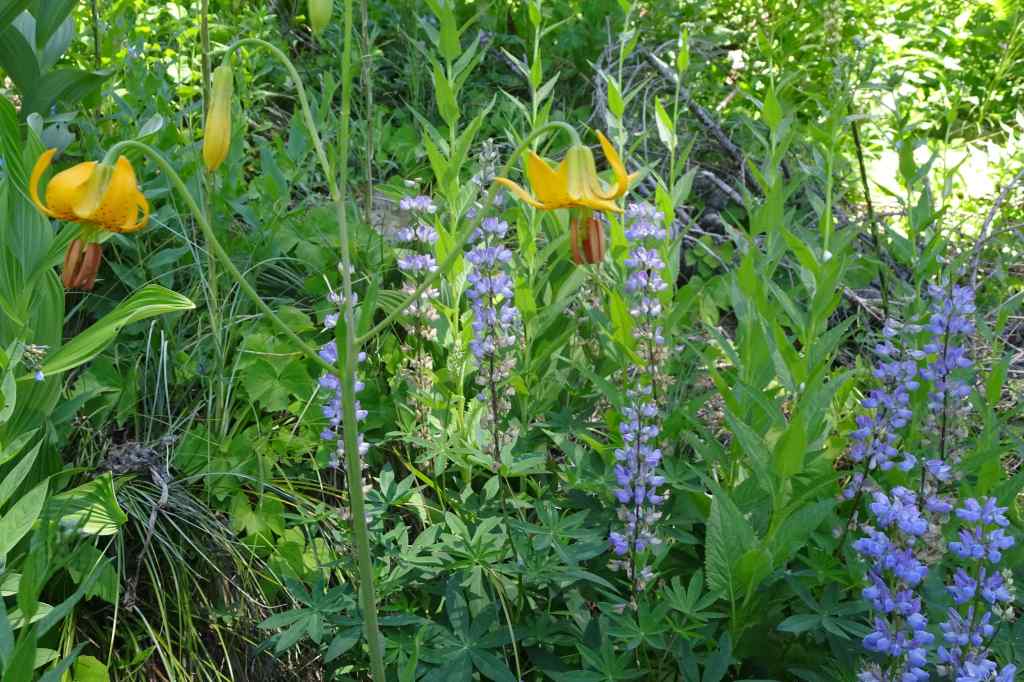
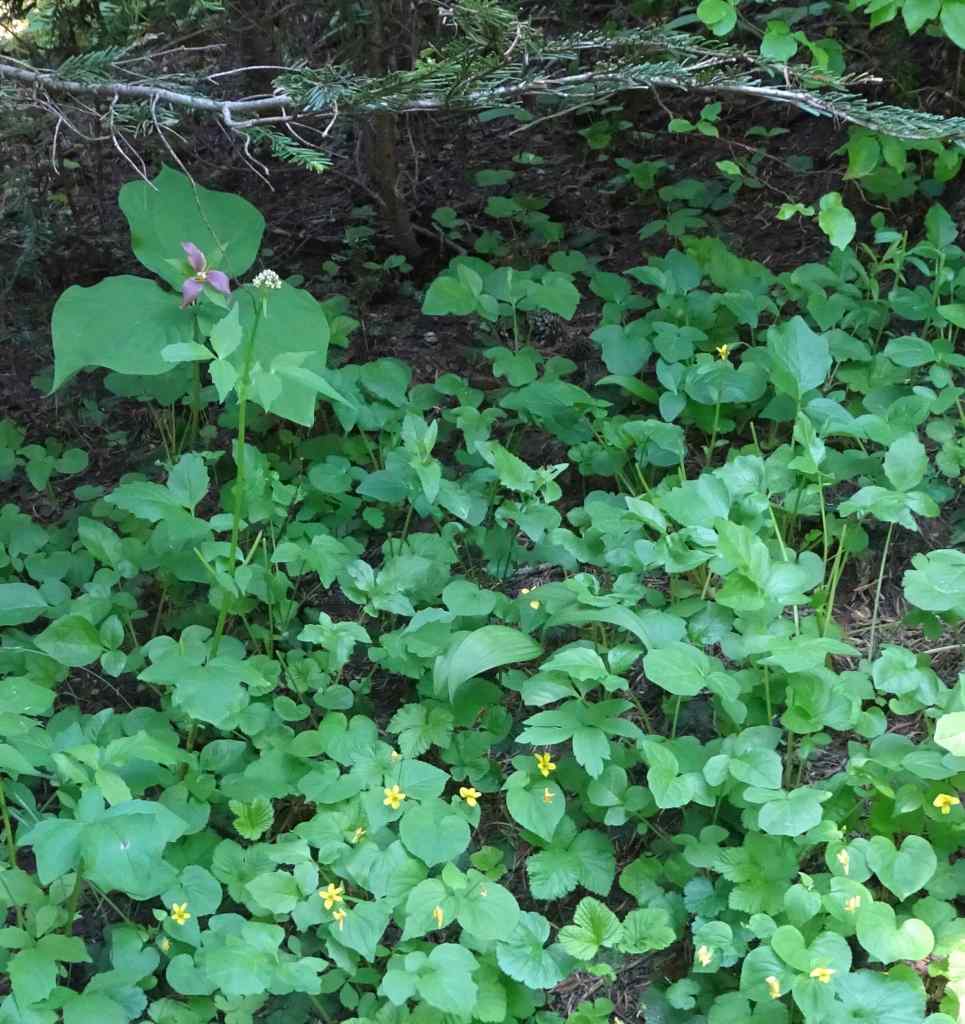
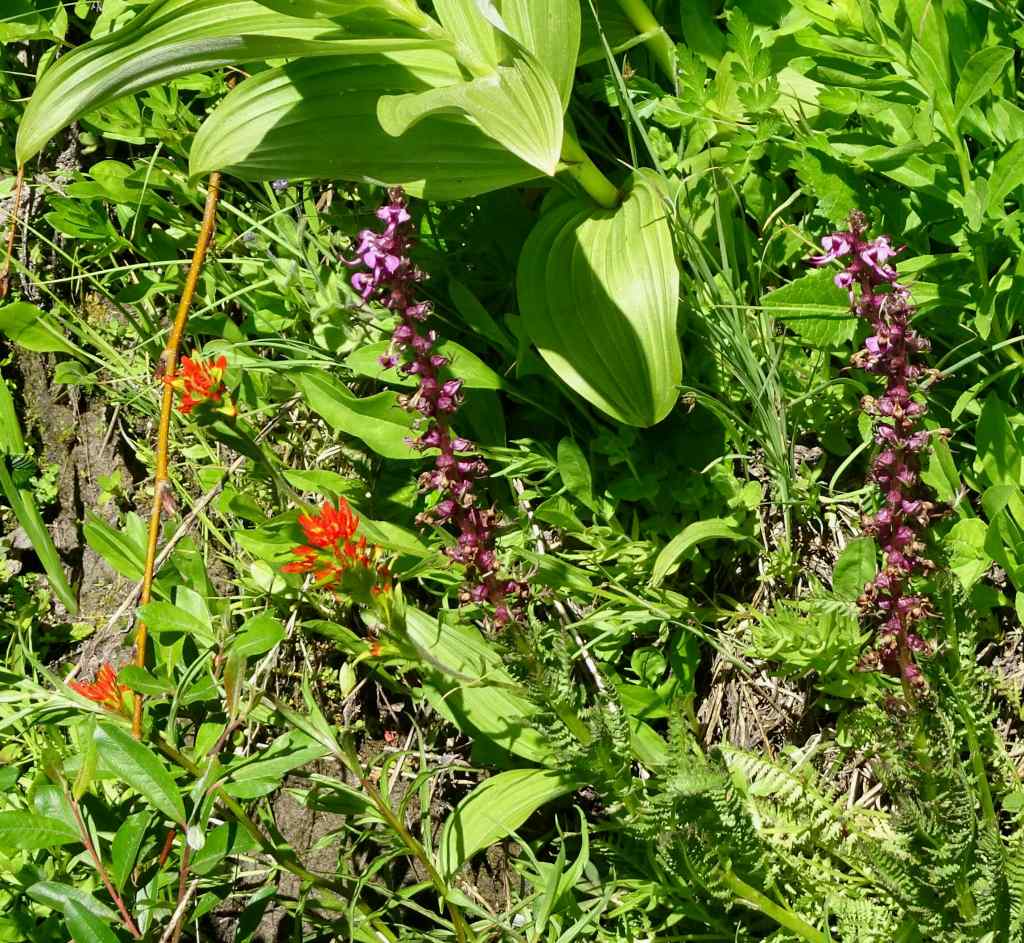
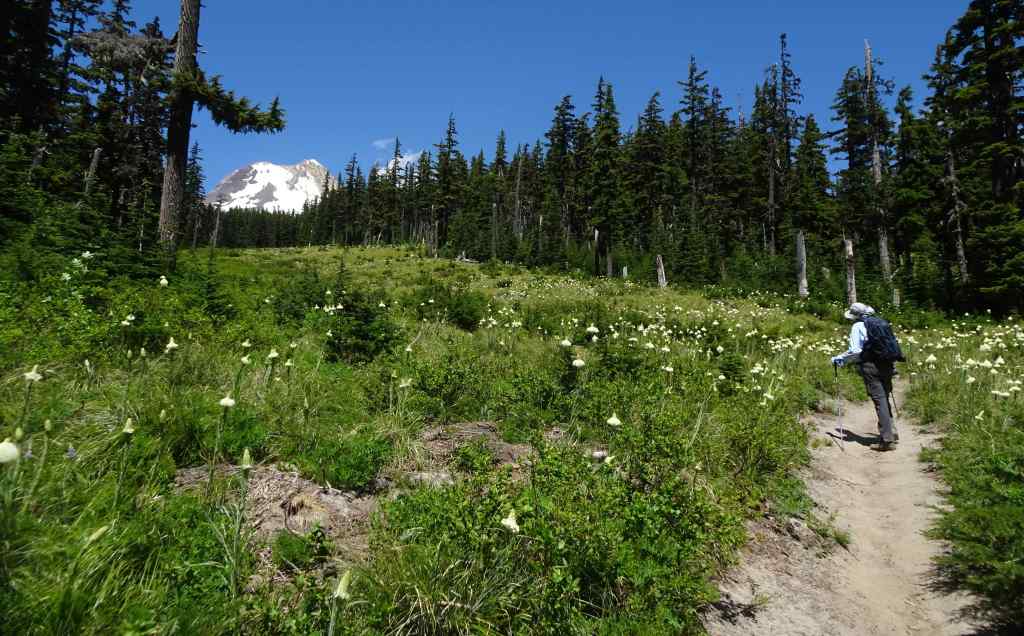
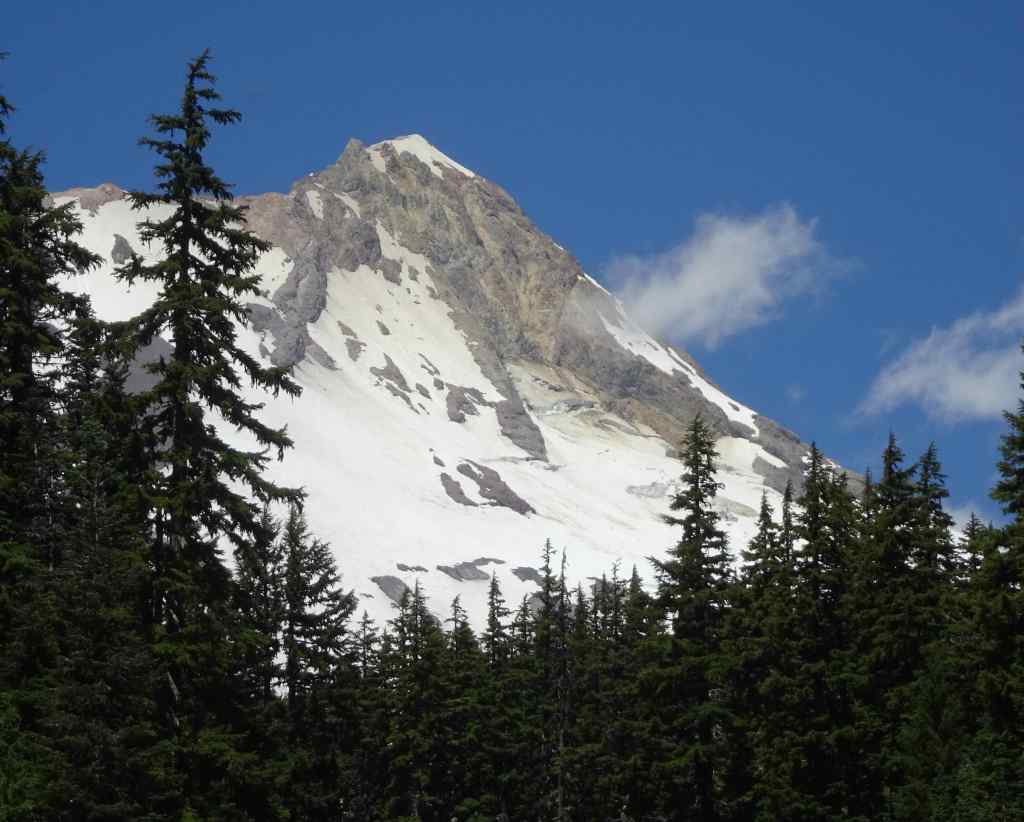
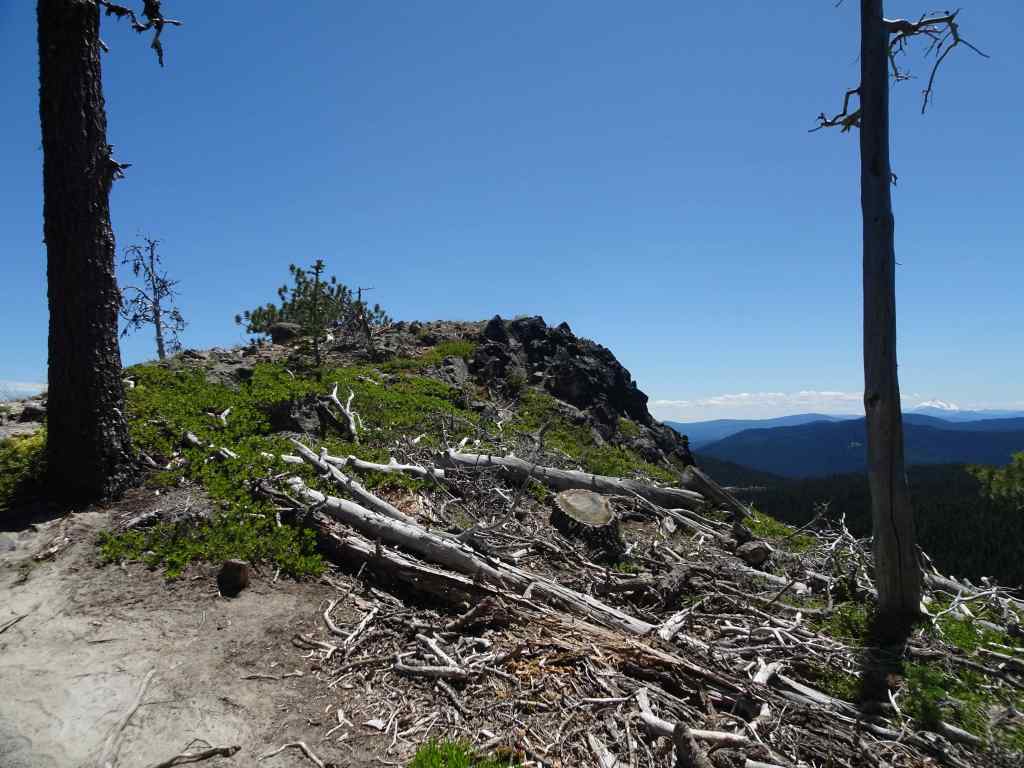
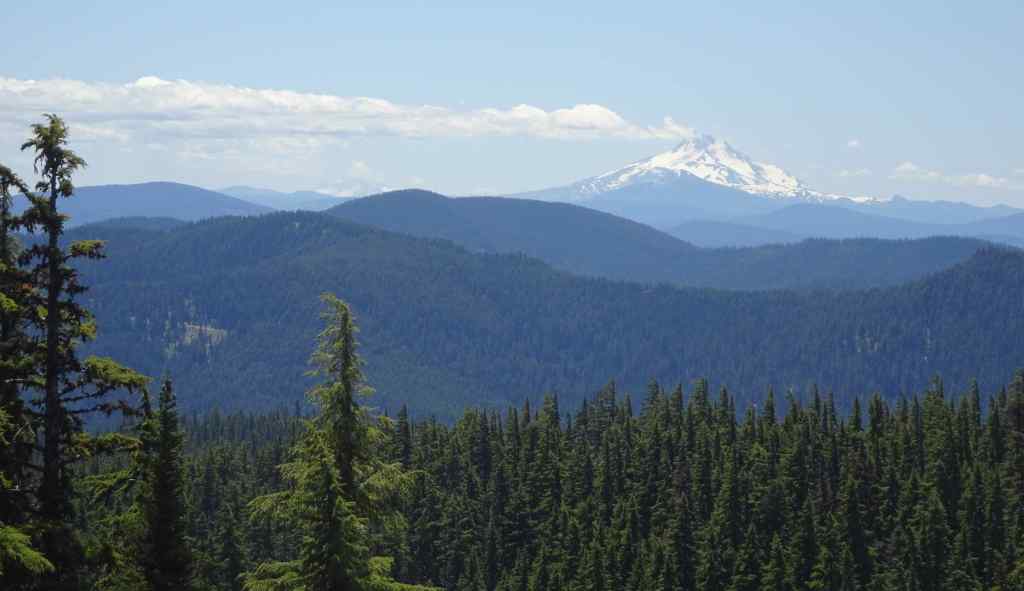
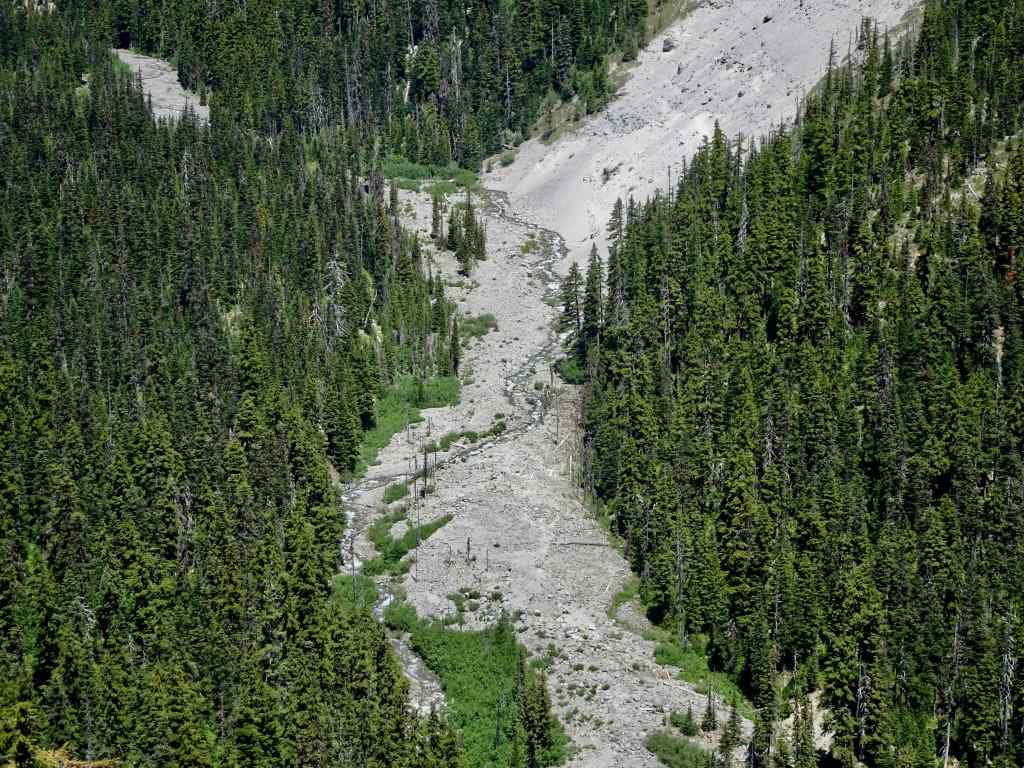
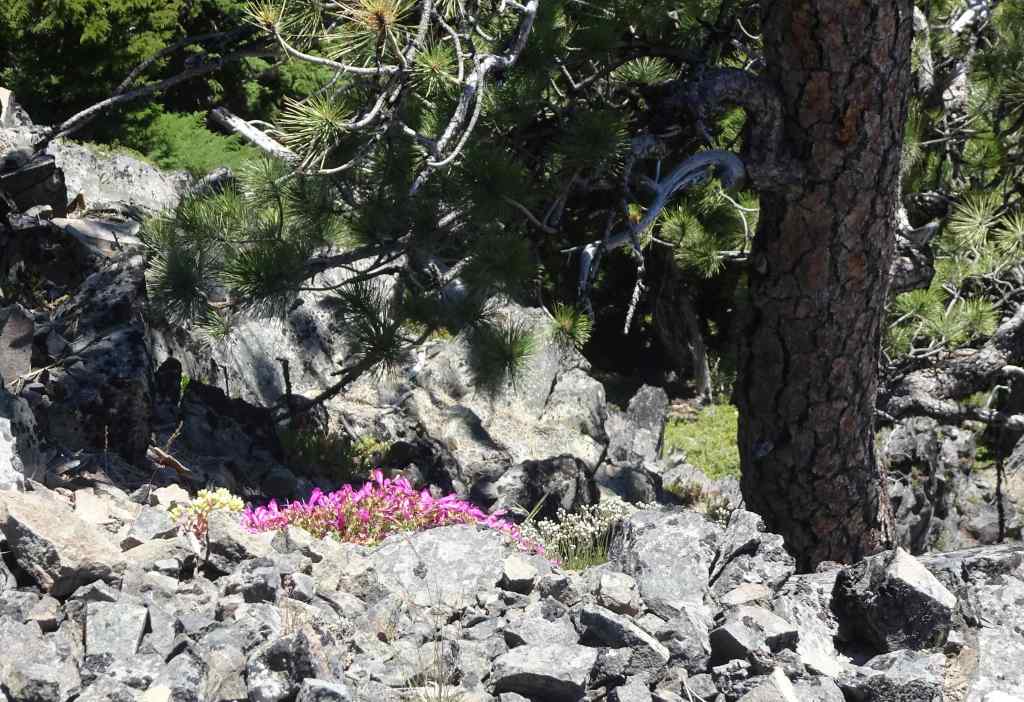
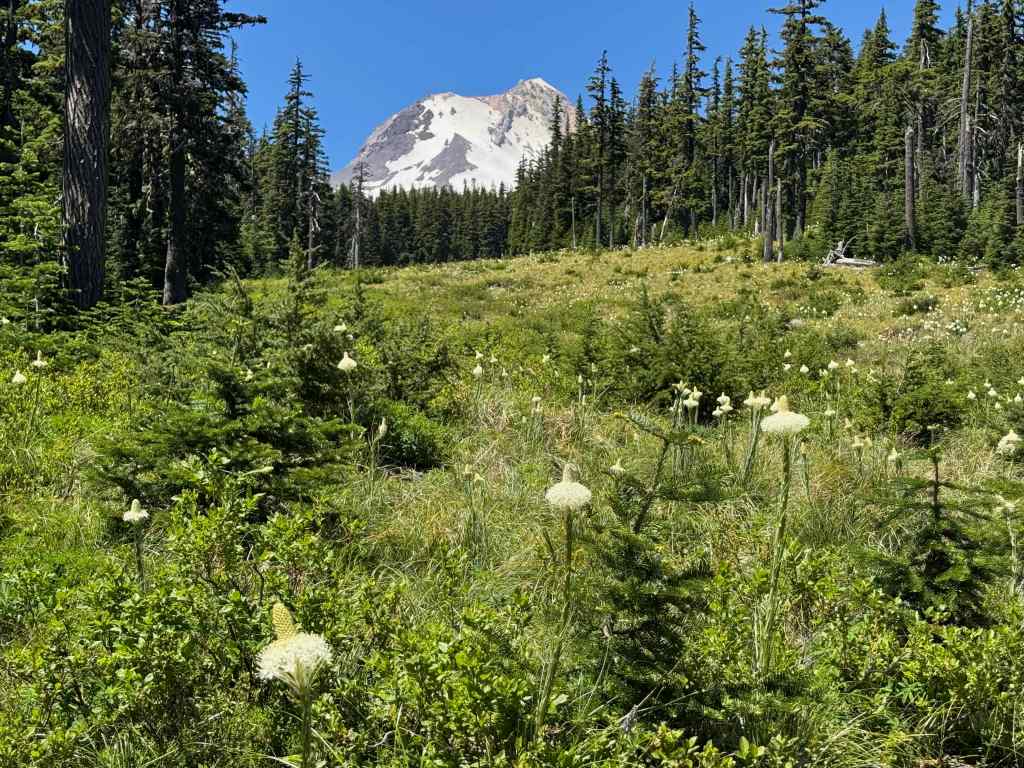
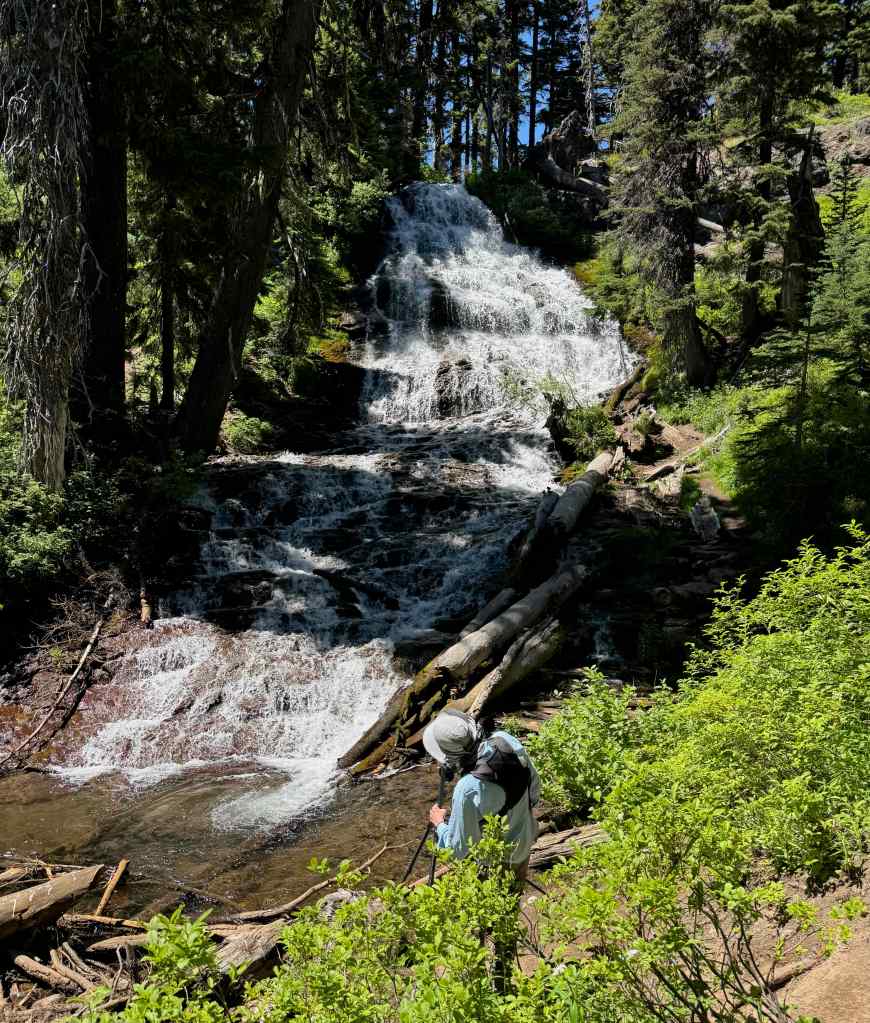
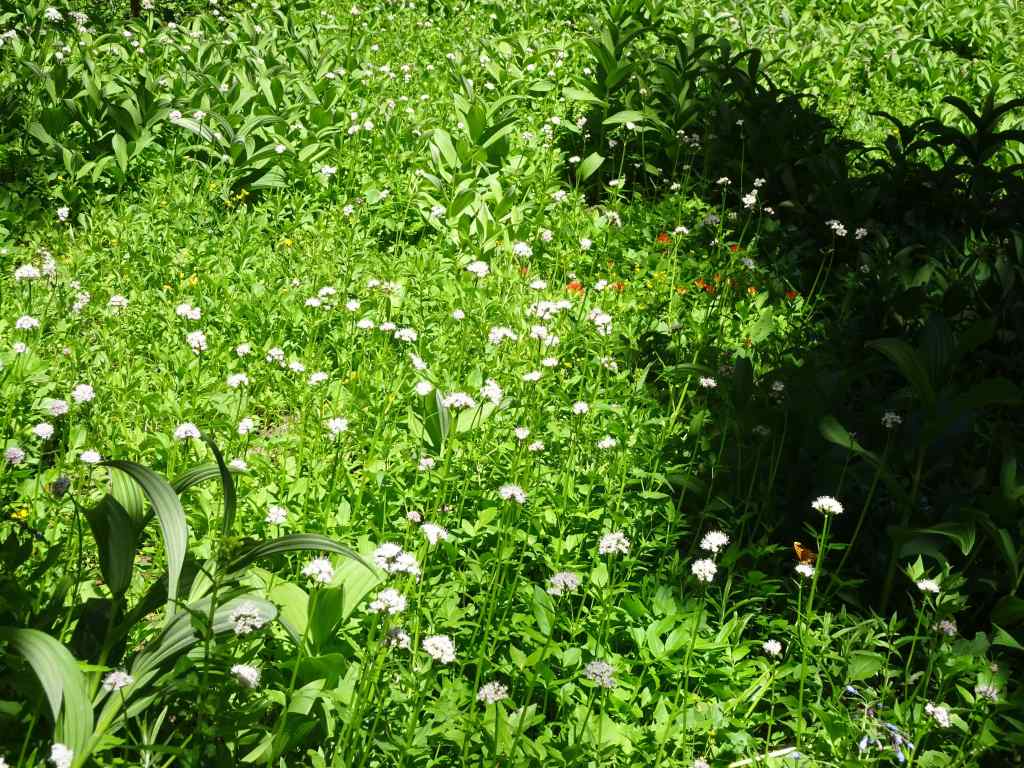
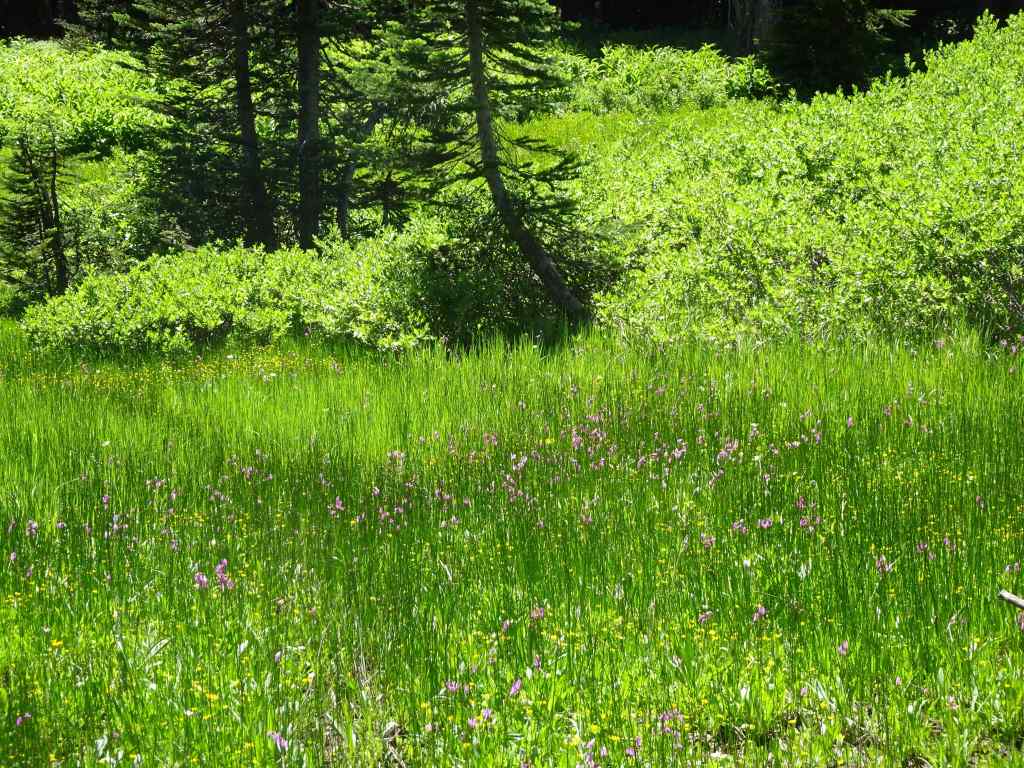
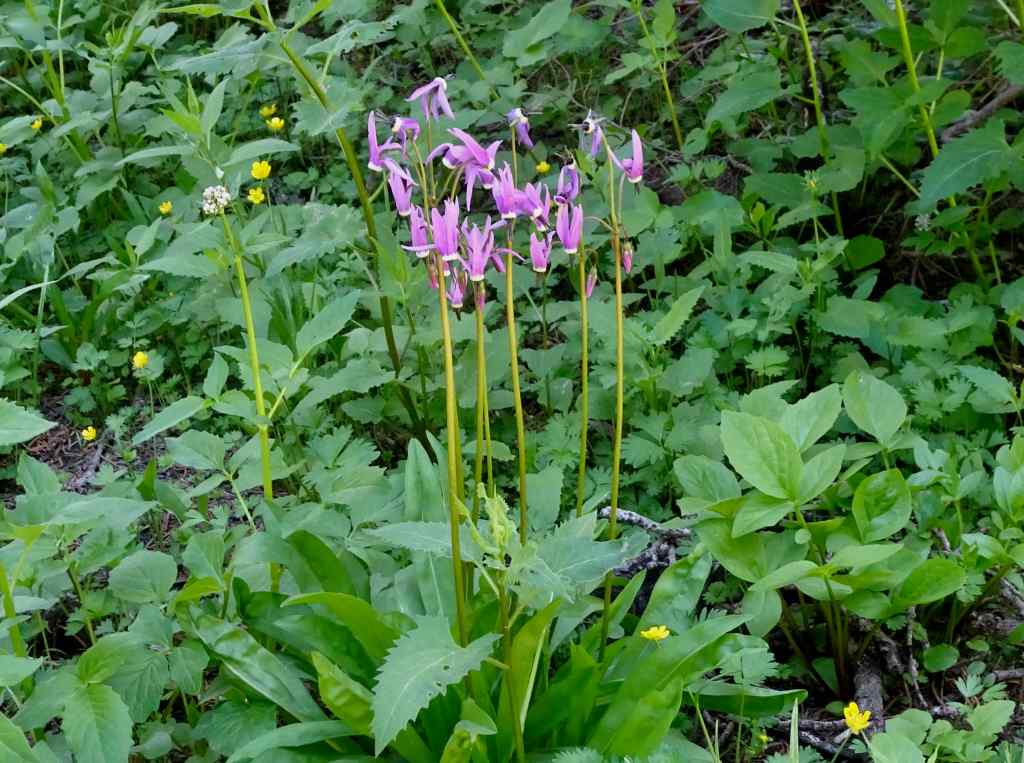
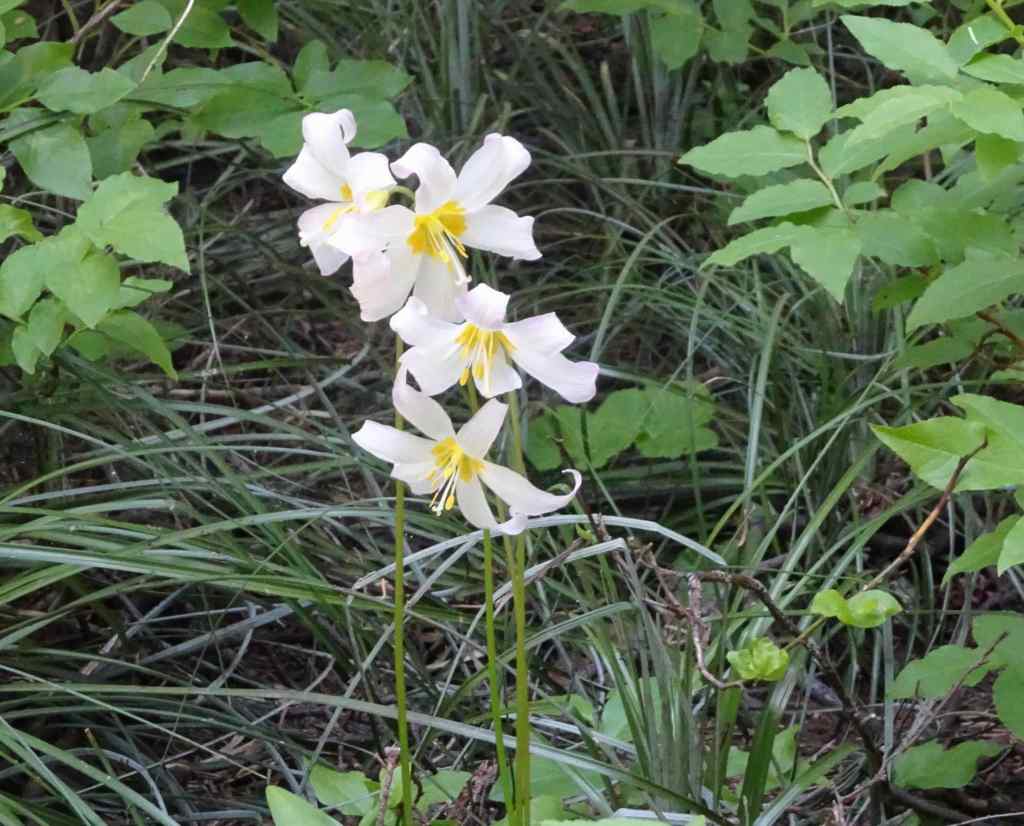
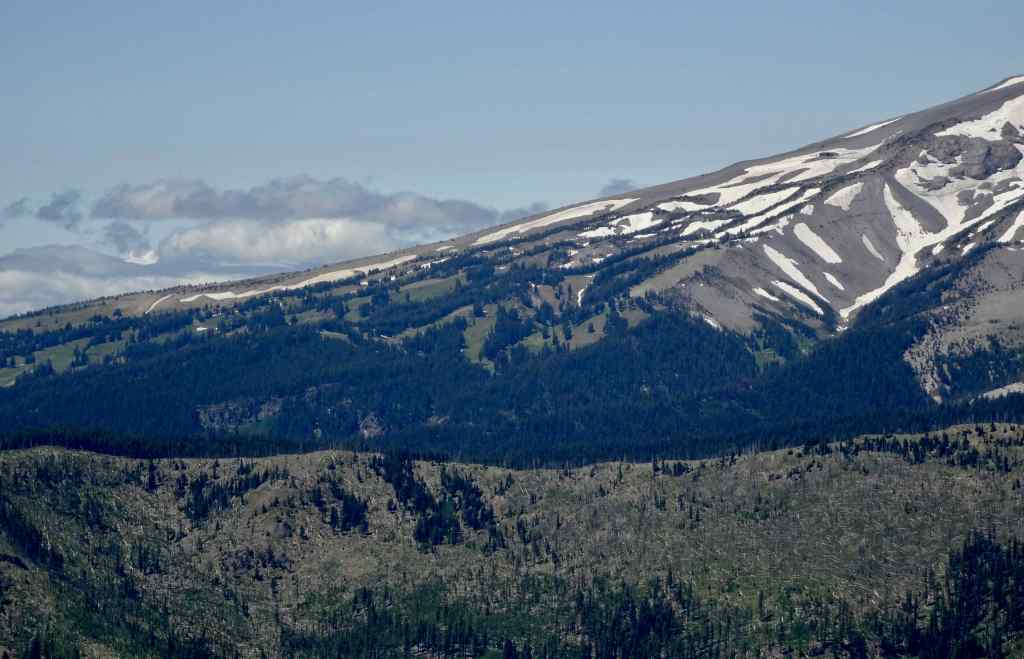
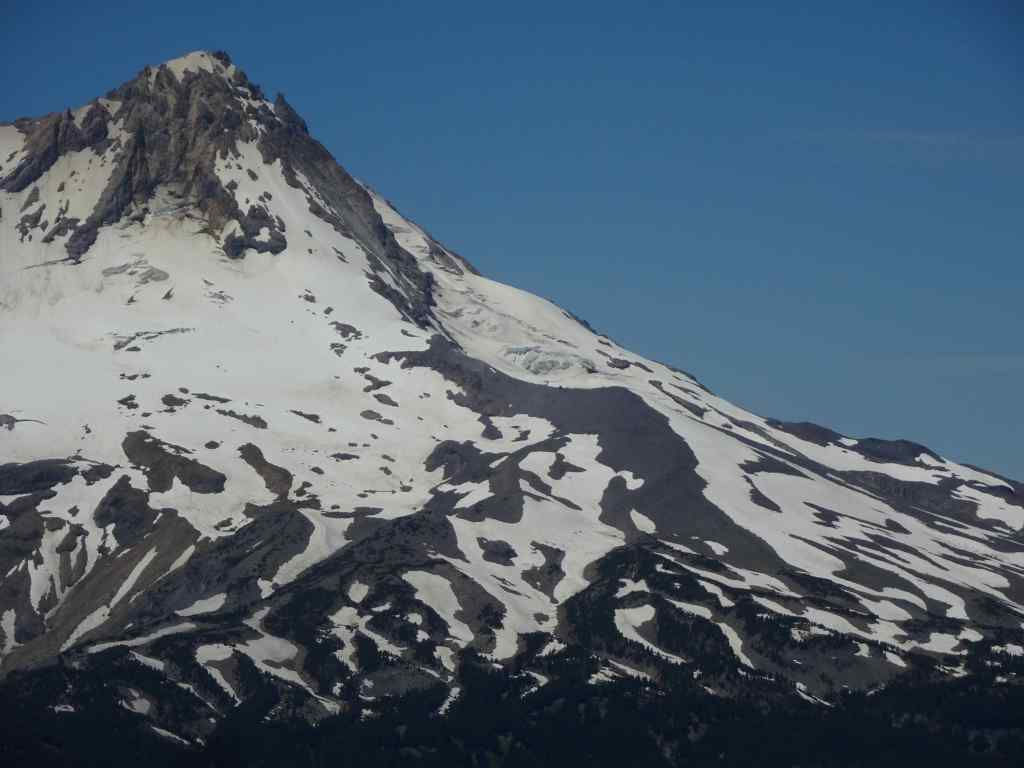
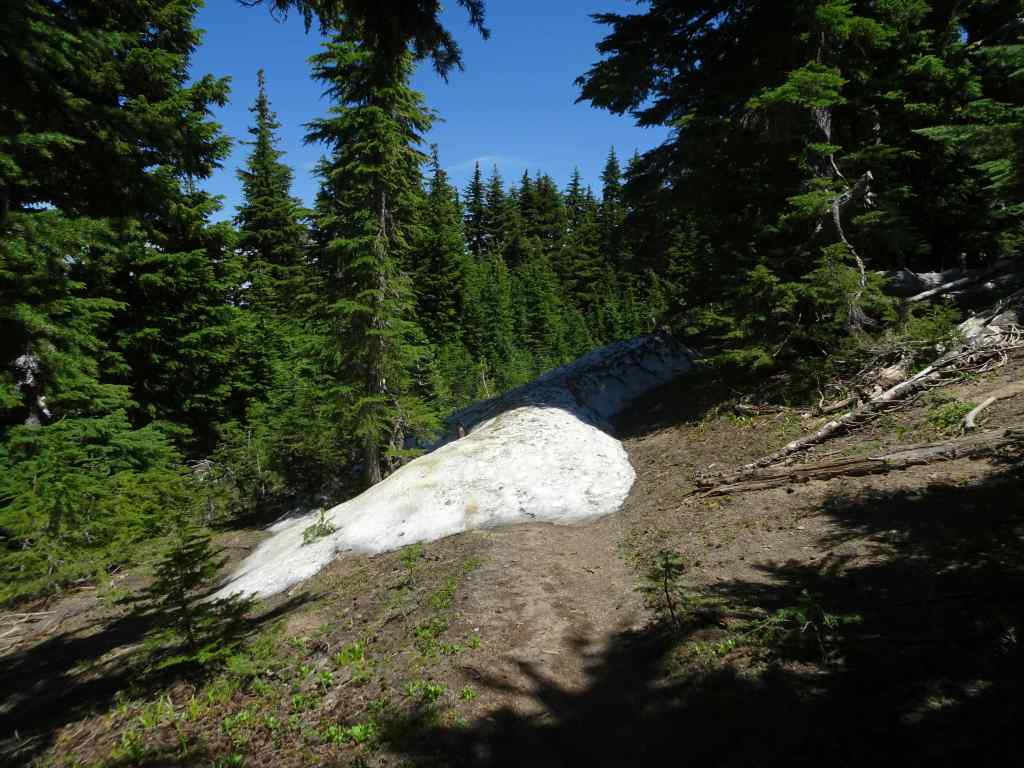
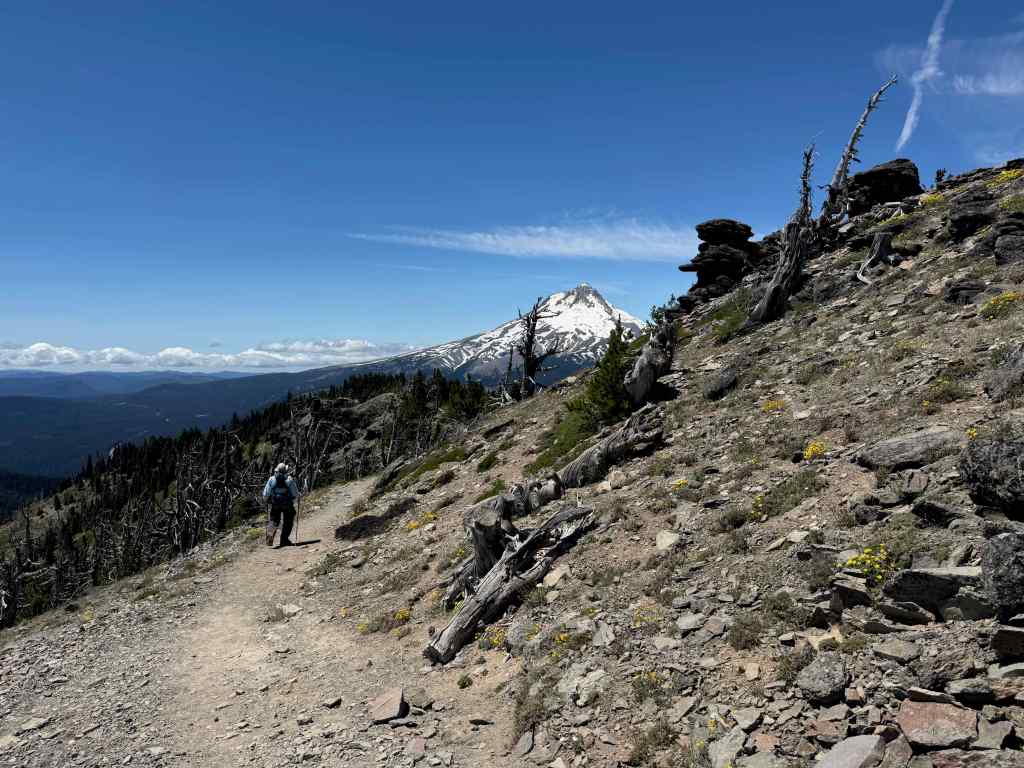
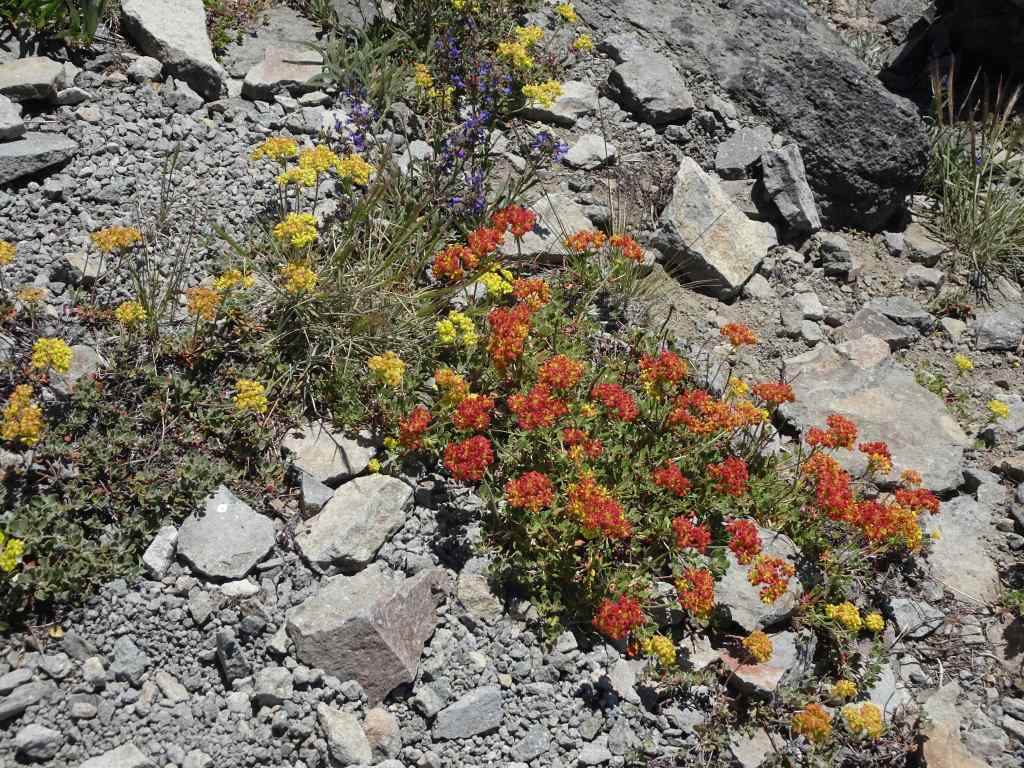
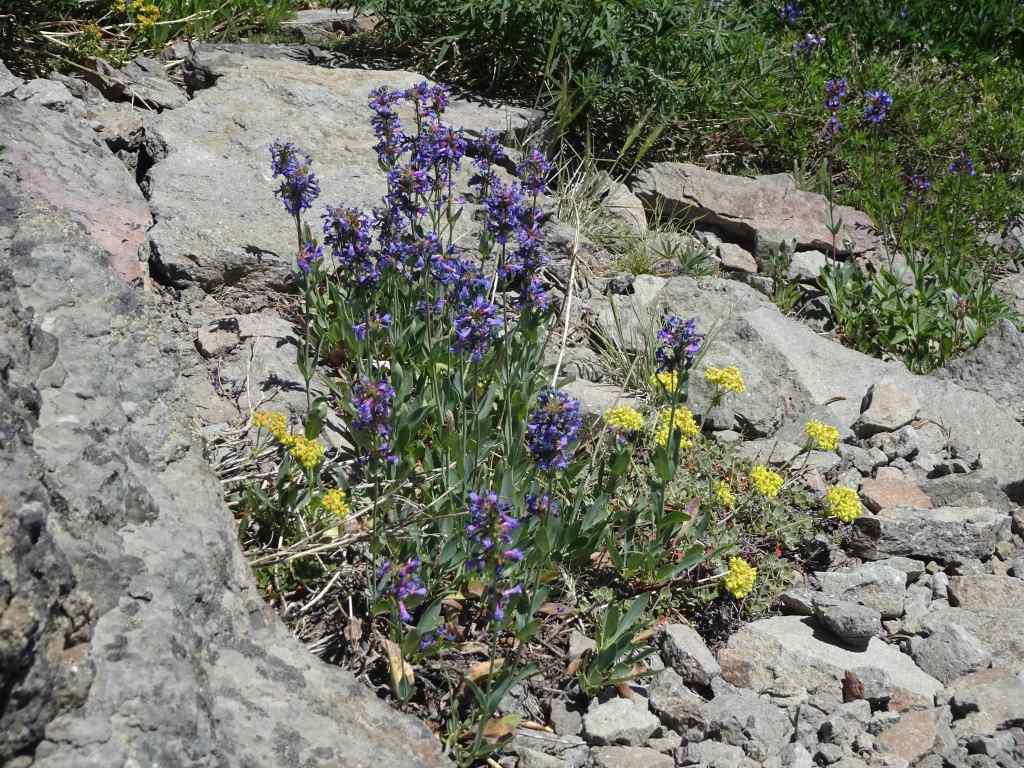
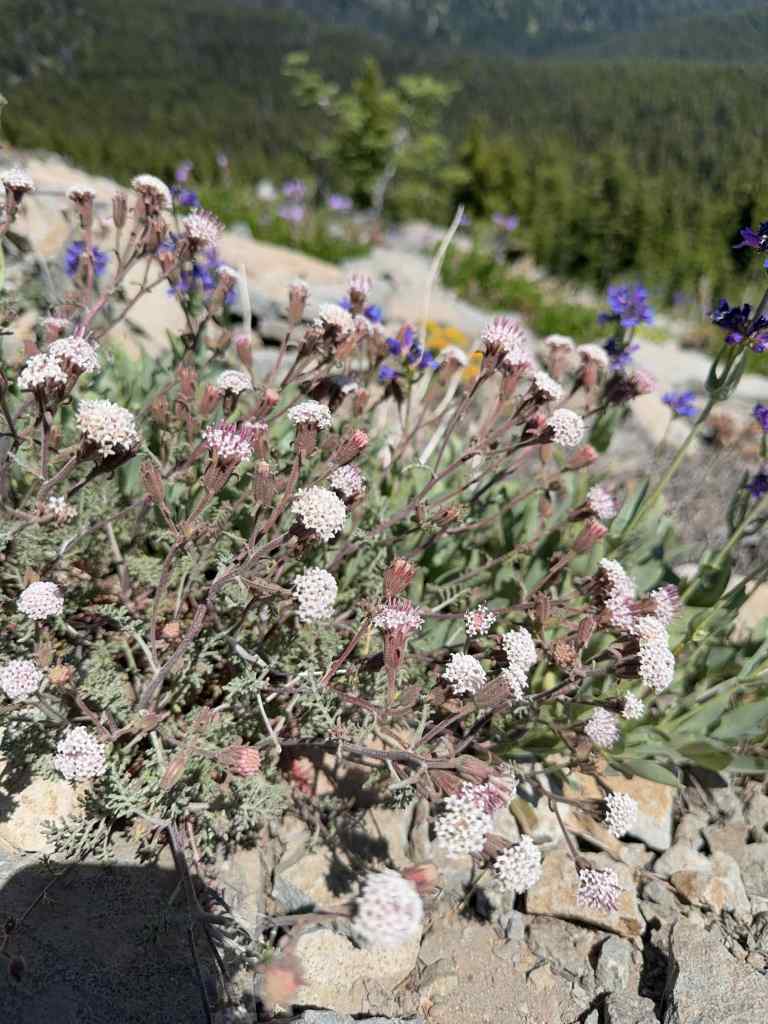
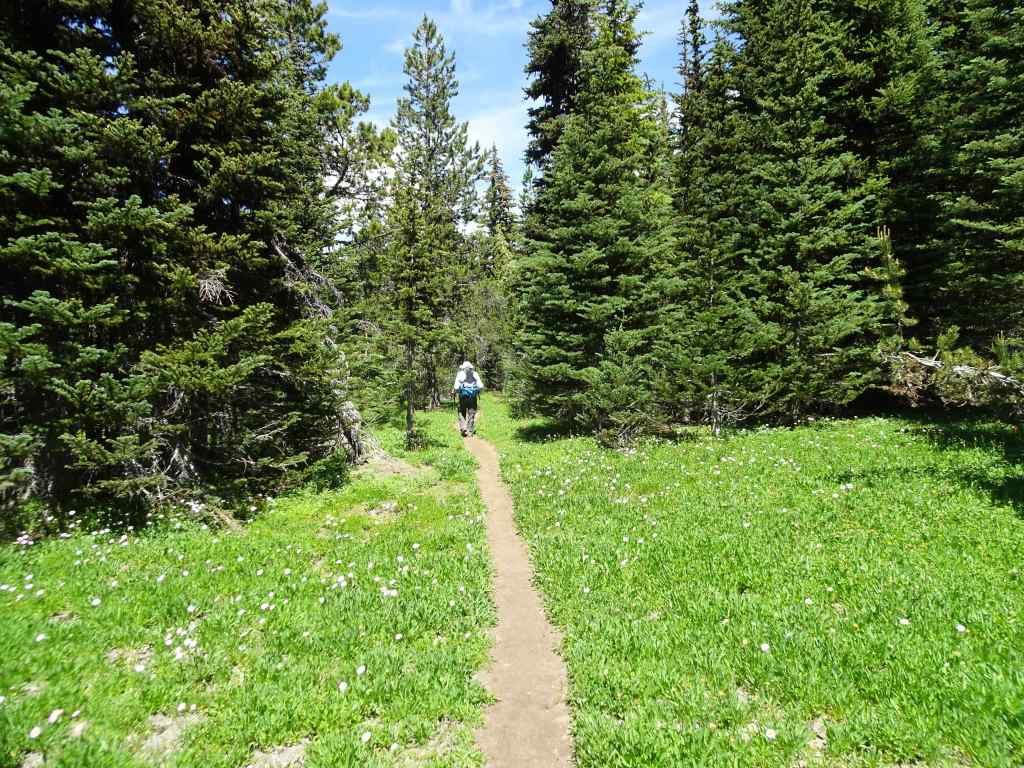
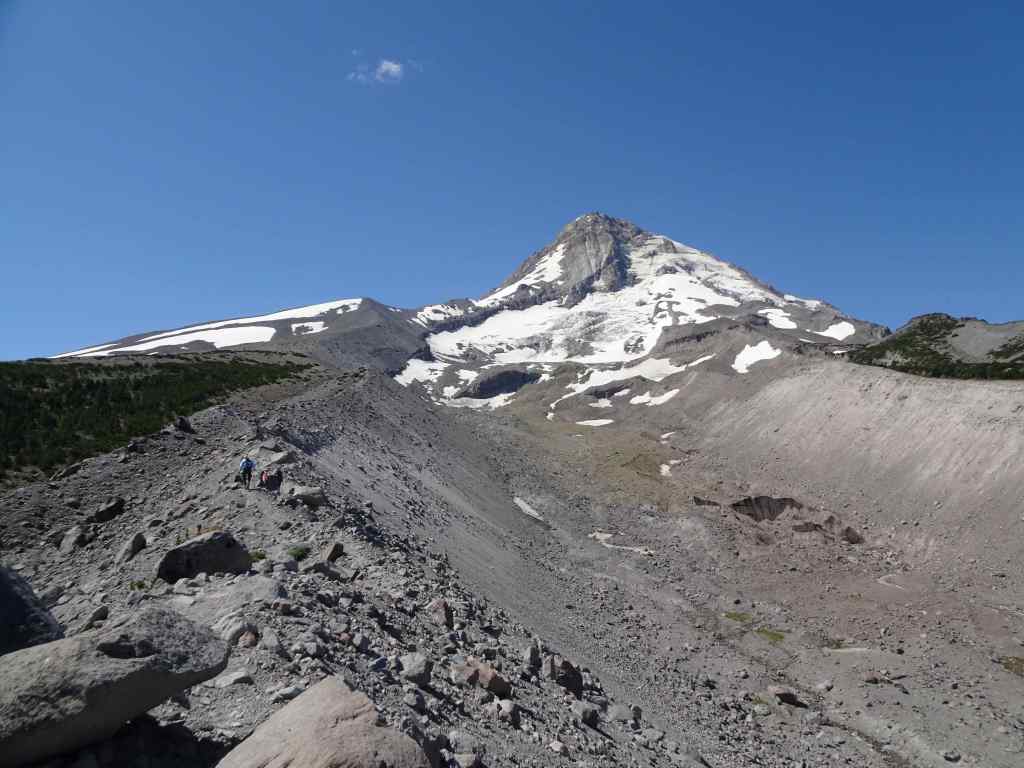
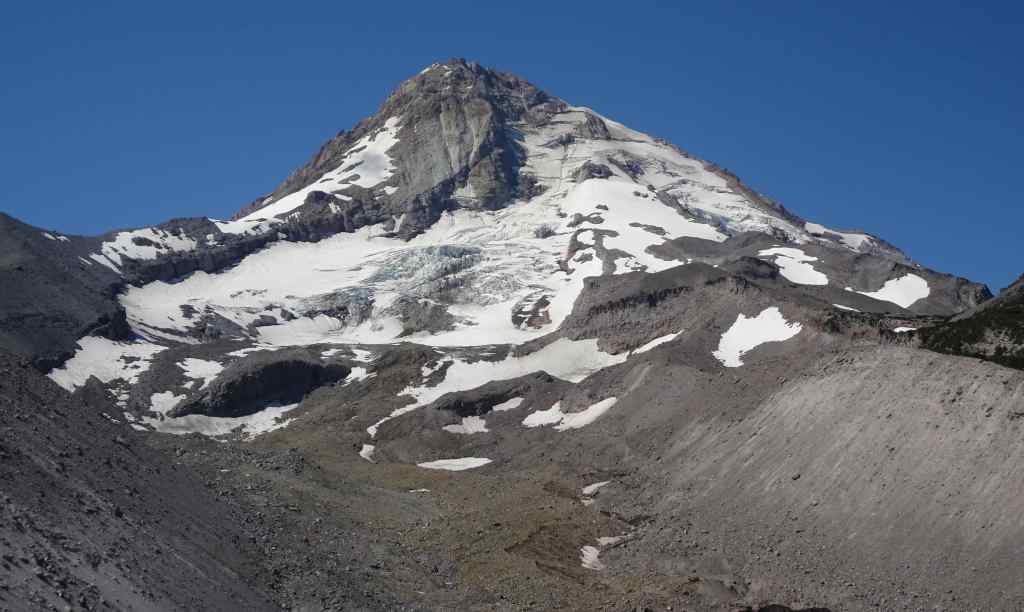
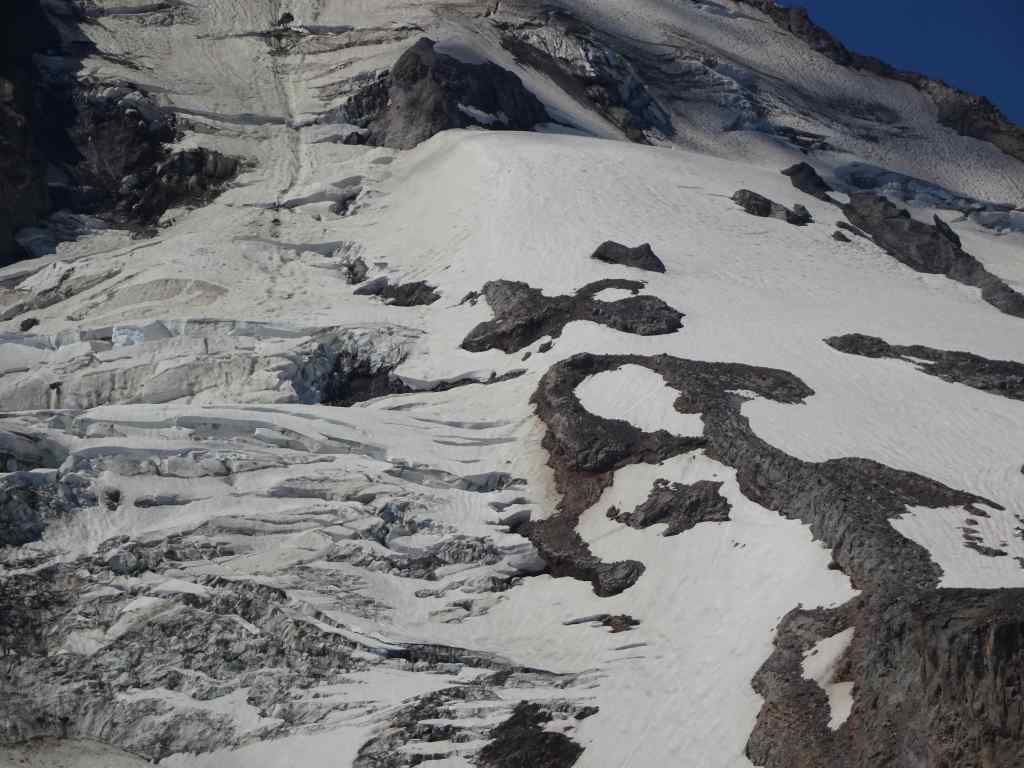
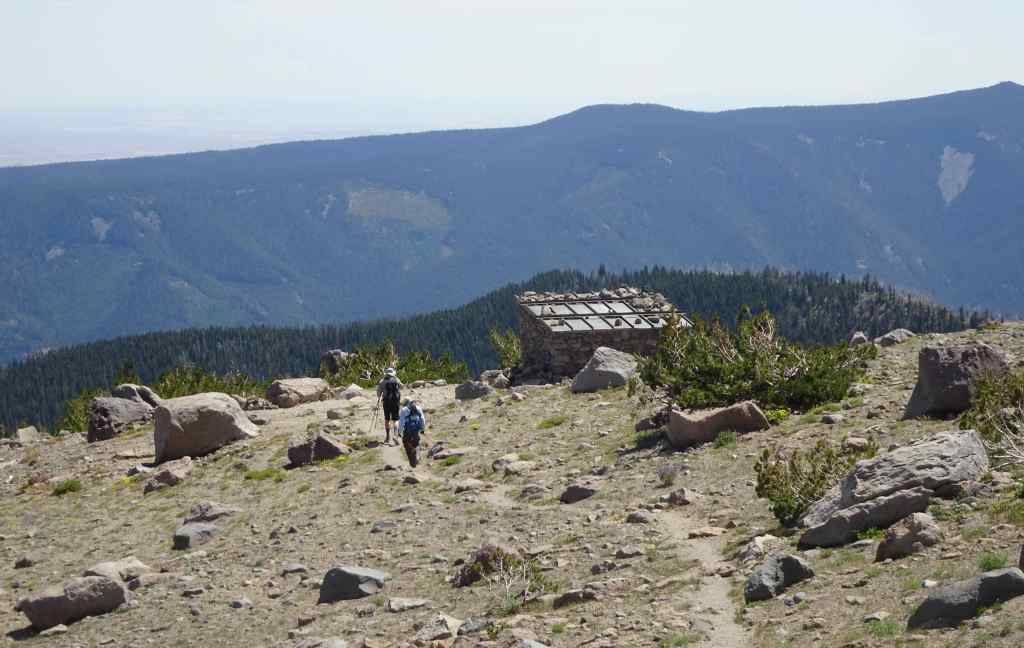
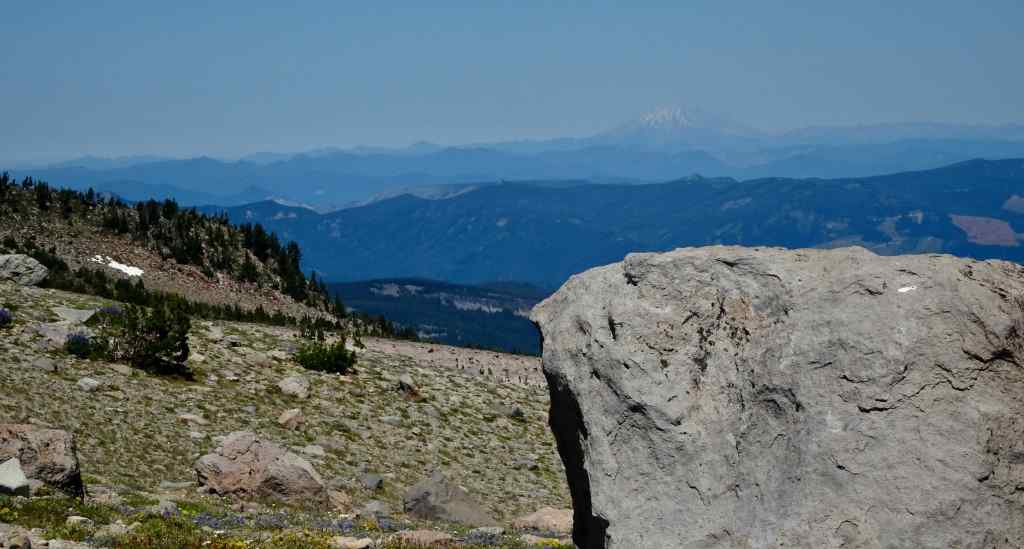
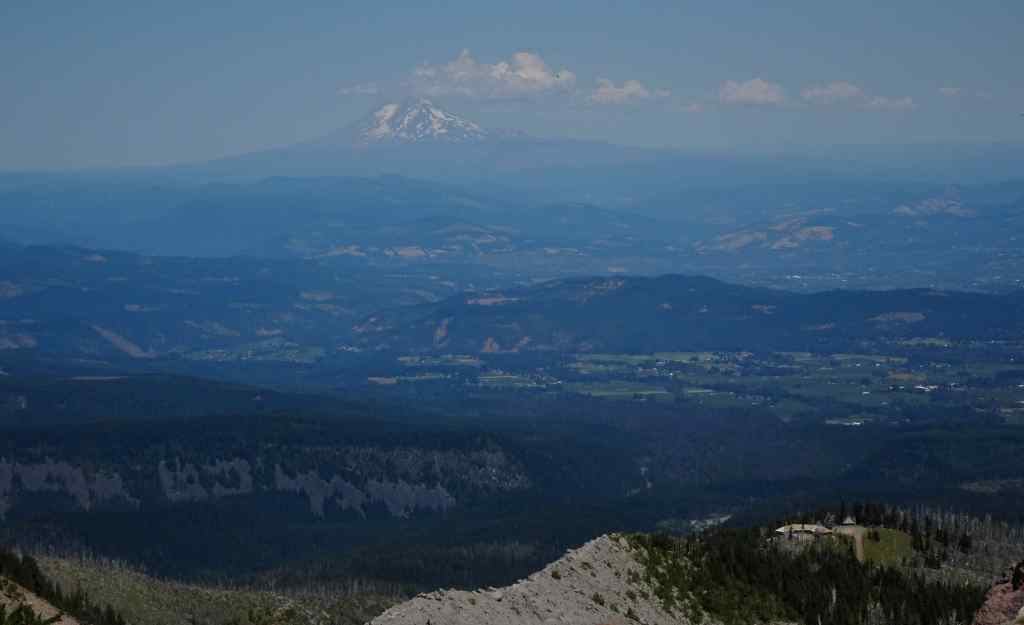
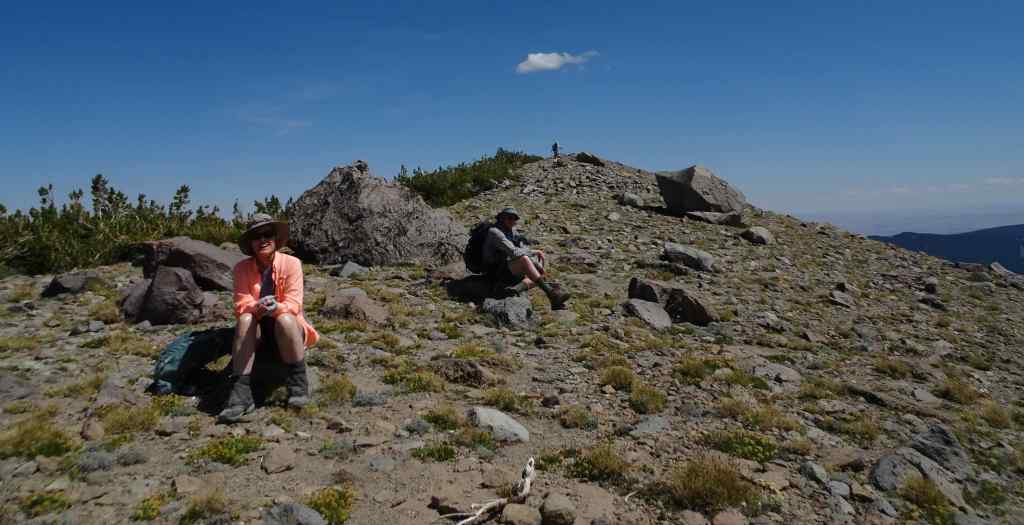
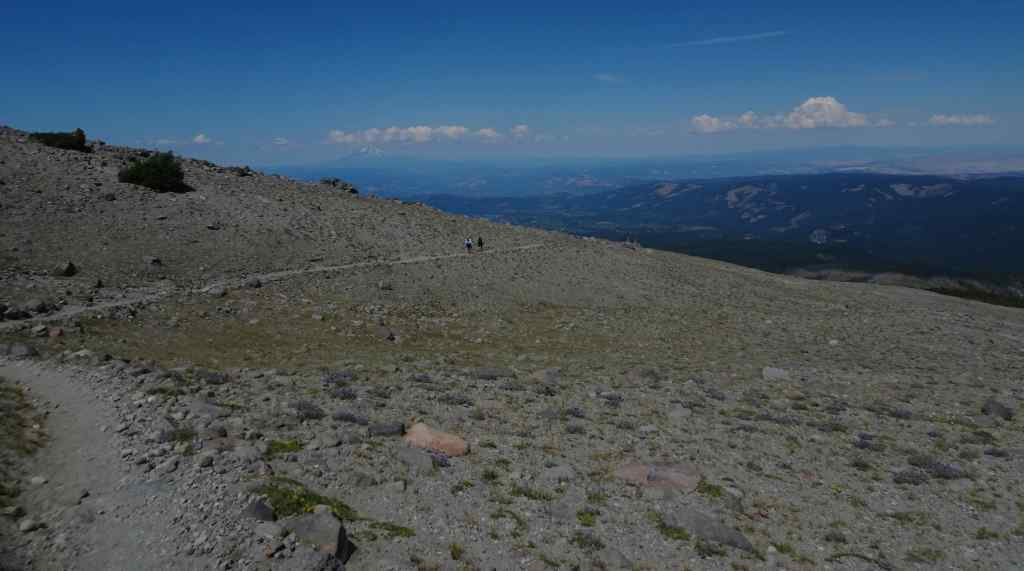
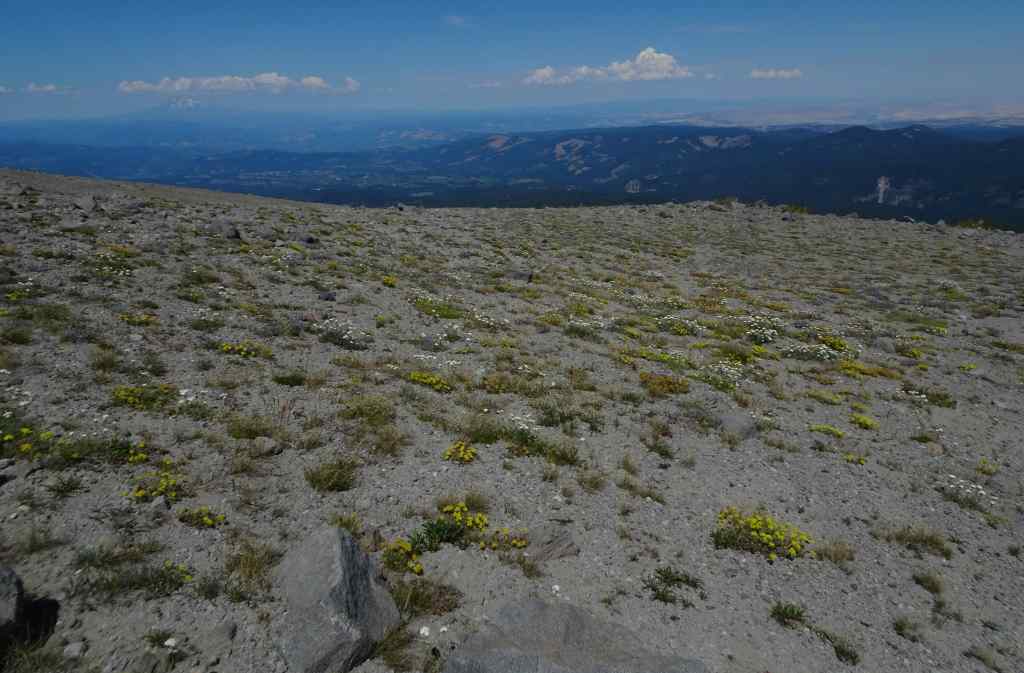
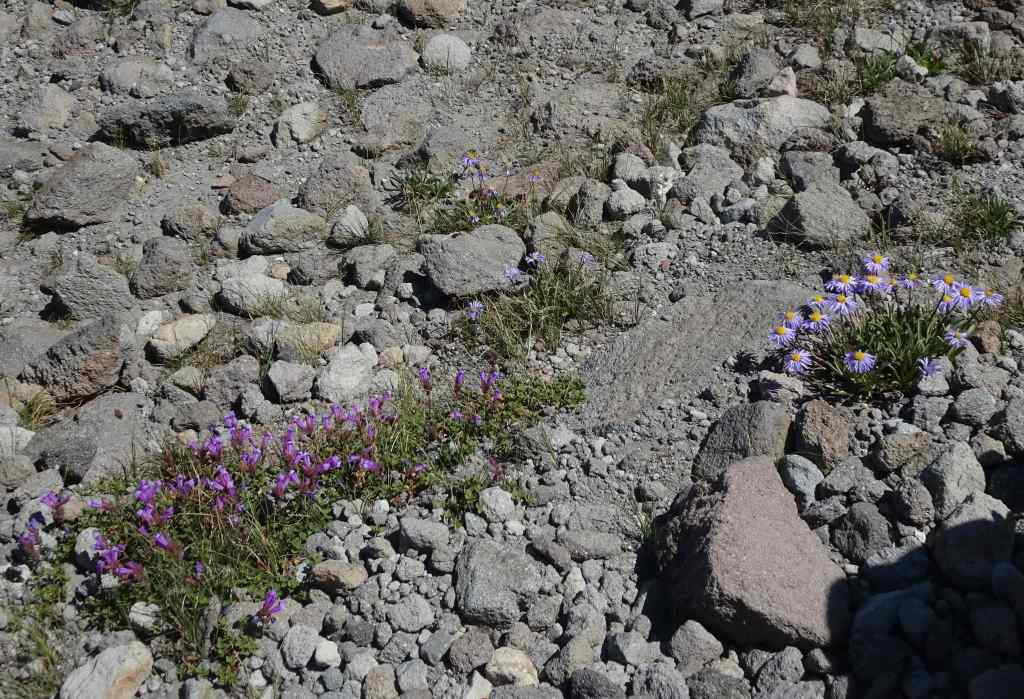
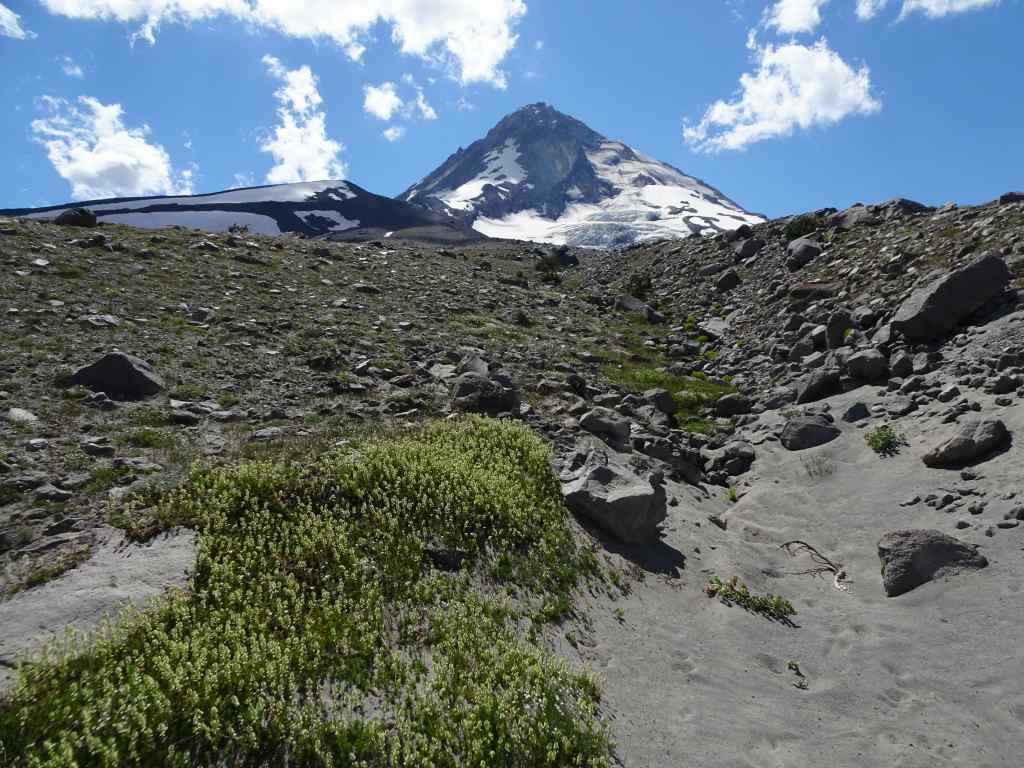
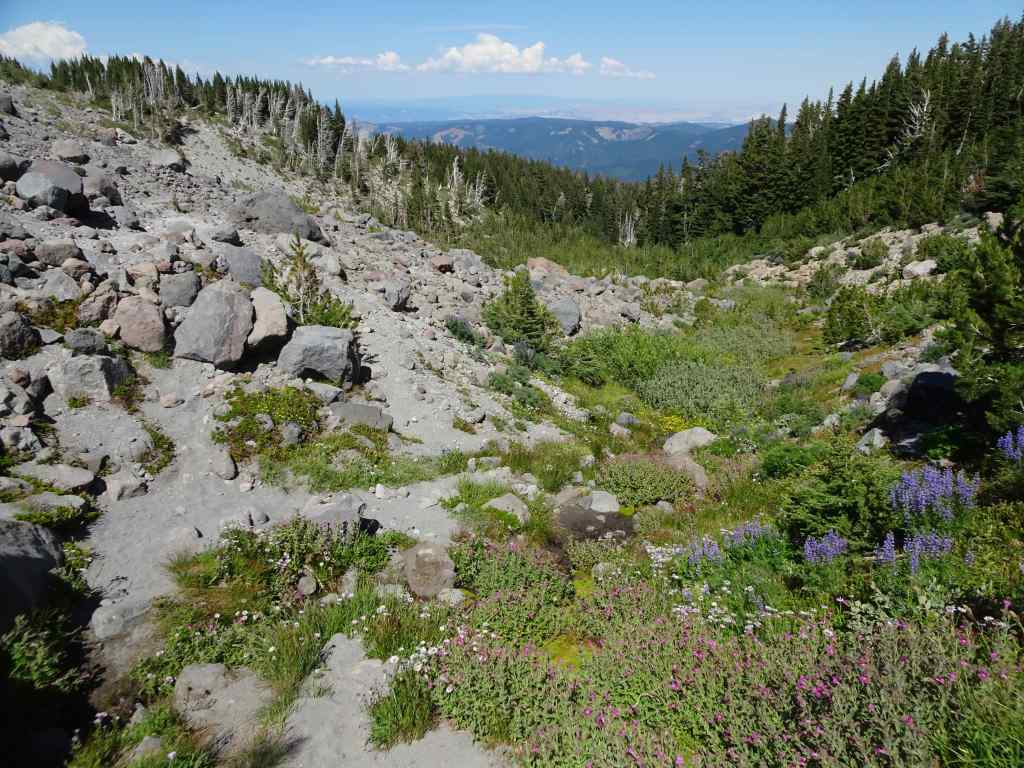
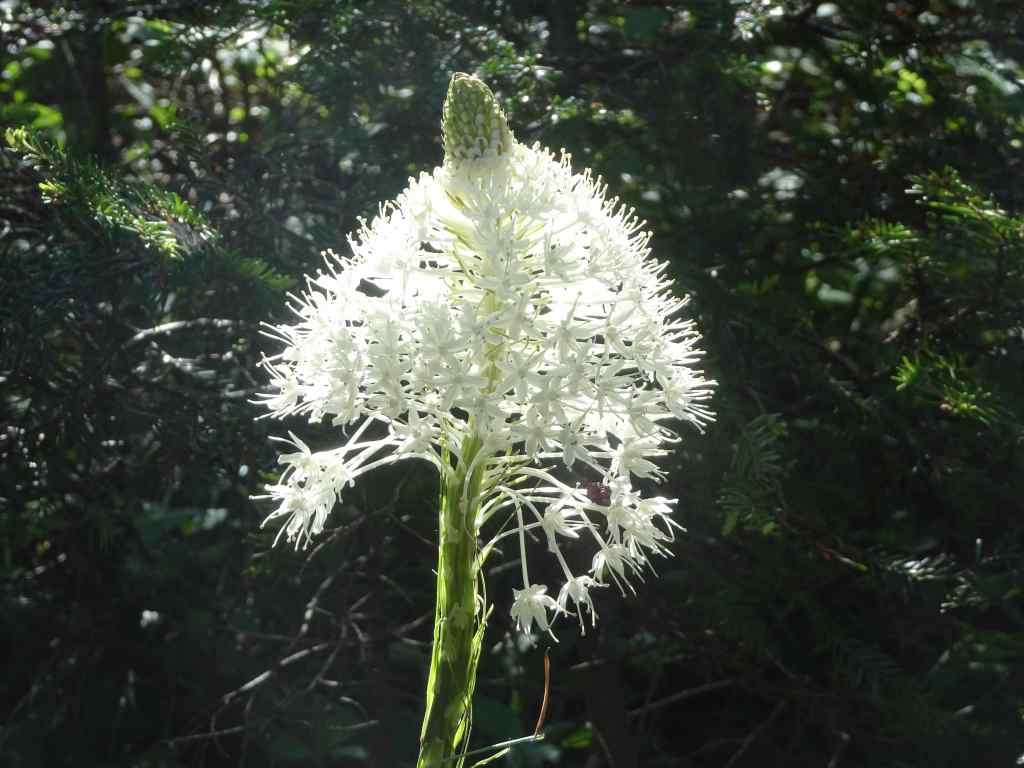
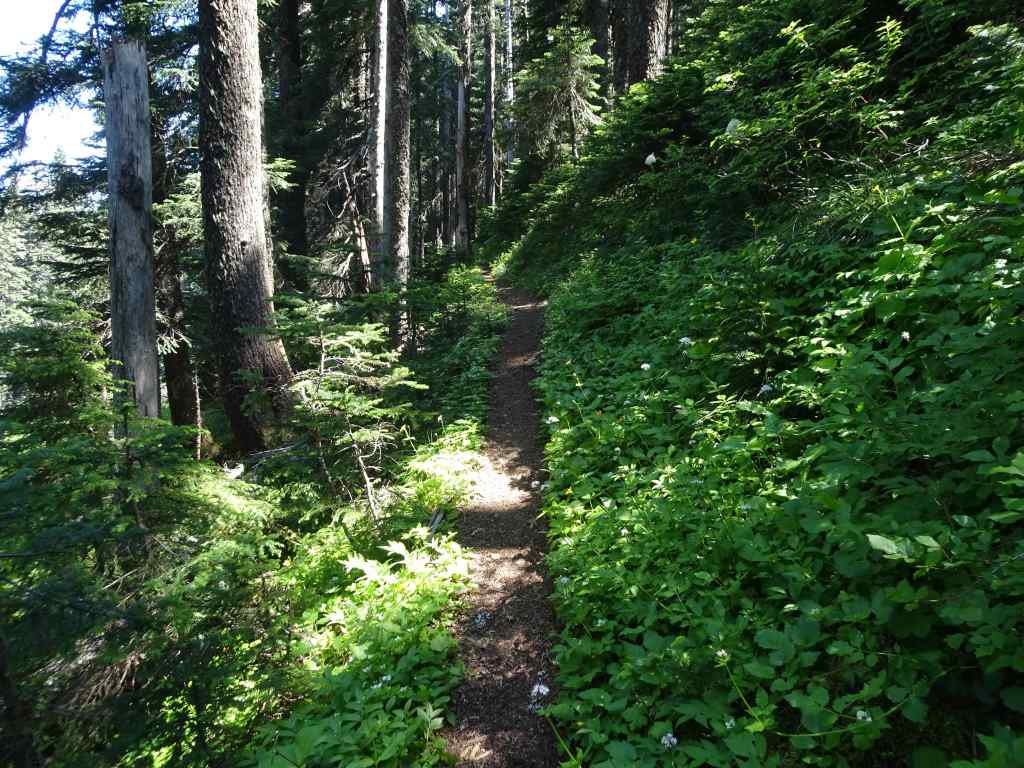
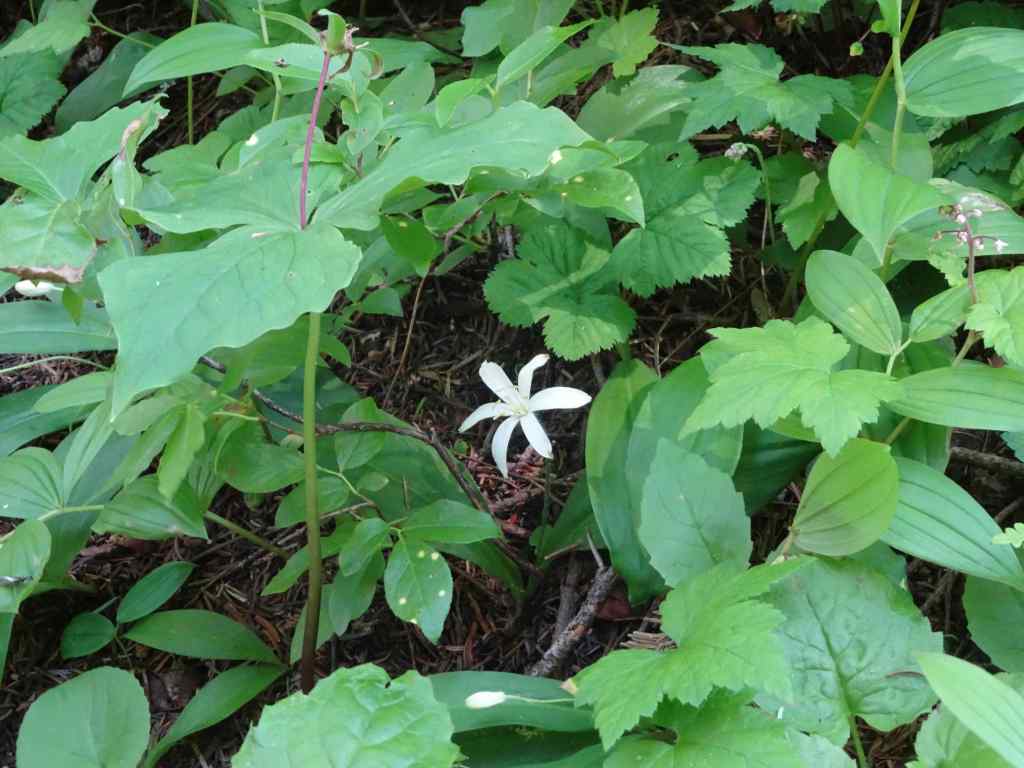
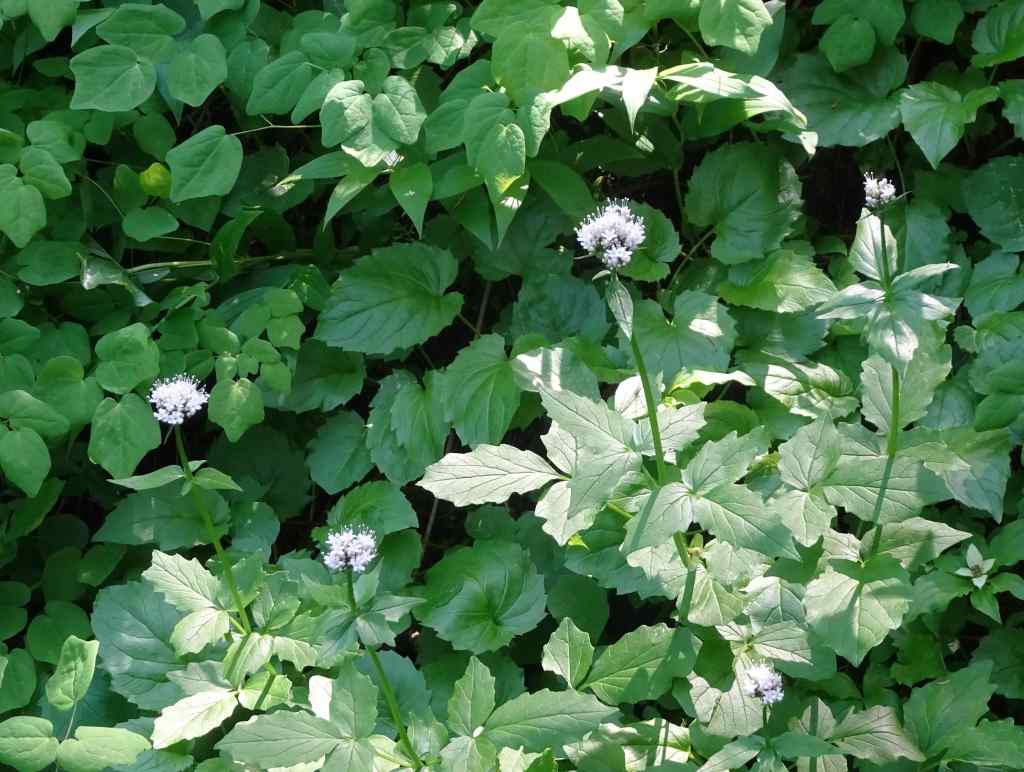
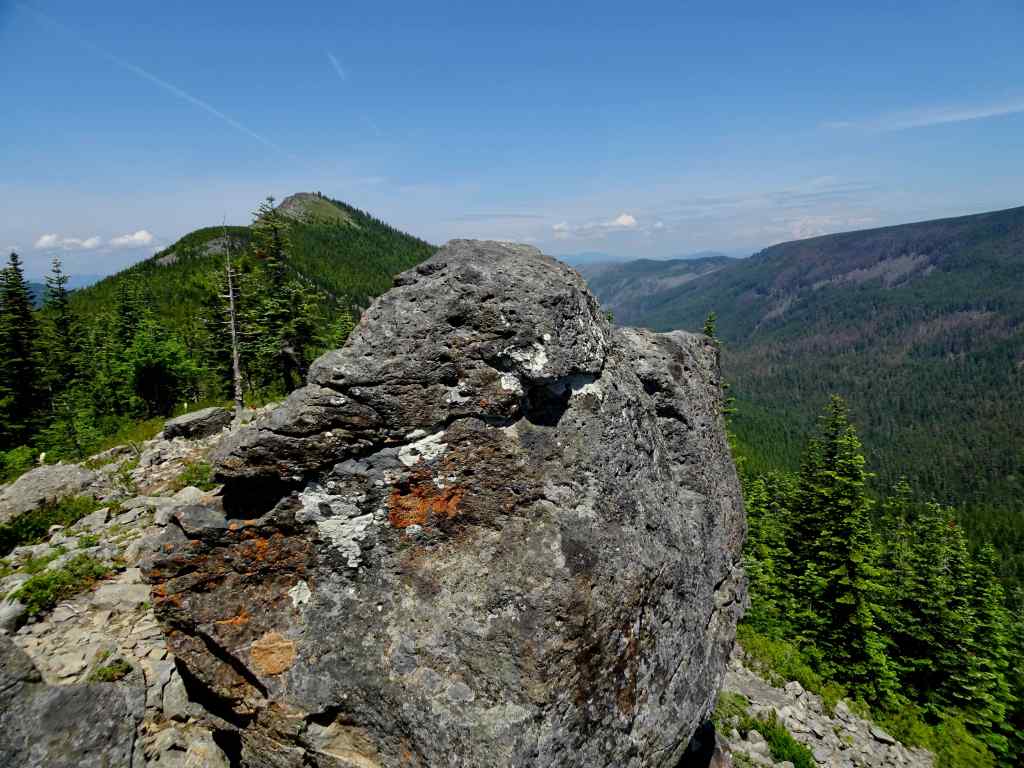
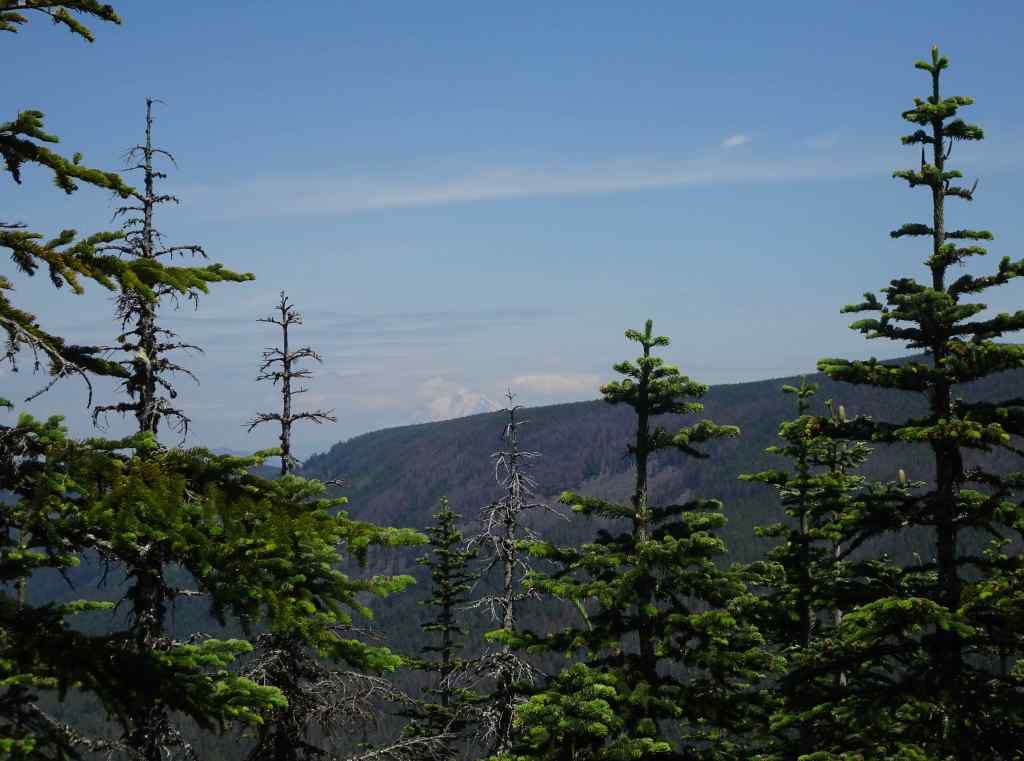
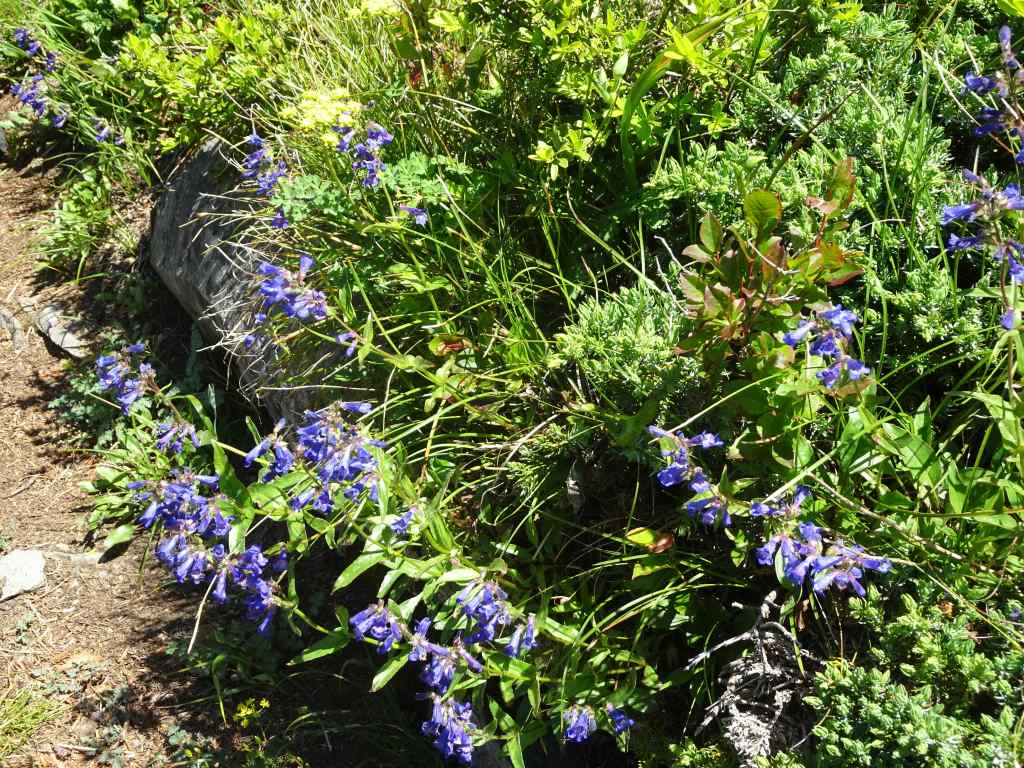
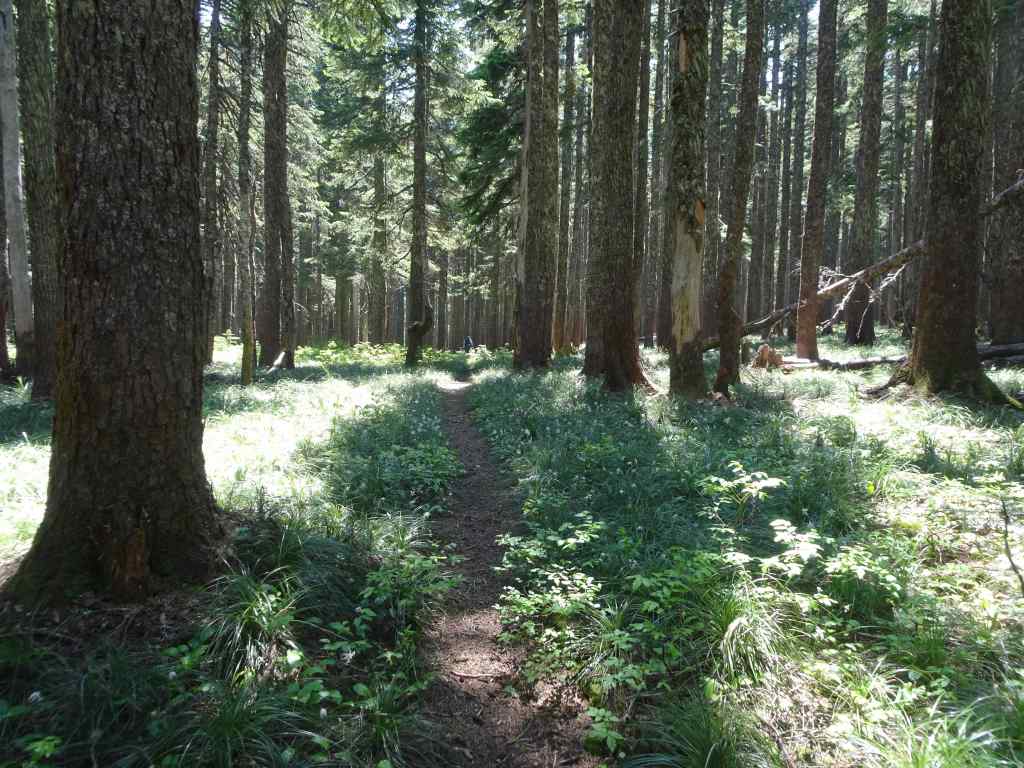
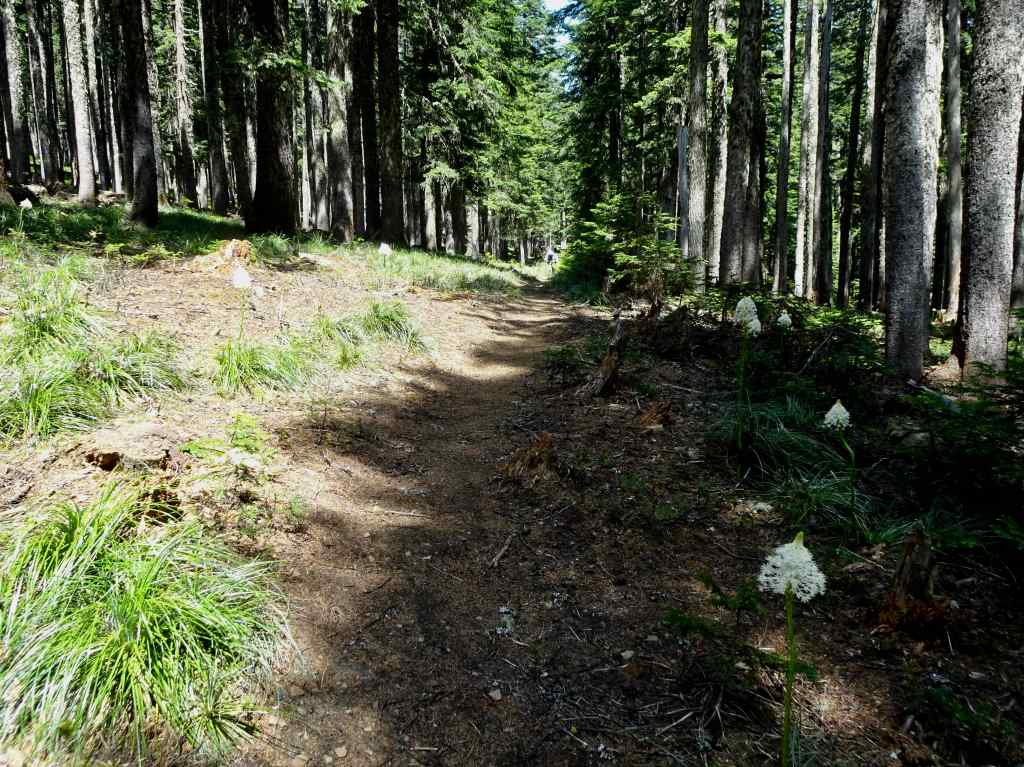
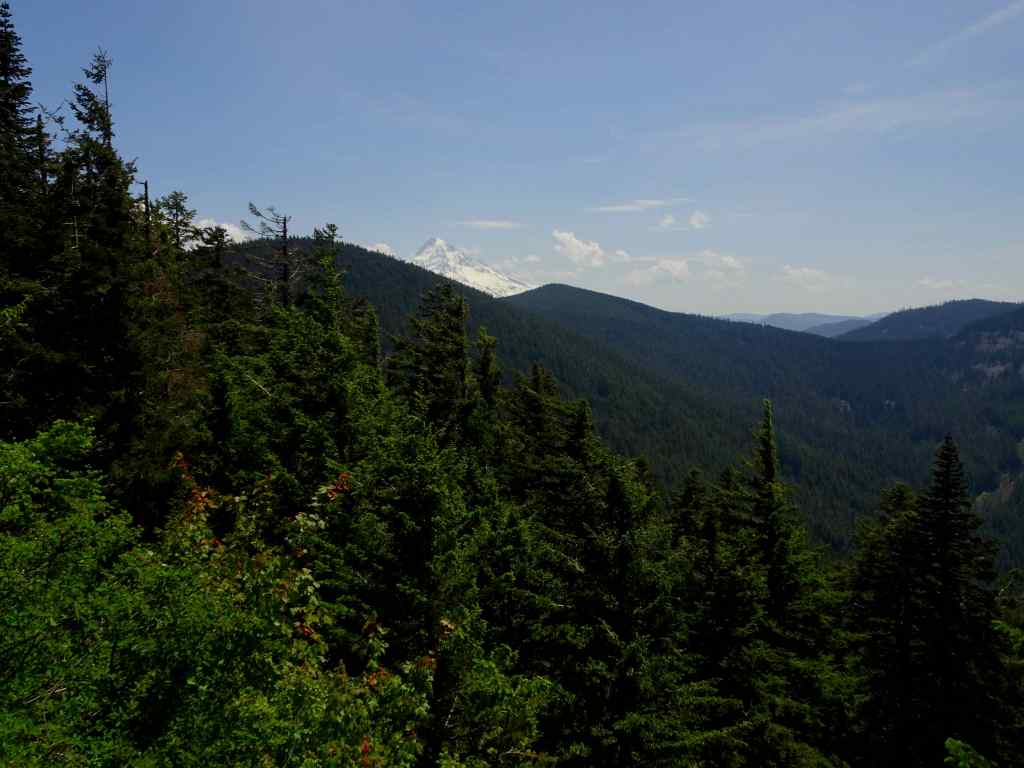
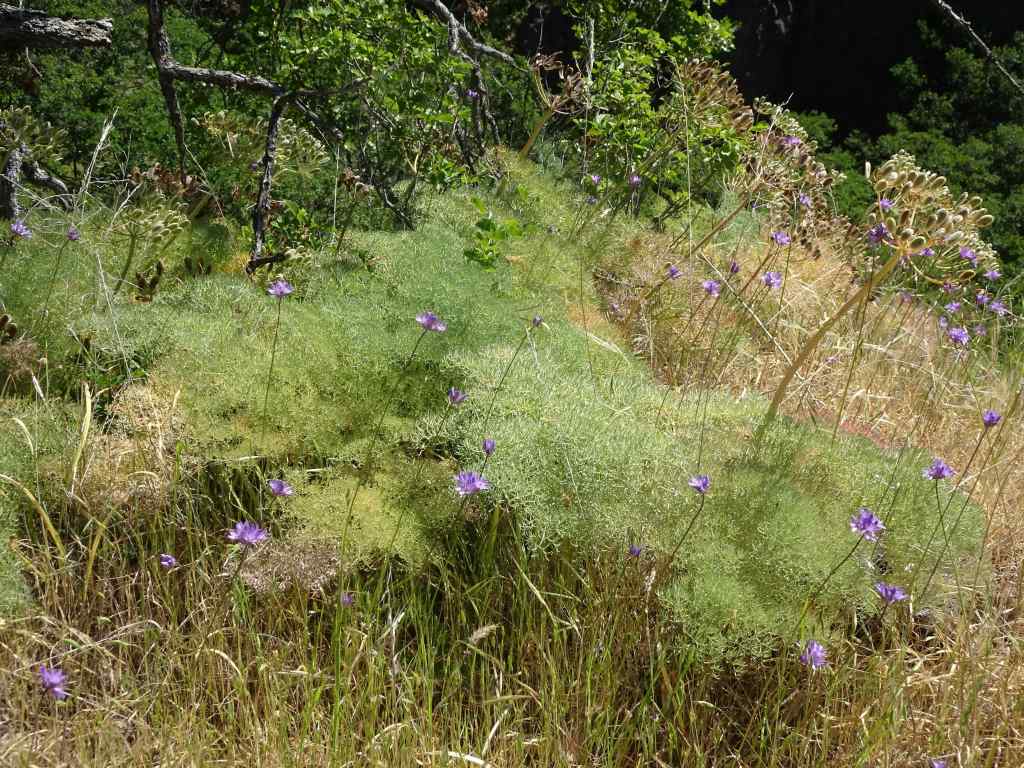
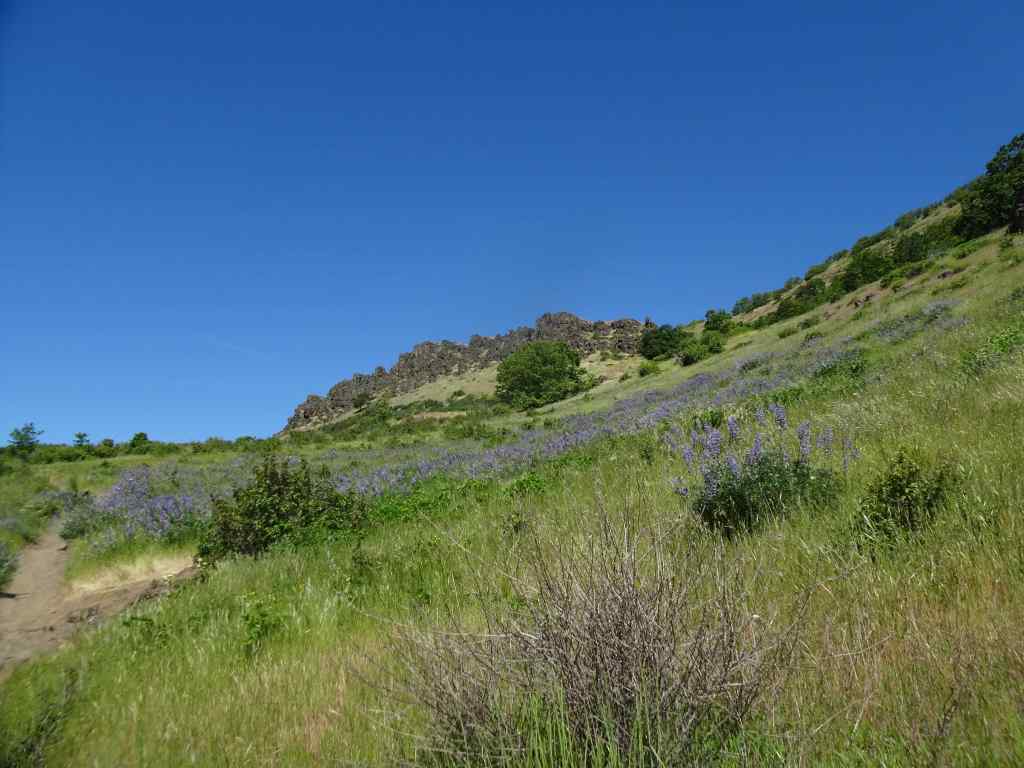
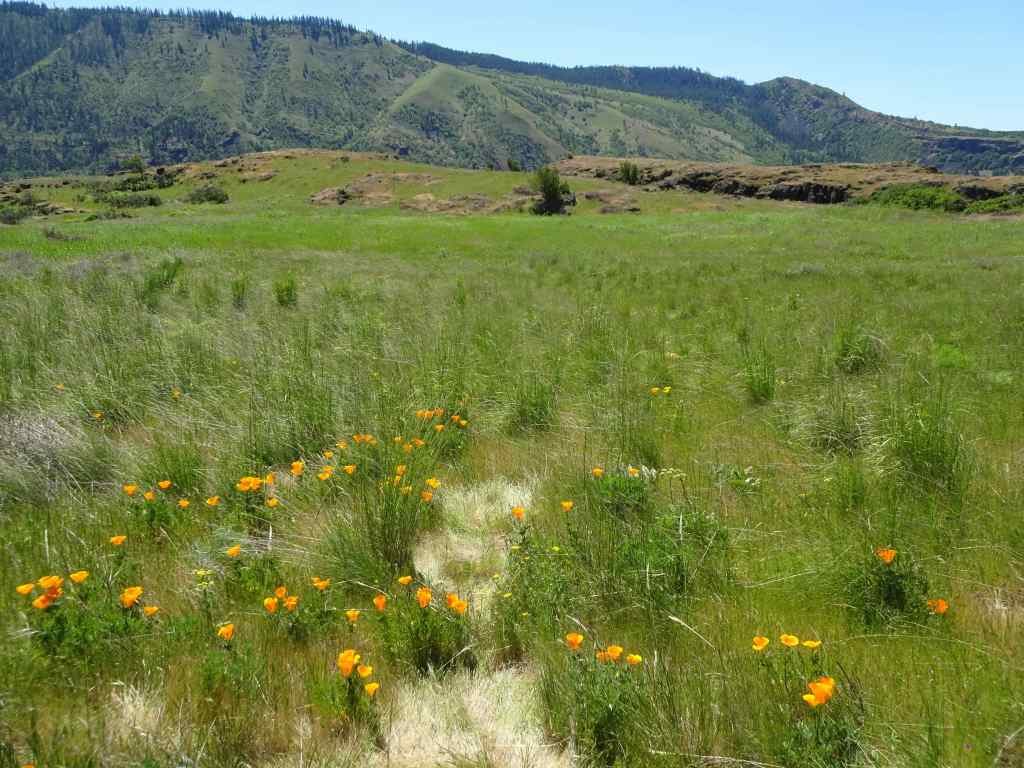
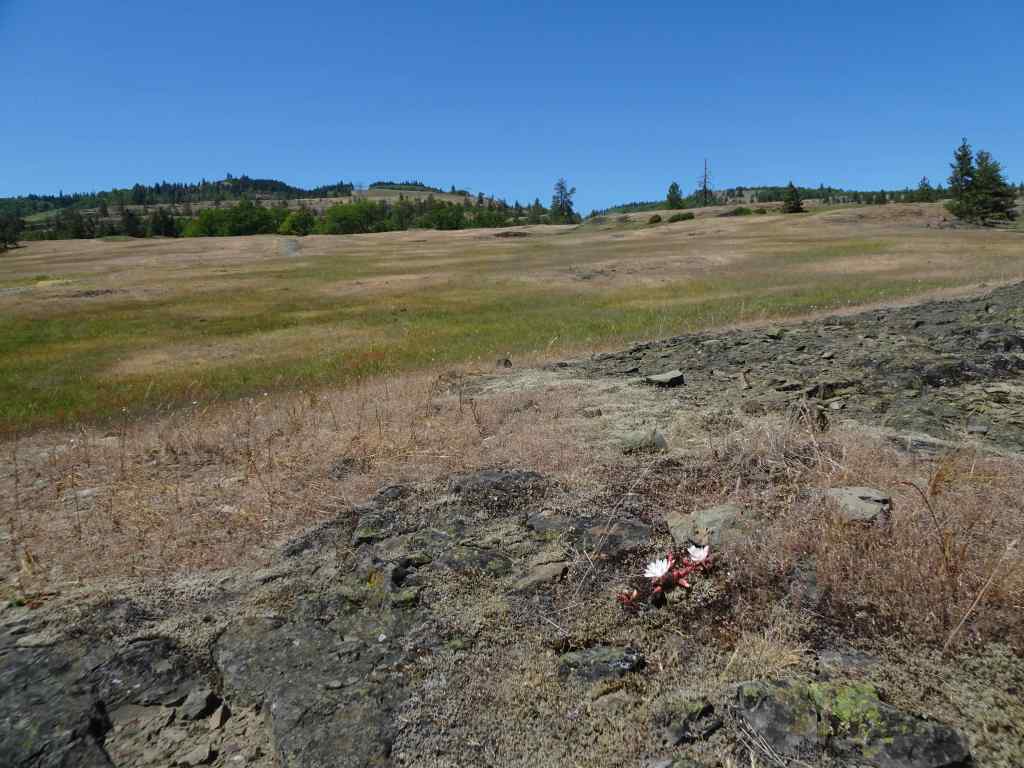
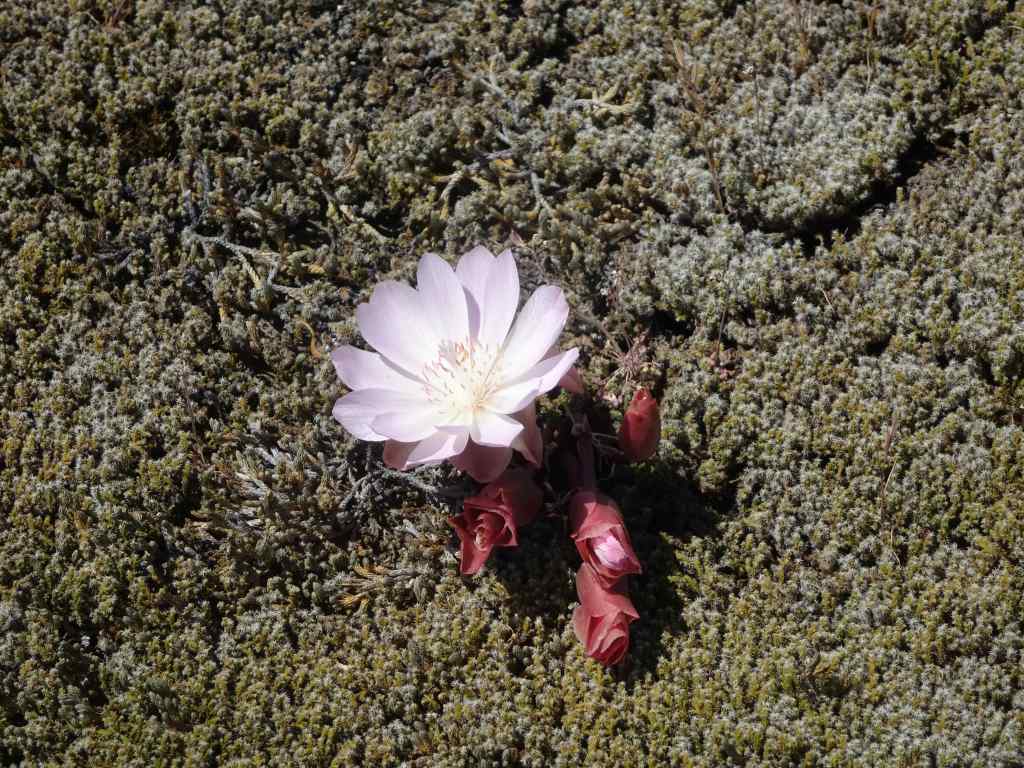
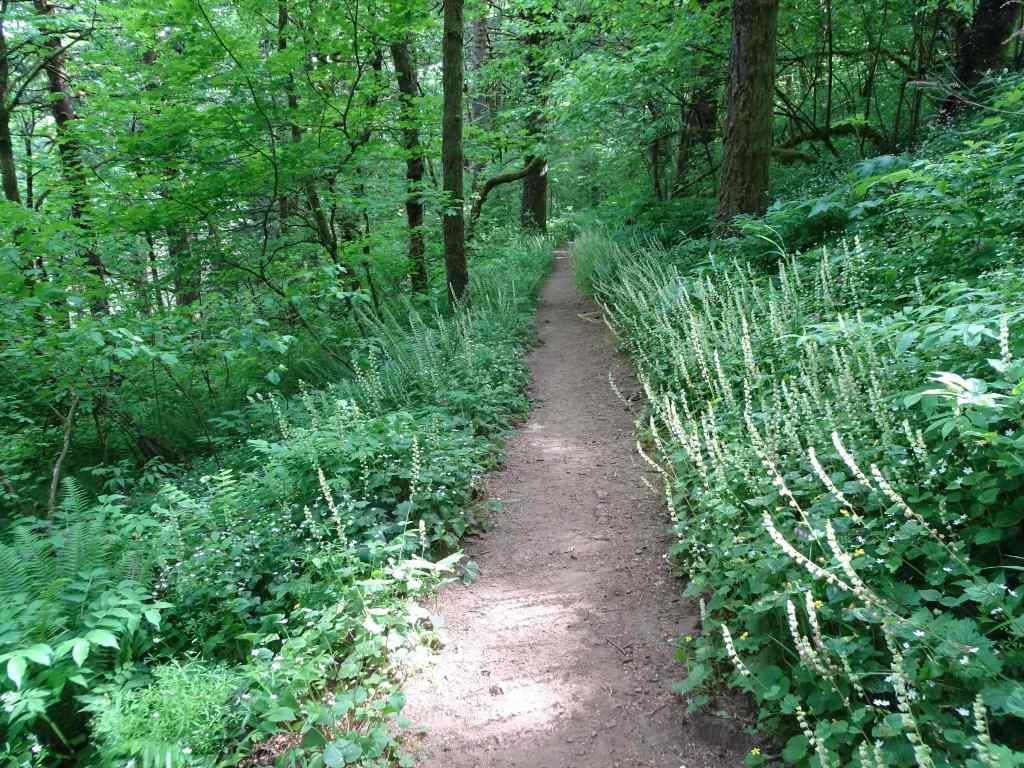
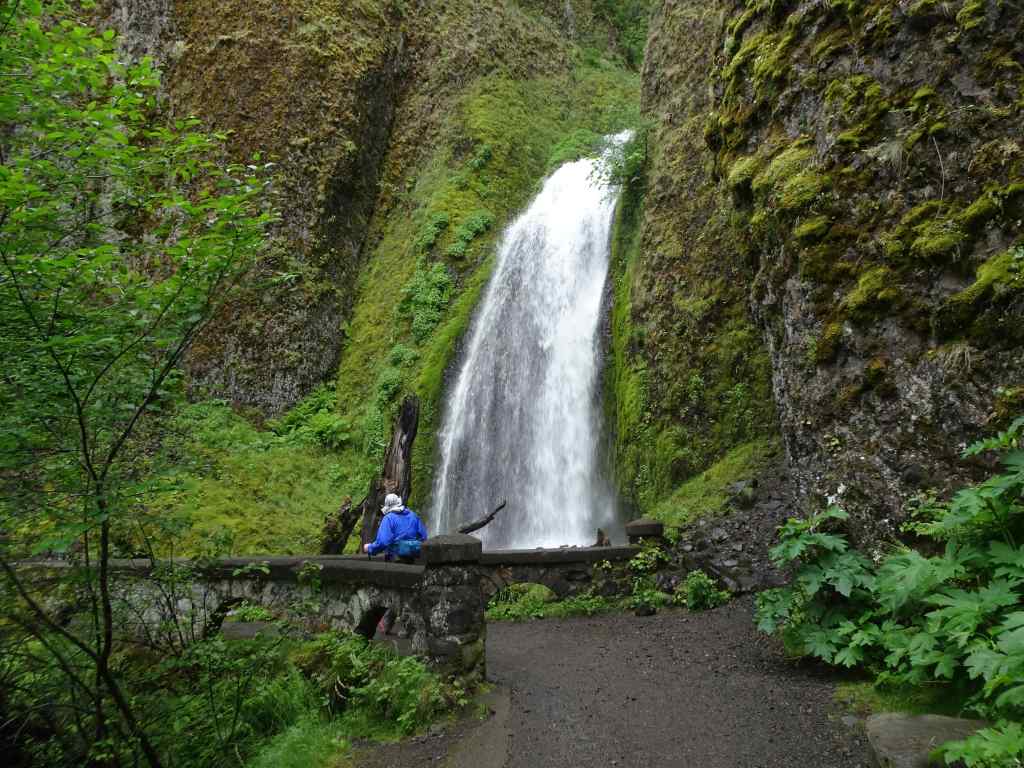
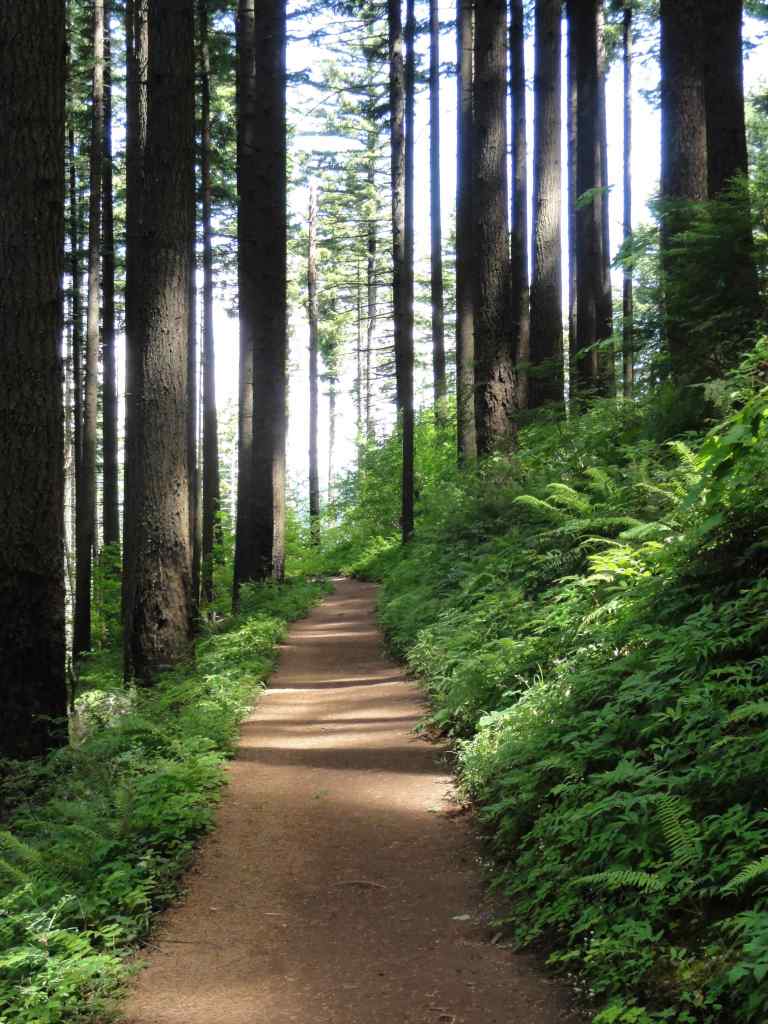
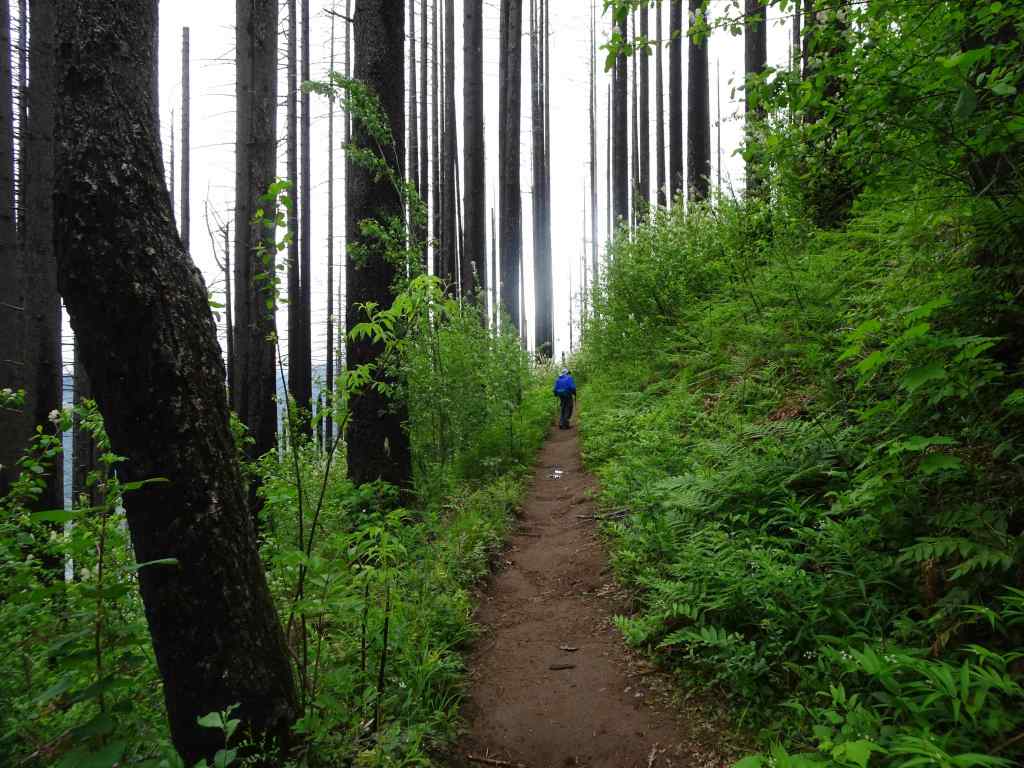
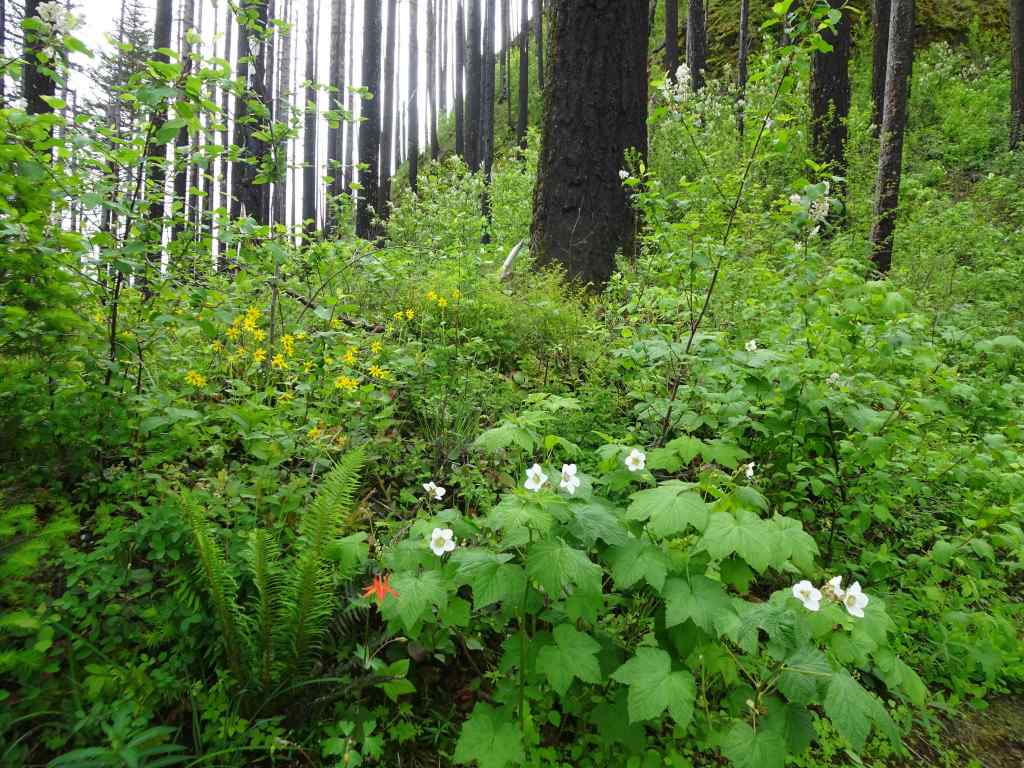
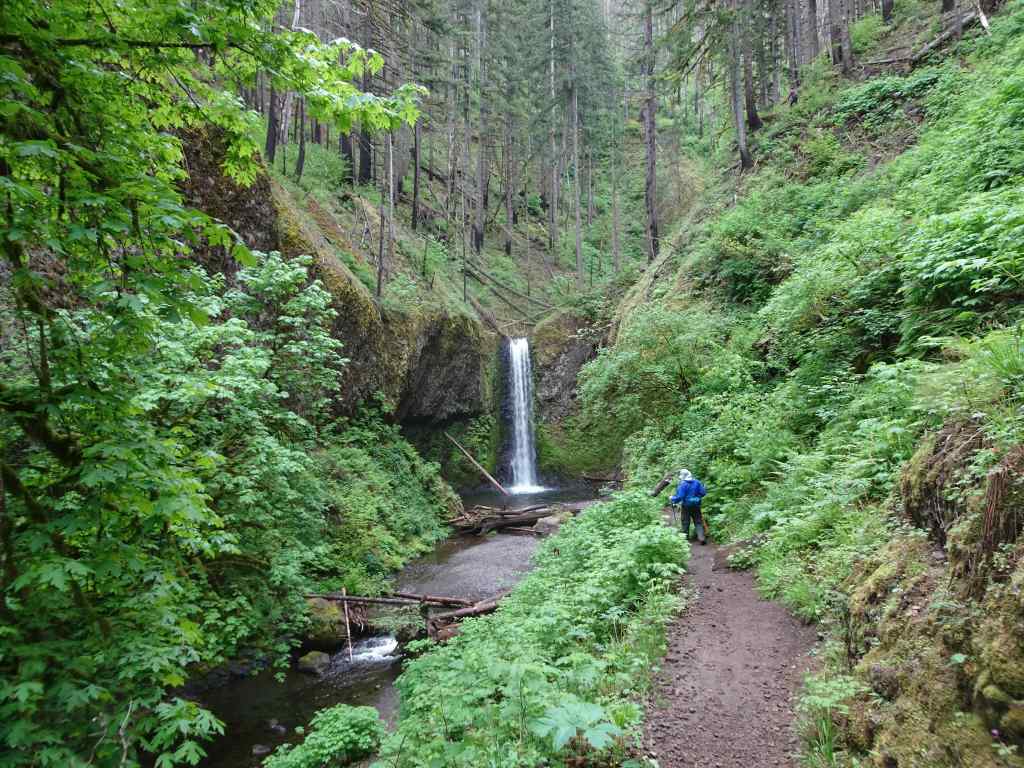
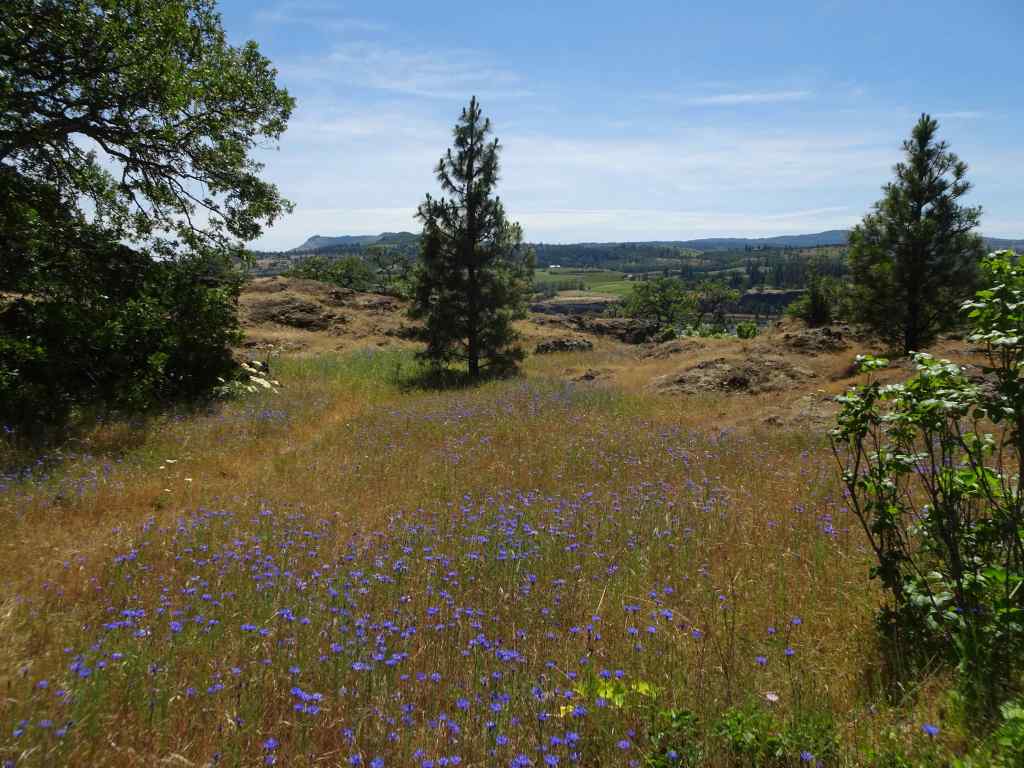
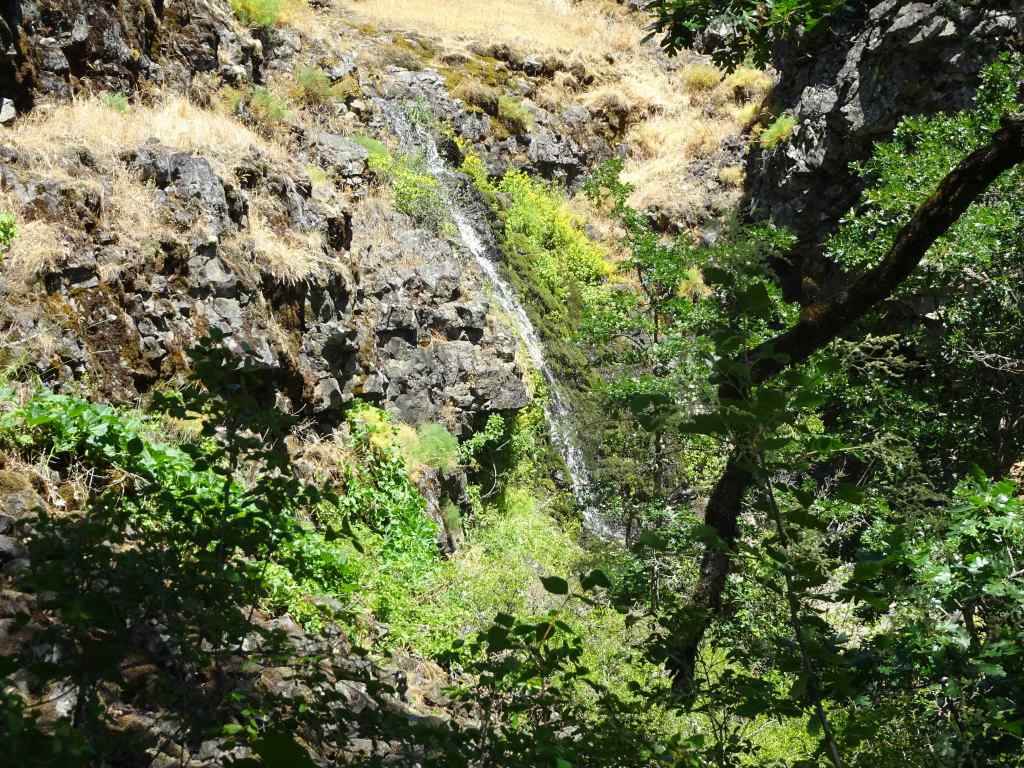
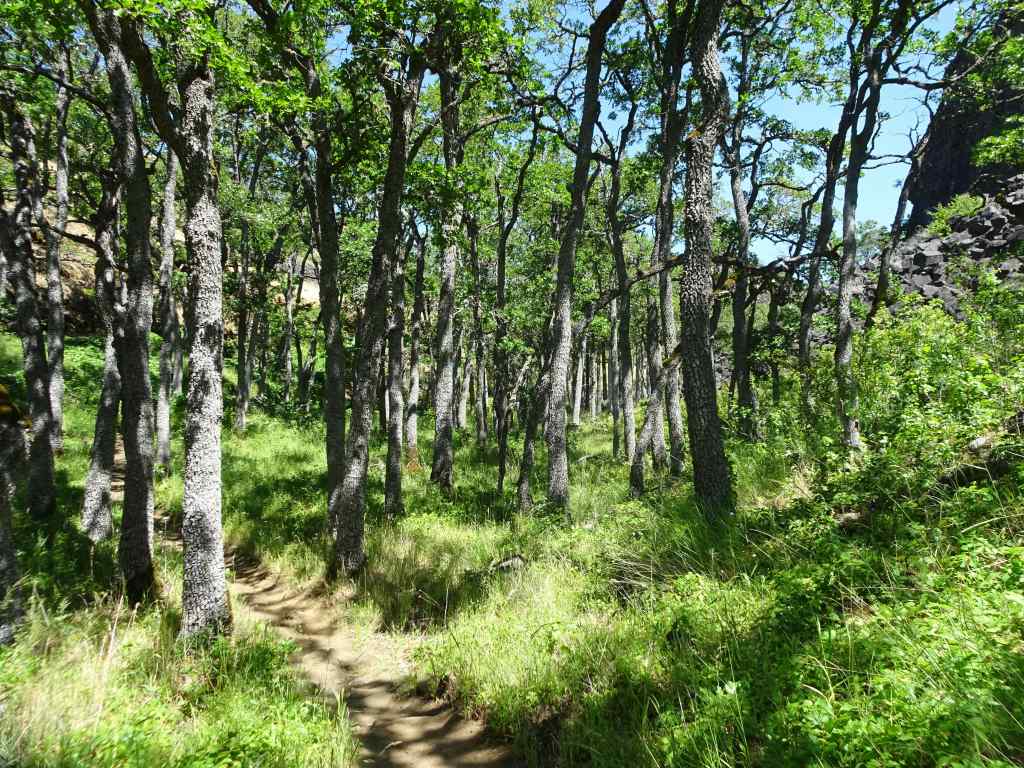
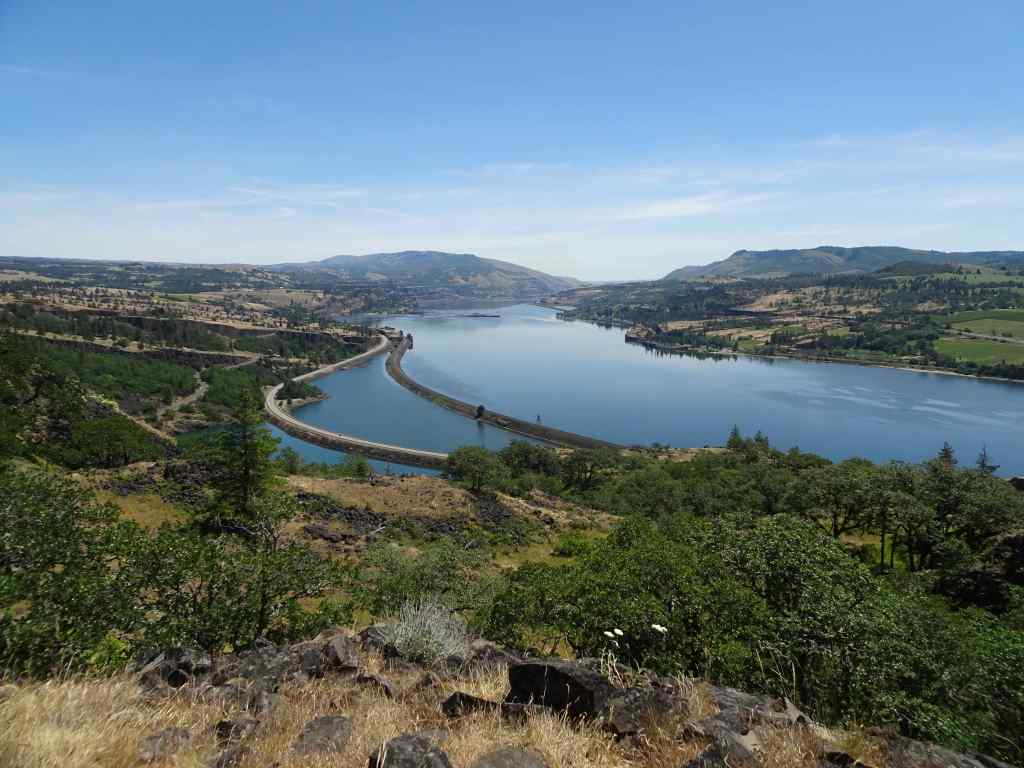
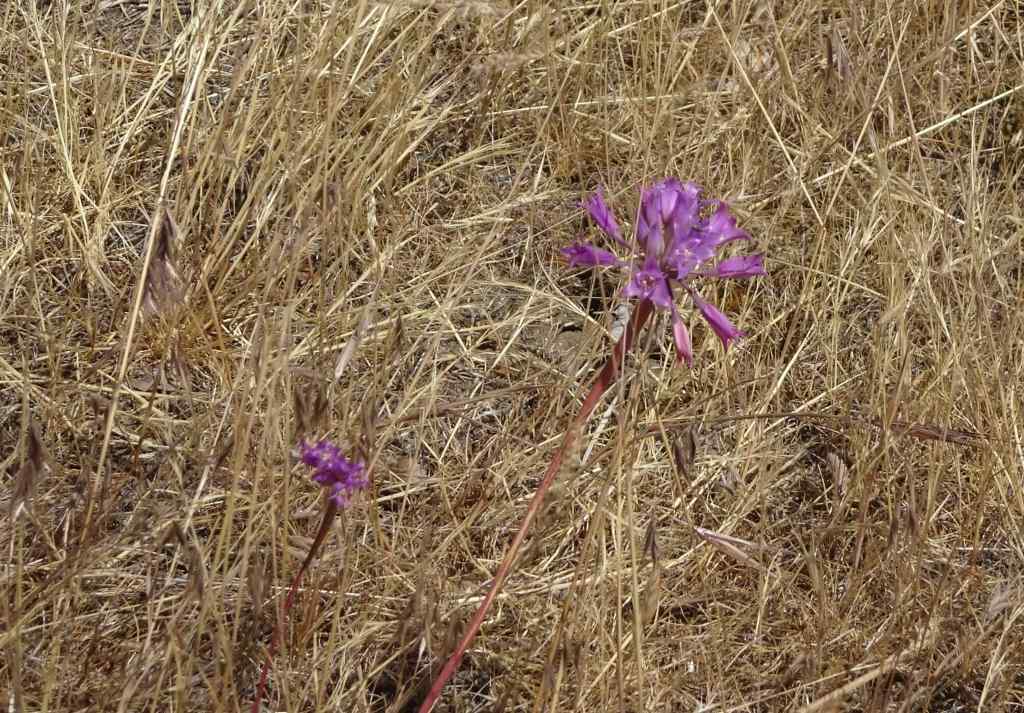
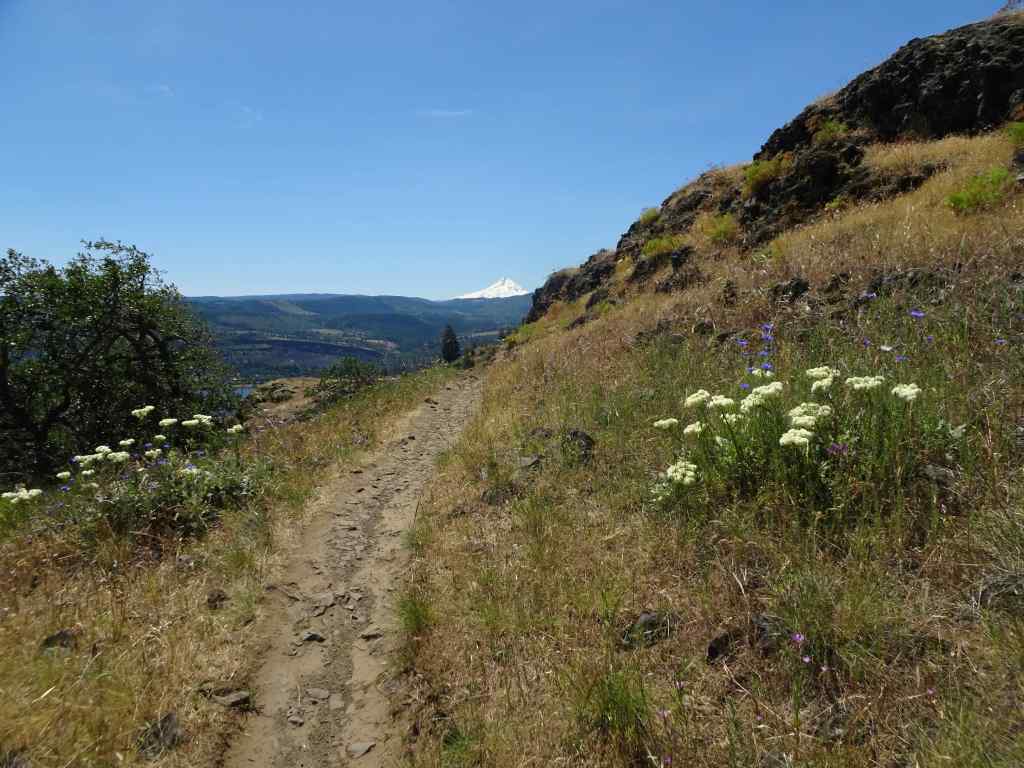
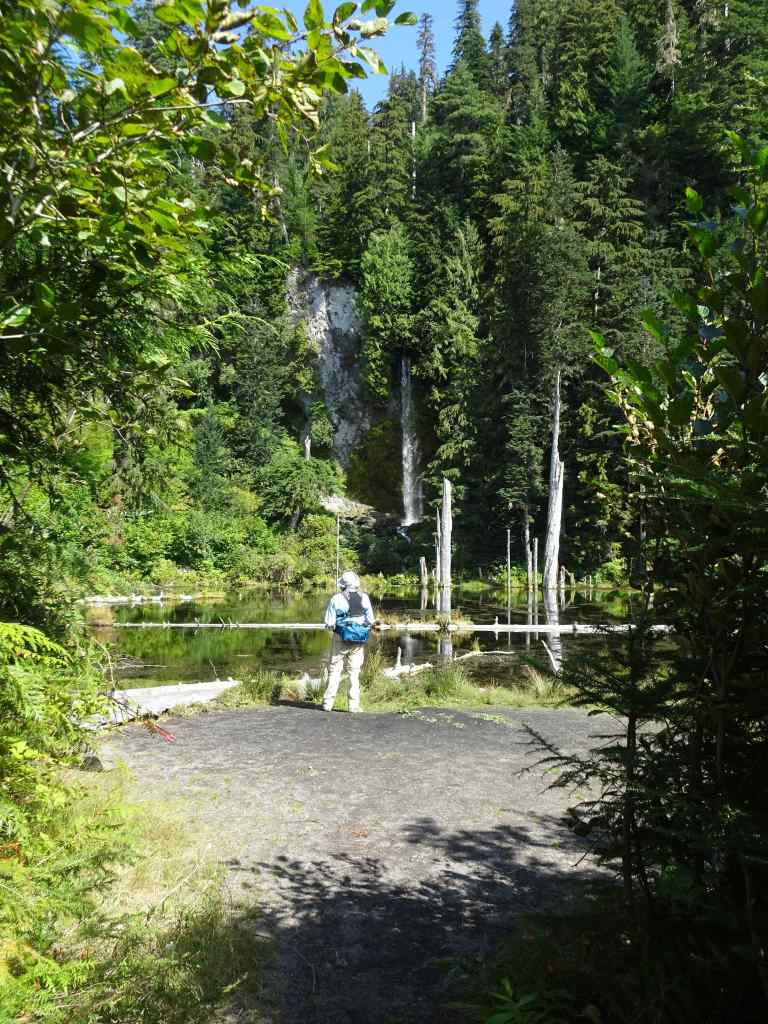
We hiked again where we have hiked before, through the lush wildflower meadows on the southern slopes of Mt Adams, on the Yakama Nation Tract D. We started at Bird Lake, and went counterclockwise uphill to the Hell Roaring Viewpoint of Mt Adams, then down along the Round the Mountain Trail and back to the lake (~5.5 miles, 1000 feet). We saw wildflowers, waterfalls, and some views through the burned forest, on a day when we only had fleeting glimpses of the mountain itself. The wildflower meadows were ‘beyond category’ today, and I took a lot of pictures!
Lower trail, from Bird Lake to Bluff Lake:
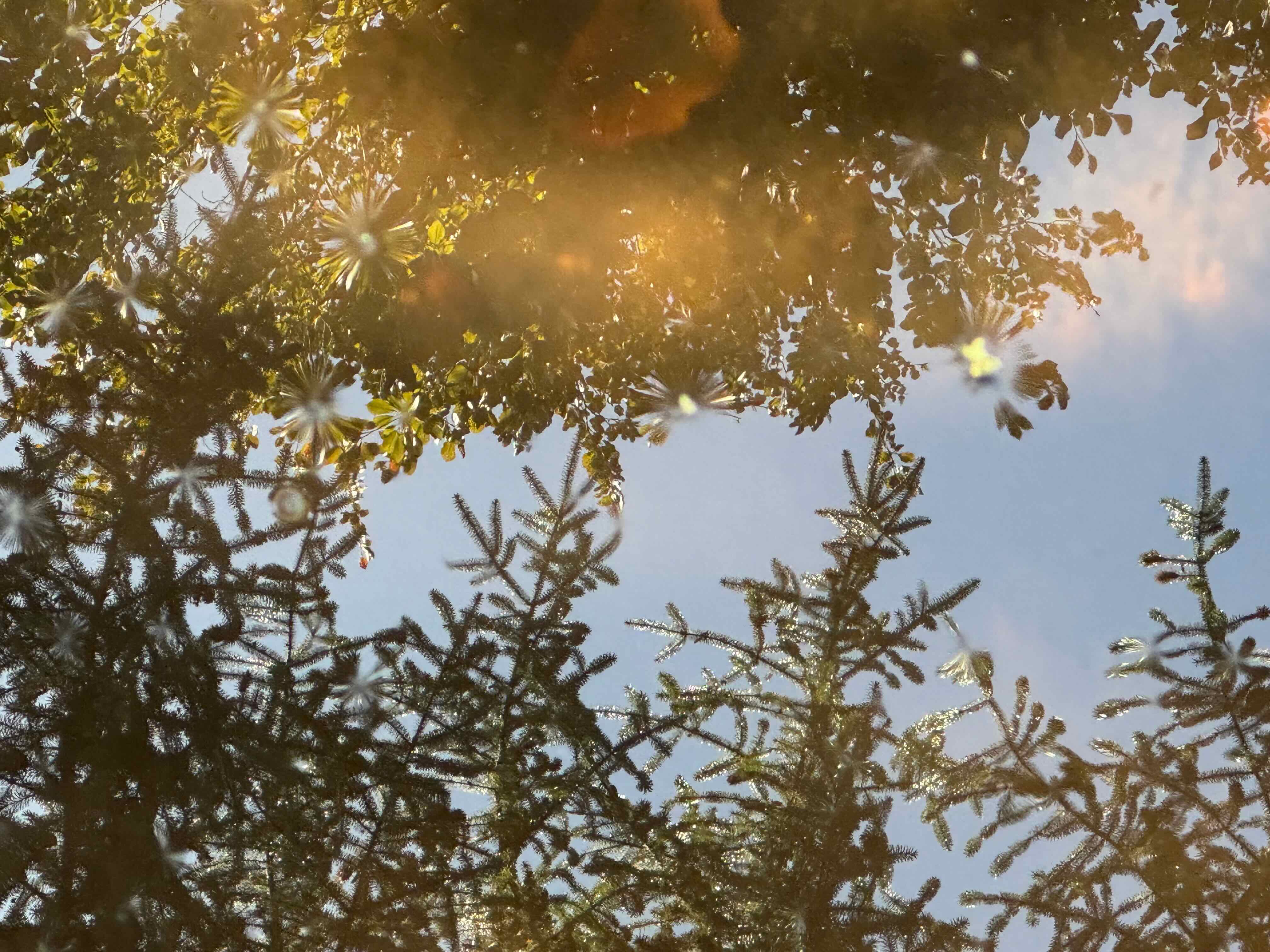
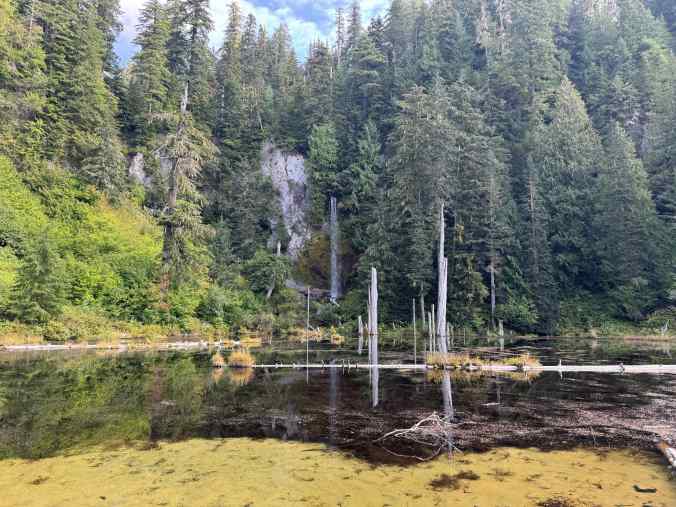
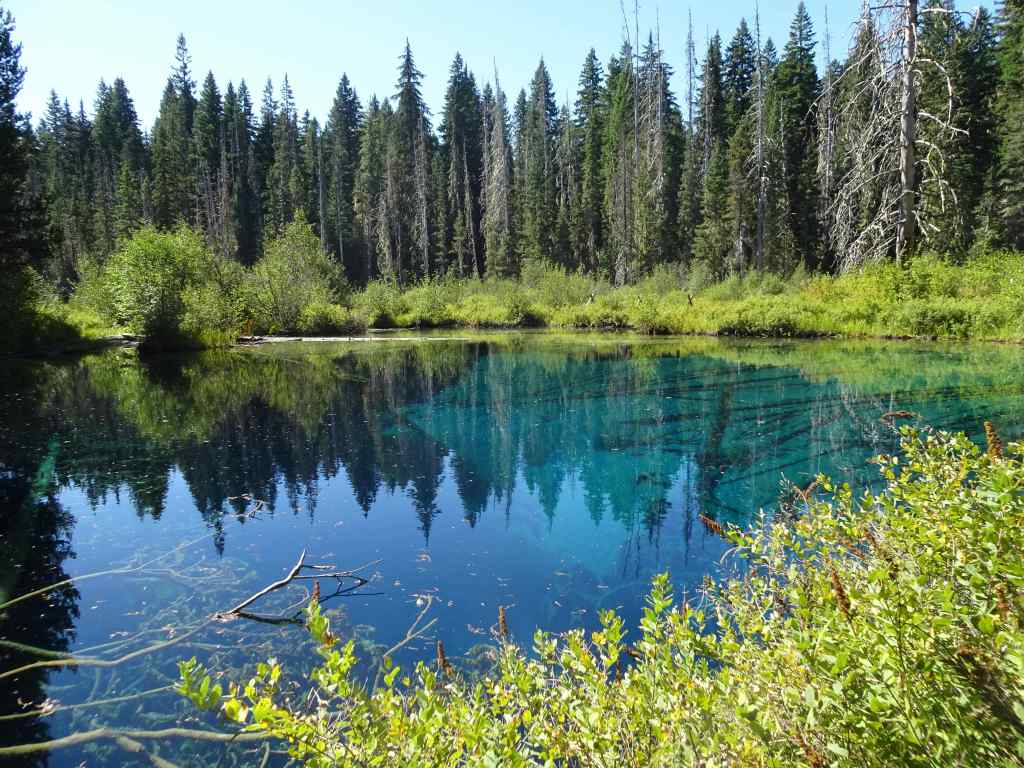
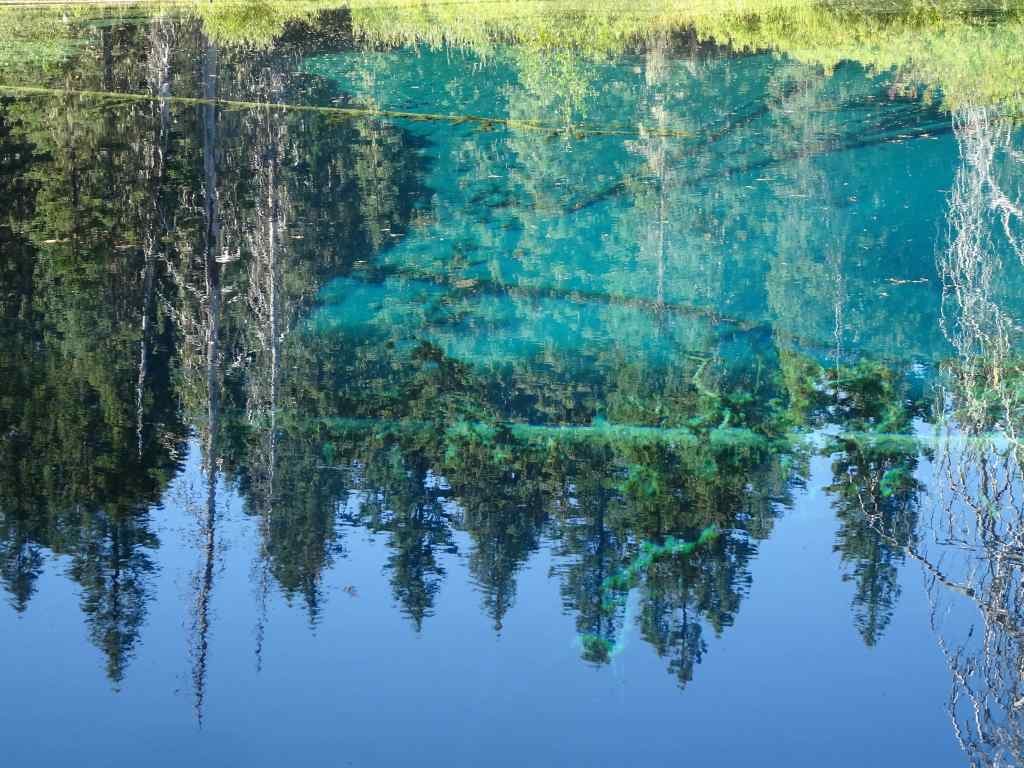
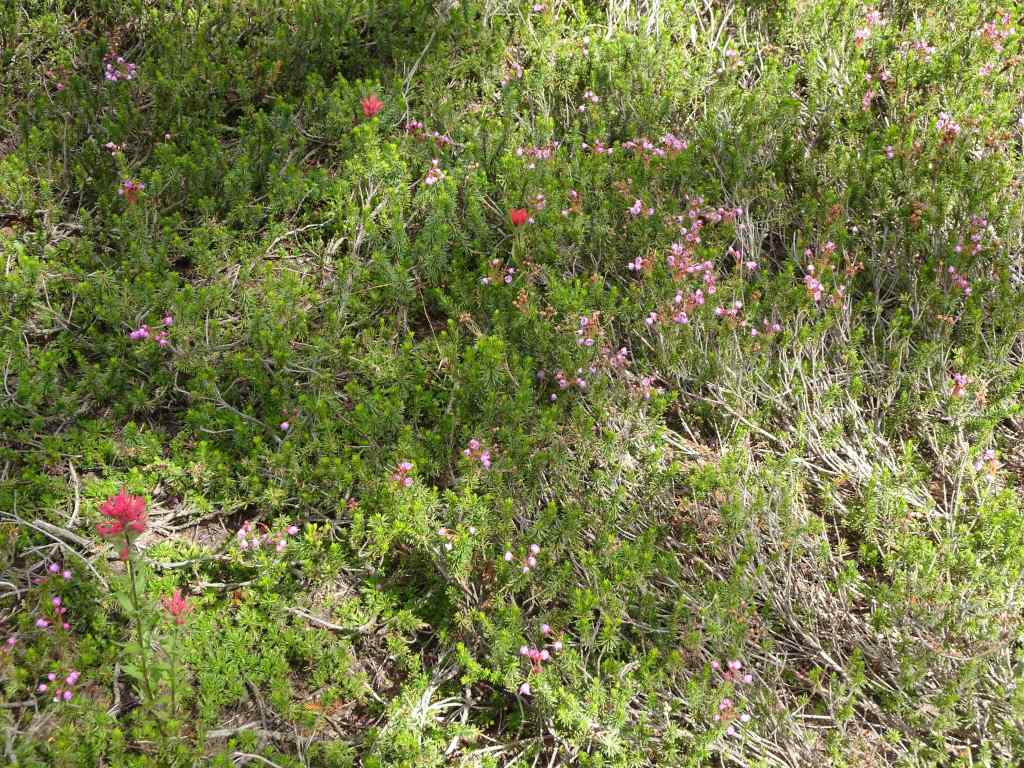
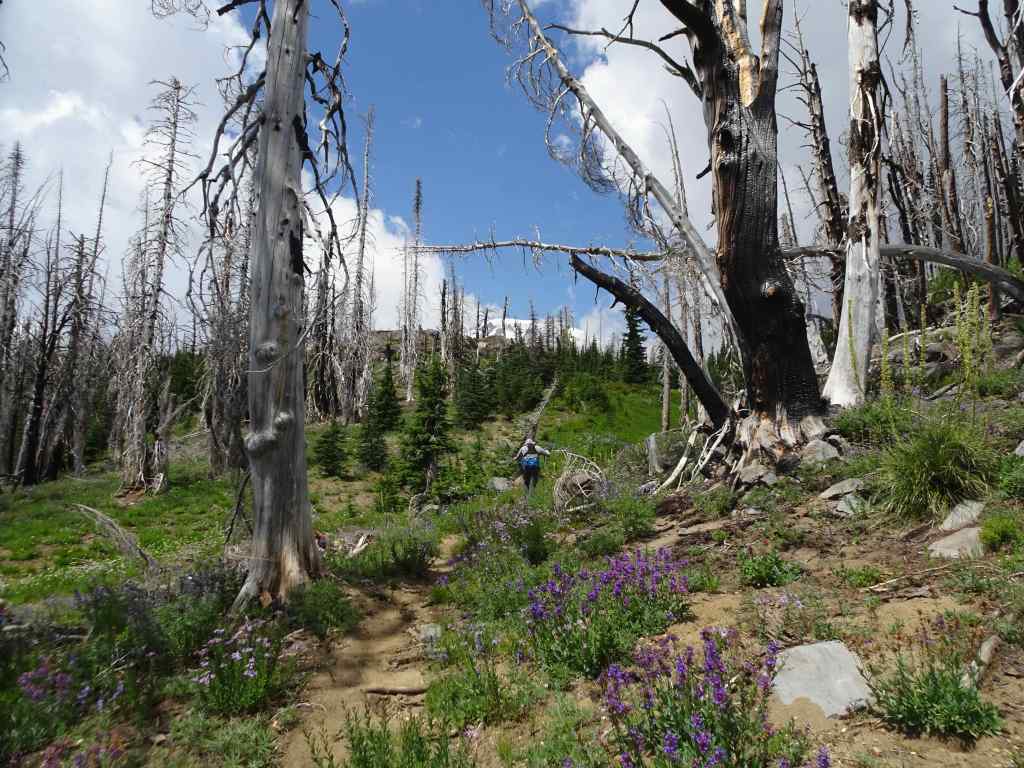
Bird Lake. Mountain not out, but pretty reflections in the lake.Partridgefoot and lupine on the lower trail.Asters under the burned trees.A frog in one of the stream crossings.Monkeyflower, lupine, lovageFireweed and false hellebore.Heather and magenta paintbrush.Bluff Lake
Next, continuing uphill to the Round the Mountain Trail:
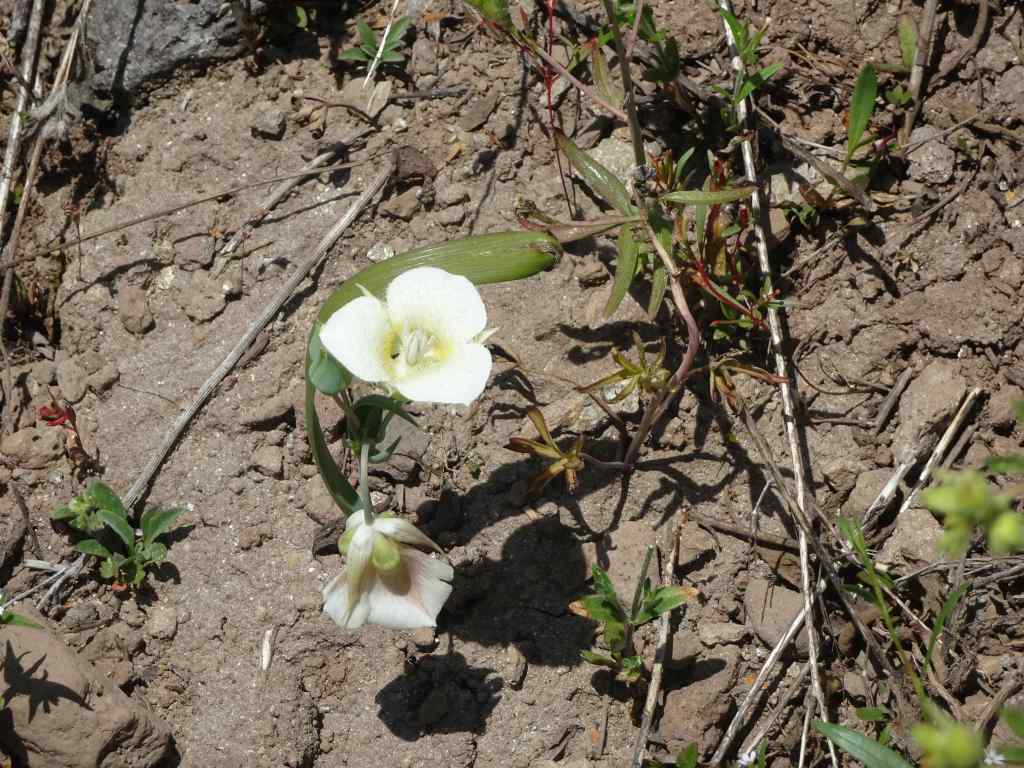
BuckwheatMagenta paintbrush, lovage and lupineSpireaMossy waterfallUp the cliffs, with mariposa liliesMore meadowsBrilliant bouquets all along the trail…Staircase Falls, just below the Round the Mountain Trail.
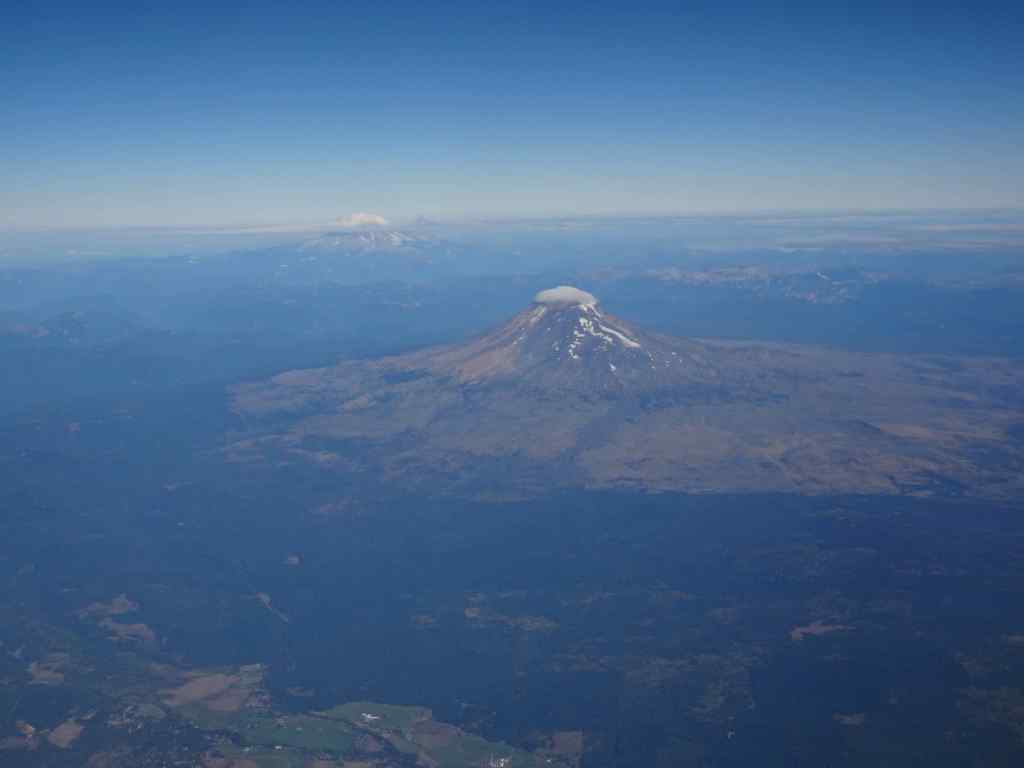
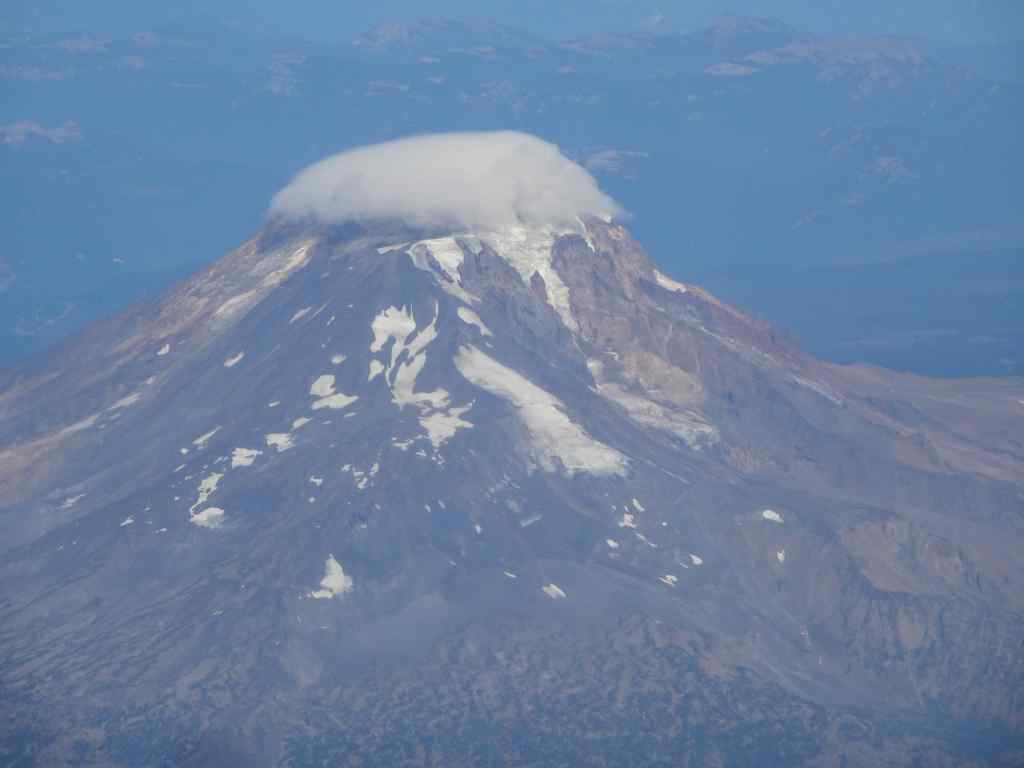
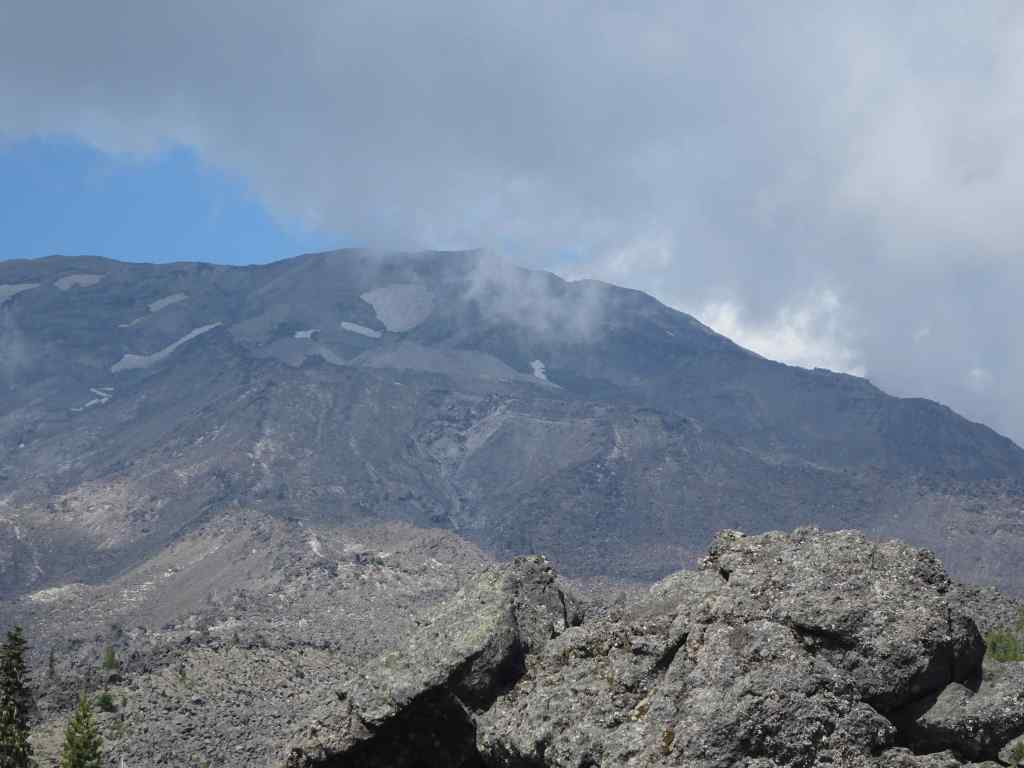
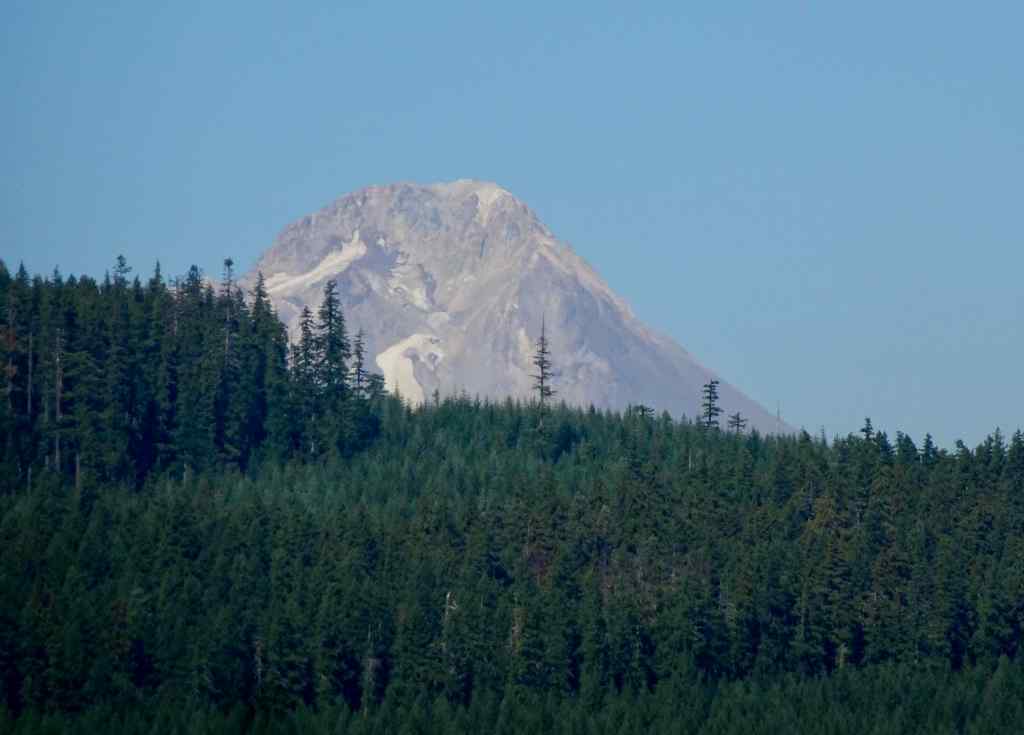
And continuing above the Round the Mountain Trail, on the Trail of Flowers, we finally had a glimpse of Mt Adams from under the clouds.
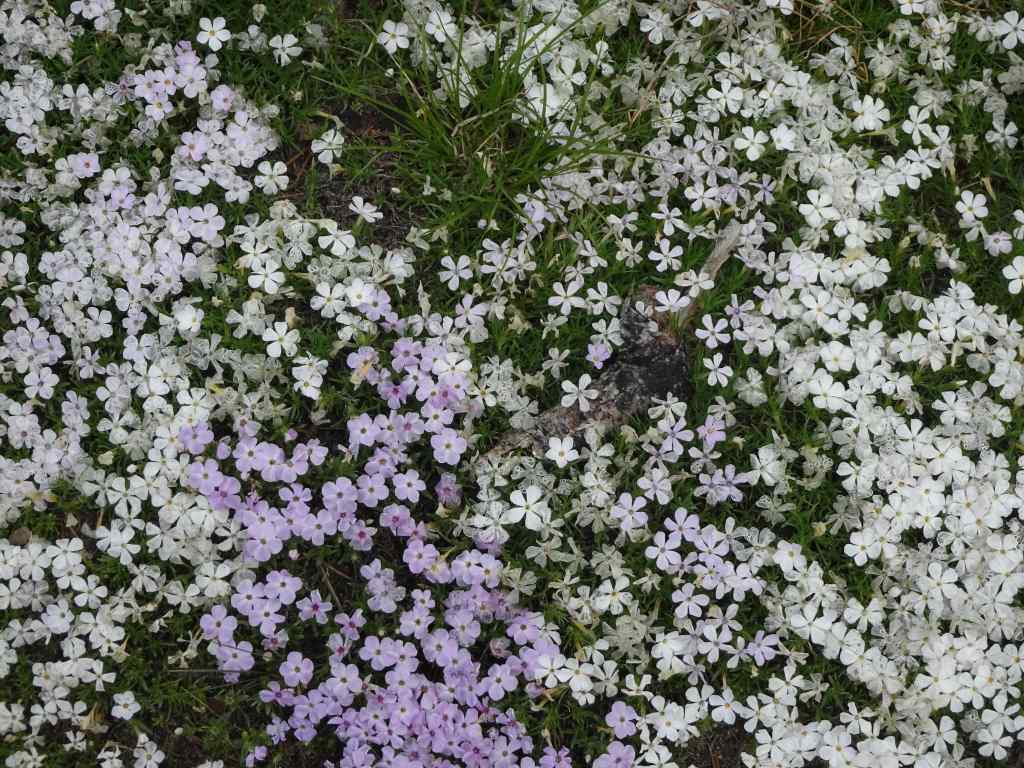
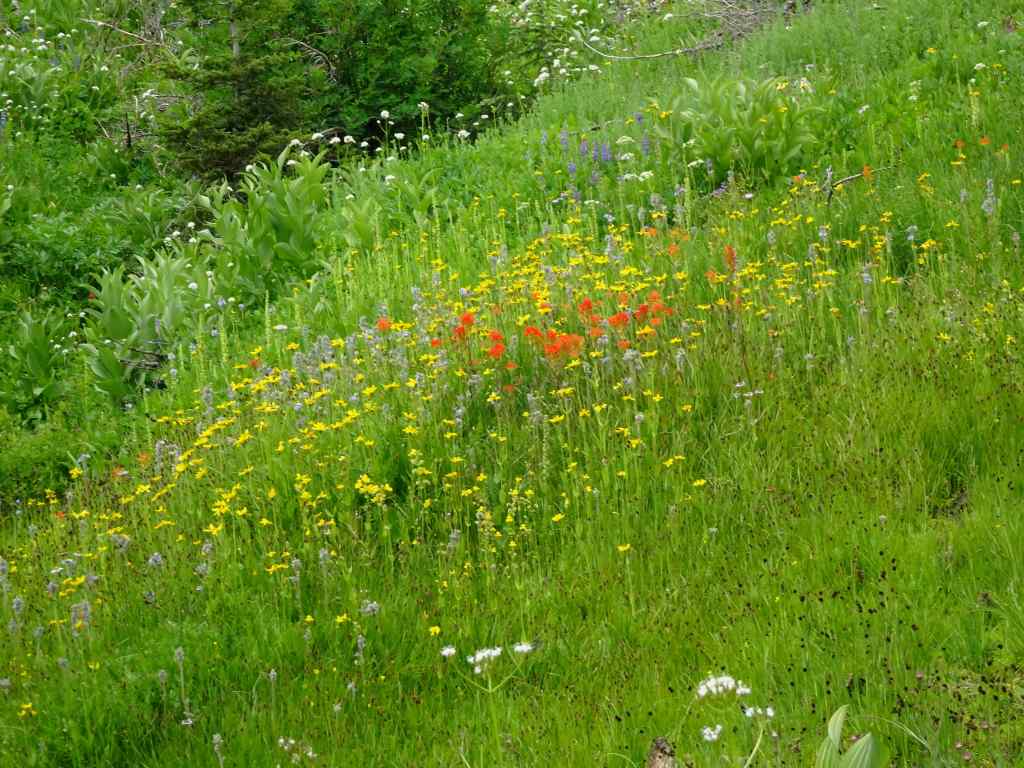
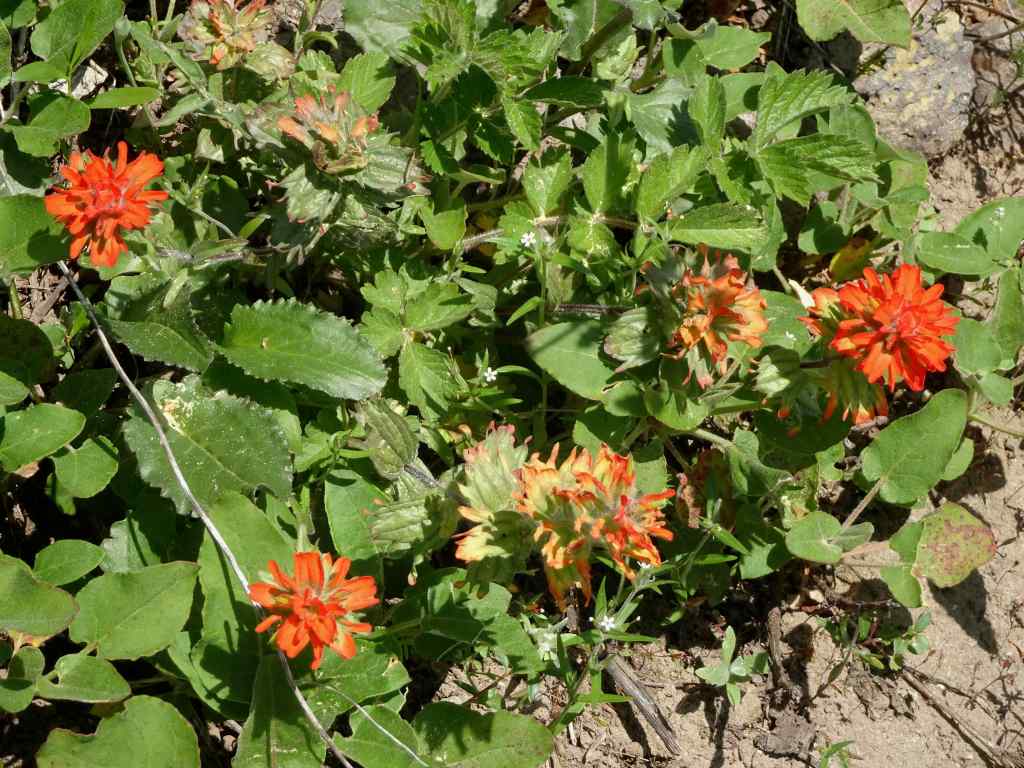
Mt Adams, with cloud cover.Closer viewBracted lousewort, with more magenta paintbrush and lupineA watchful treePhloxA brief view of the summit of Mt Adams.Orange paintbrush, yellow ‘daisies’ of some sort, and white sitka valerian.And another view of Mt Adams as we hiked up to the next rock ledge.
The ledge along the upper Trail of Flowers Loop provides a view to the landscape to the south.
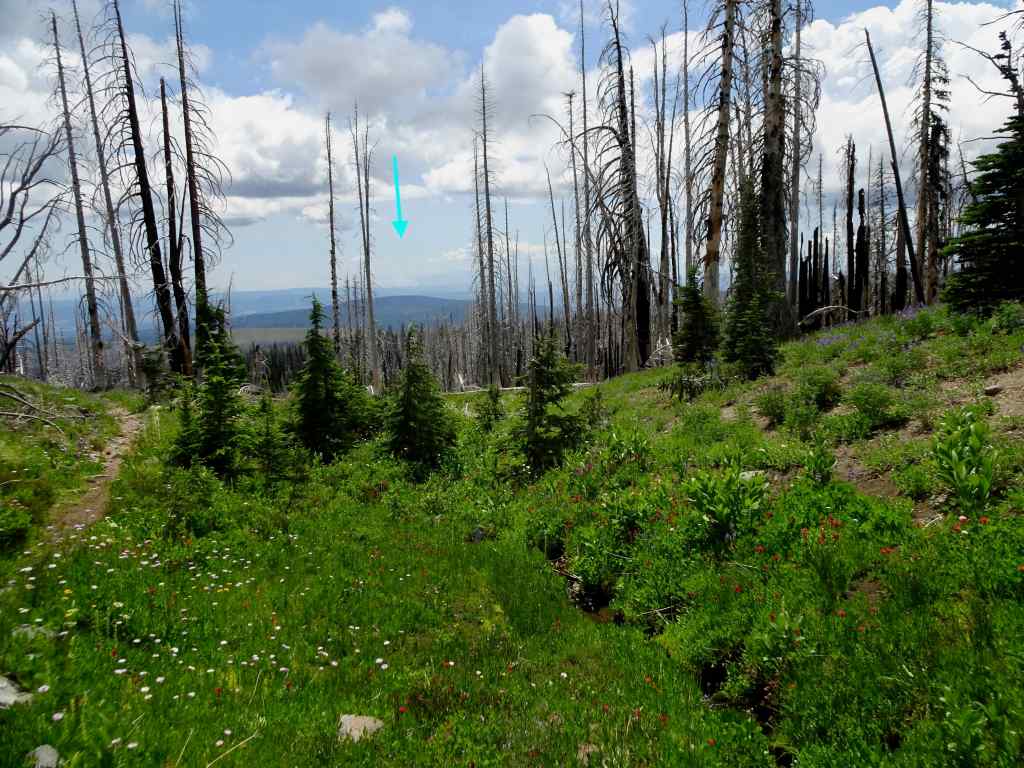
Looking south toward Oregon – blue arrow pointing to the smoke plume from the Burdoin Fire.Closer view of the Burdoin Fire smoke plume.And a wider view across the southern flanks of Mt Adams, and its ghostly forest, burned several times in the past twenty years.
We continued upward through more meadows to the Hellroaring Viewpoint…
Mt Adams on view from the upward trailSandwort and mariposa liliesHellroaring Viewpoint – top of the mountain back under the clouds.Mazama Glacier Hellroaring Falls
We retraced the trail back to the Trail of Flowers, then down to the Round the Mountain Trail, and continued westward through numerous meadows divided by small creeks that are all branches of Bird Creek.
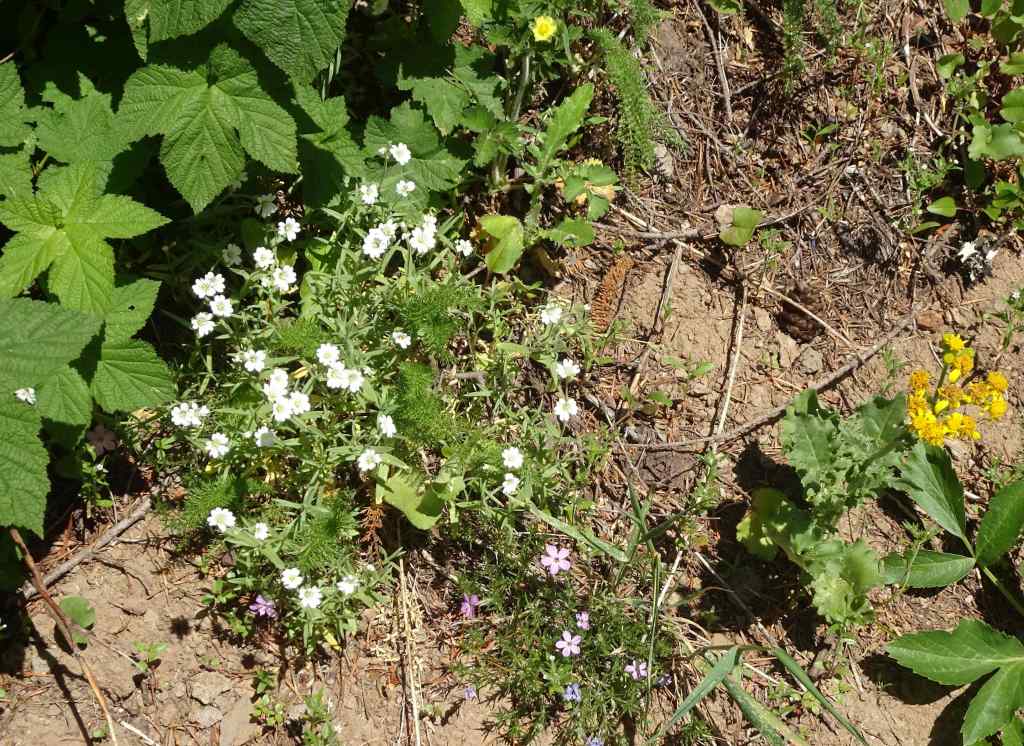
Every kind of flower in these meadowsEasy walking,Another brief glimpse of Mt AdamsAnd more meadowsAll the flowers!A pondAnd more meadows! Next we crossed a slight rise, and then descended to our start point, by going down the Crooked Creek drainage…More meadows on the downward trail…This slope along Crooked Creek was so colorful!More color!Approaching Crooked Creek FallsCrooked Creek Falls
The slopes below Crooked Creek Falls are heavily burned, but the creeks are still colorful with flowers…
Monkey flower, lupine, Sitka valerian, paintbrush
And back to Bird Lake…
Back to Bird Lake, partial view of Mt Adams this afternoon.Meanwhile, dark clouds formed a backdrop for these glowing ghost treesAnd a last view of Mt Adams from the gravel road down.
It was a “wildflower bathing” day on the slopes of Mount Adams!
I wrote most of this post in July, as this event unfolded.
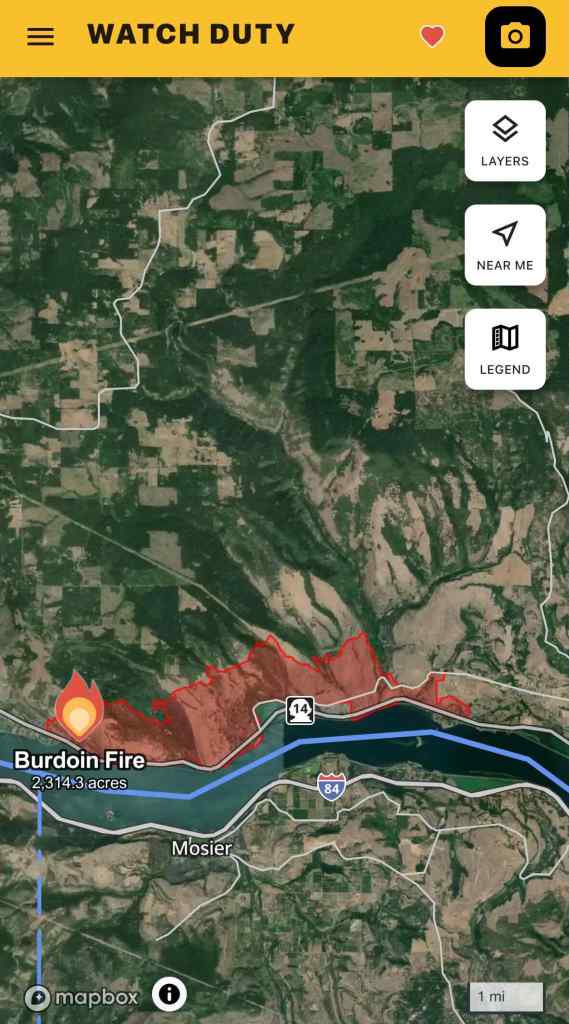
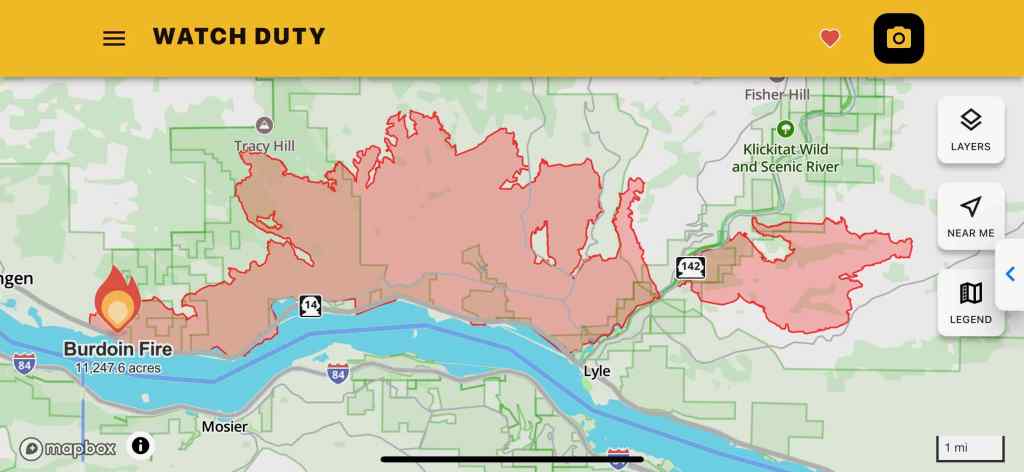
The Burdoin Mountain Fire started on Friday, July 18th, near Coyote Wall: a hot day, an east wind, and whoosh, by Sunday, July 20th, it had burned all the way east to the Klickitat River. In Portland, I followed news reports of evacuations of homes and families and communities; of firefighters on the ground and planes scooping water out of the Columbia River. I kept checking the map on the Watch Duty App – as the red line crept east, remembering all of the many hours we have spent in the fall, winter and spring, hiking the open grassy slopes and rocky cliffs above the river. Wildflowers and fall colors, all captured in my mind’s eye, and stored on my computer hard drive photo files…
July 19th fire boundary – Screenshot from the Watch Duty App.July 24th fire boundary. Screenshot from the Watch Duty App
The biggest concern is for the area residents and their homes. I was keeping my fingers crossed for my favorite trees, too. I hoped the speed of the fire as it traveled through the grass would cause the conflagration to bypass some of the trees:
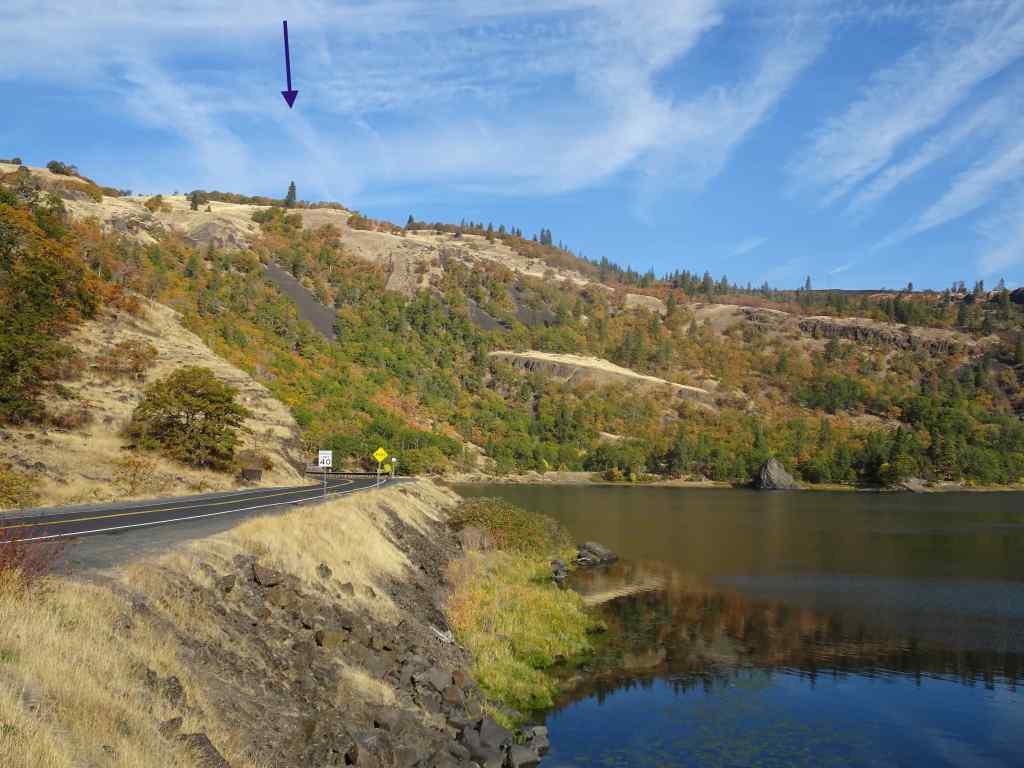
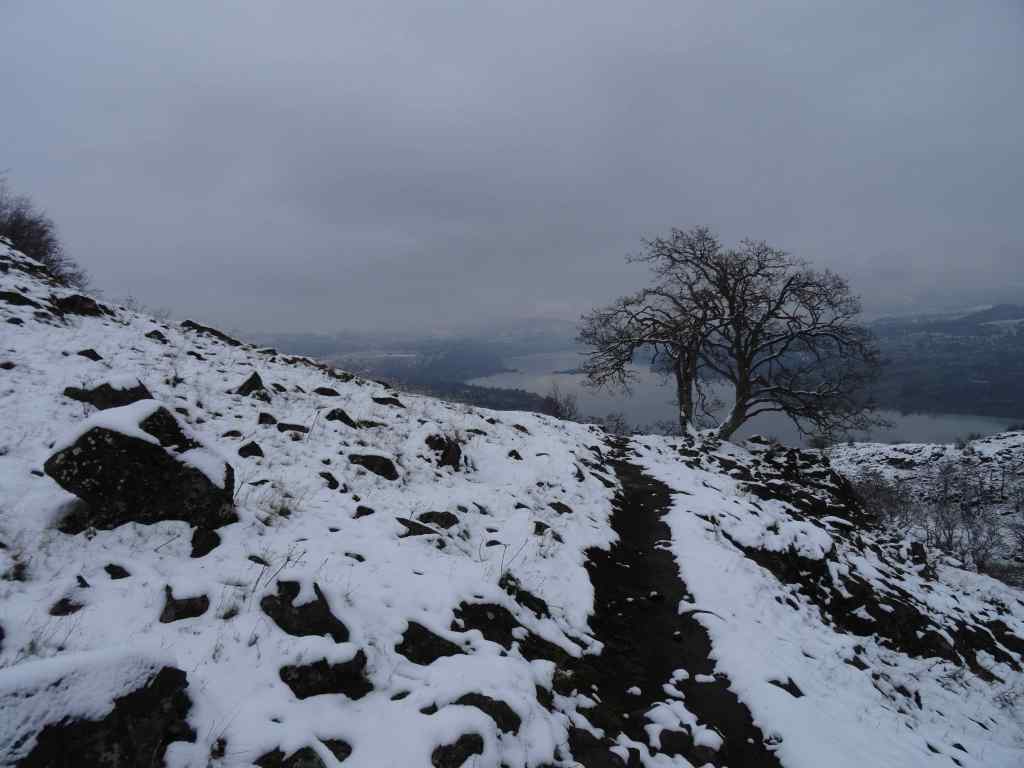
The guide tree above Rowland Lake – a tall ponderosa pine near the spot where we often have lunch when hiking the Labyrinth – it overlooks many of the trails here in its high perch – will it still be there?
Arrow pointing to the guide tree – from near the Labyrinth trailhead above Rowland Lake, October 24, 2024.Guide ponderosa as seen from Rowland Wall, April 20, 2018.Guide ponderosa from the west as we hike toward our lunch stop and turnaround point, December 16, 2017.Lunch stop near the ponderosa, with all the eastern gorge on view, October 17, 2023.
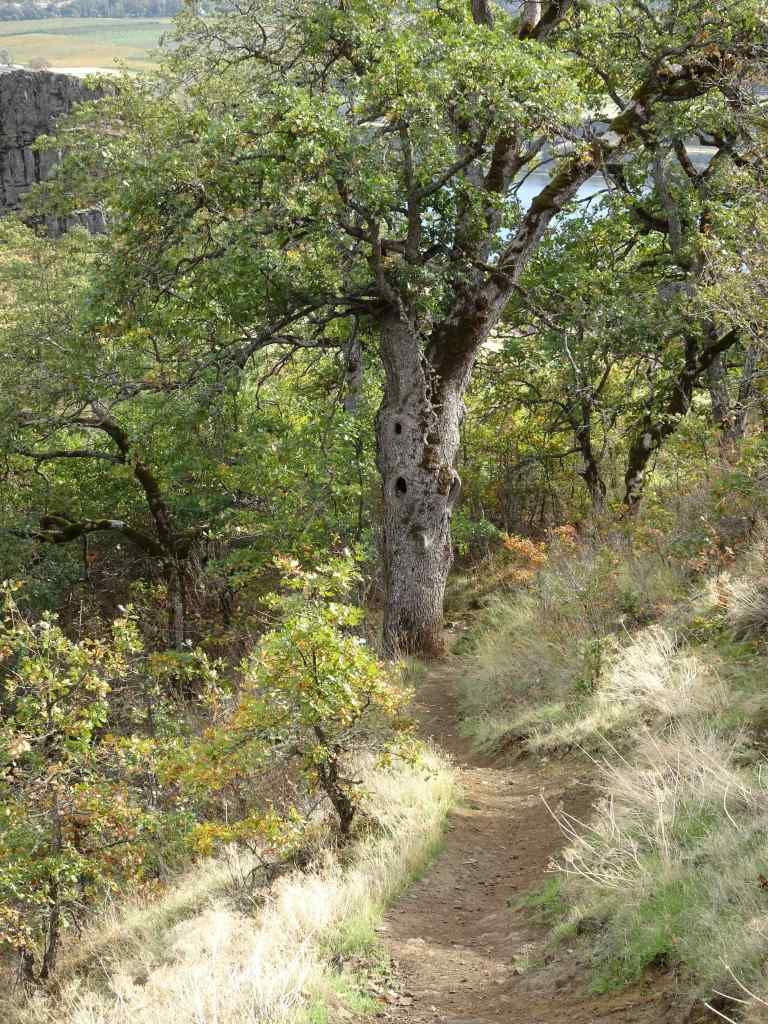
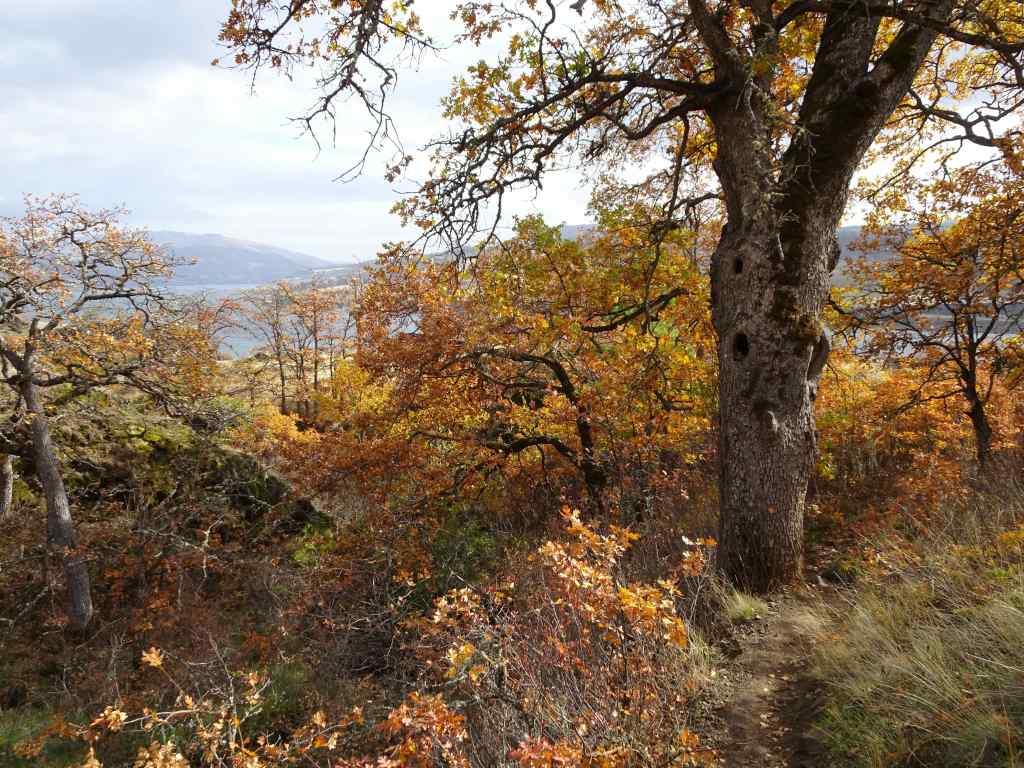
Also along the Labyrinth Trail, my favorite oak grove:
Labyrinth oak grove in the spring, May 17, 2025.Labyrinth oak grove in the fall, October 27, 2021.
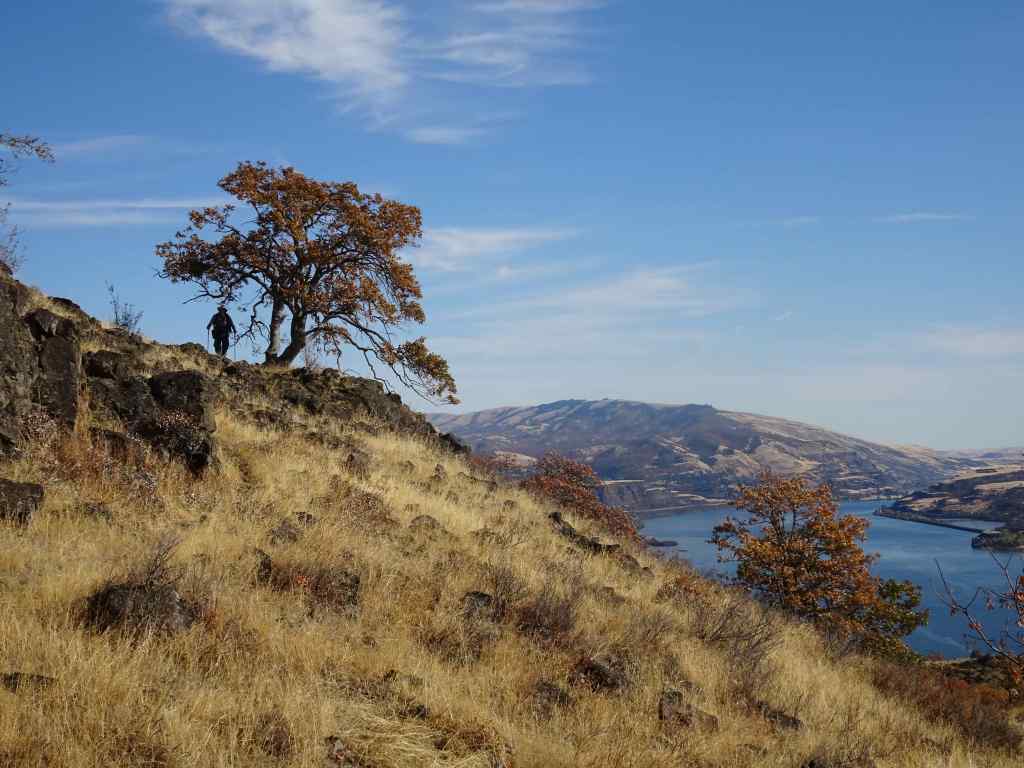
The solitary oak tree that perches on the cliff edge is always photogenic, as seen going uphill, to the east:
April 18, 2018October 24, 2024December 3, 2016December 28, 2015
And downhill, to the west:
October 17, 2023, with Mt Hood beyond.
On the way down, I always say goodbye to the one-eyed oak sentinel on the lower trail:
October 17, 2023October 27, 2021
I have been browsing my photo library, and there are so many other beautiful trees there. As the red fire boundary moved farther east on the map, to the Catherine Creek slopes, I thought of the many ponderosa pines, and the small oak groves, including those guarding the fairy ponds:
March 3, 2025
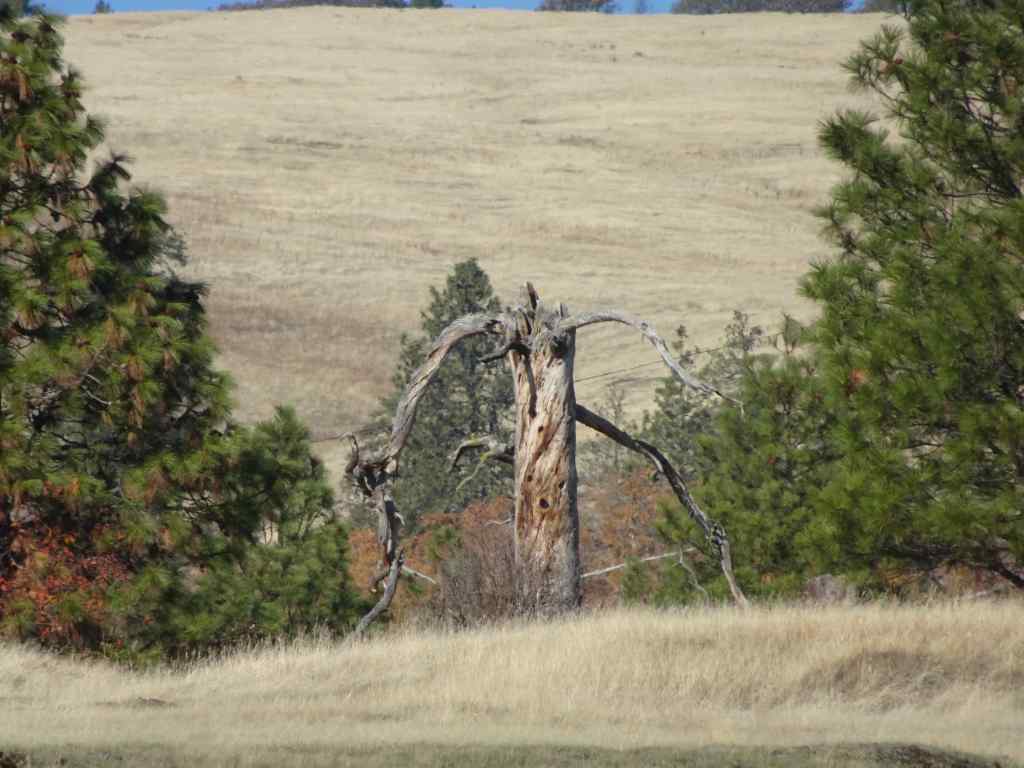
Even farther east, there is my ‘ent’, a snag guarding the eastern slope where there is always so much birdsong in spring, and so many flowers!
November 7, 2024‘Ent’ snag
Next I see fire has made its way all the way east to the Balfour-Klickitat Reserve where we go to see the juvenile bald eagles practicing flight in the small lagoon off of the mouth of the Klickitat River every winter…
January 17, 2023December 28, 2015
We are in the Schroedinger phase…that is, all I know is the fire outline on the map, that keeps spreading eastward. I don’t know what has burned and what has survived.
Part 2 – Preliminary outcome report
As of this writing (late July), the fire is contained, evacuations lifted. Tragically, 19 homes were destroyed and 47 were damaged. No lives were lost. Local people have reported that the burned area was patchy in nature. Many trees were spared. The local residents have a difficult path ahead. Land managers will be monitoring the trail situation. We don’t usually hike here in summer. When the weather turns to cooler temperatures, I hope to find myself on these trails again, to visit my trees and report back.
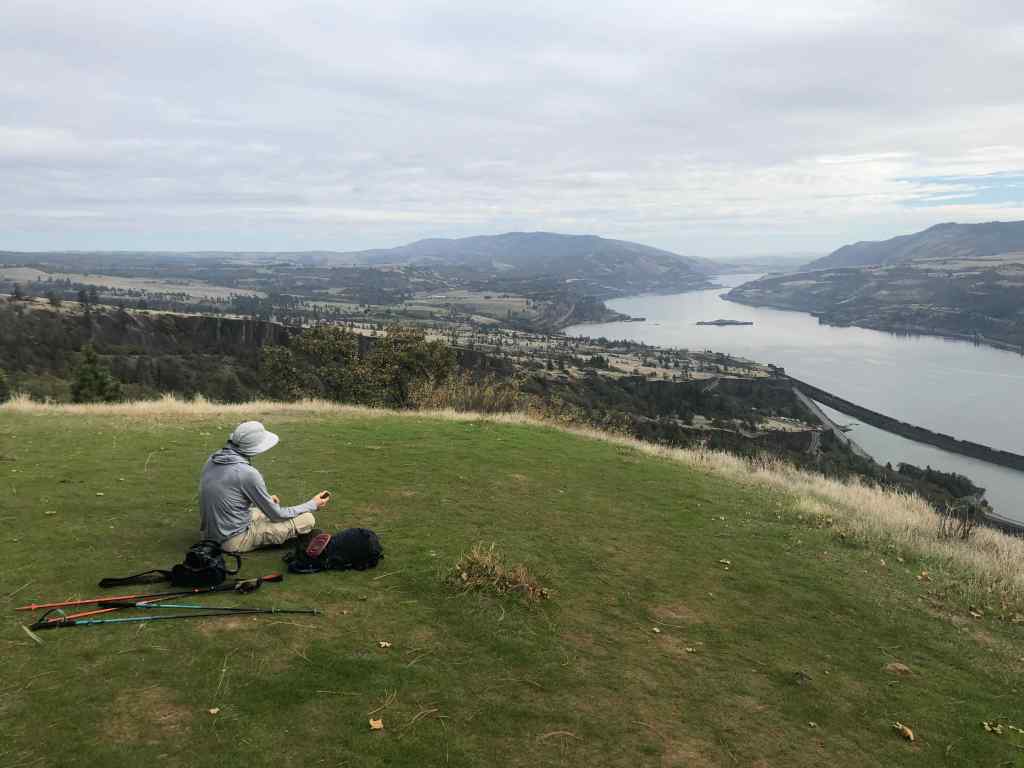
View north toward the Burdoin Fire area from the Mosier Plateau, April 21, 2025, taken before the fire. All of this area north of the Columbia River is in the burn zone, from Coyote Wall, on the west, past the Catherine Creek slopes on the eastern edge, and farther east, all the way to the Klickitat River. The arrow points to my guide ponderosa, on the slope above the Labyrinth.
Of our five hikes in July, three were on or near Mt Hood.
7/3 – Picnic Rock and Umbrella Falls
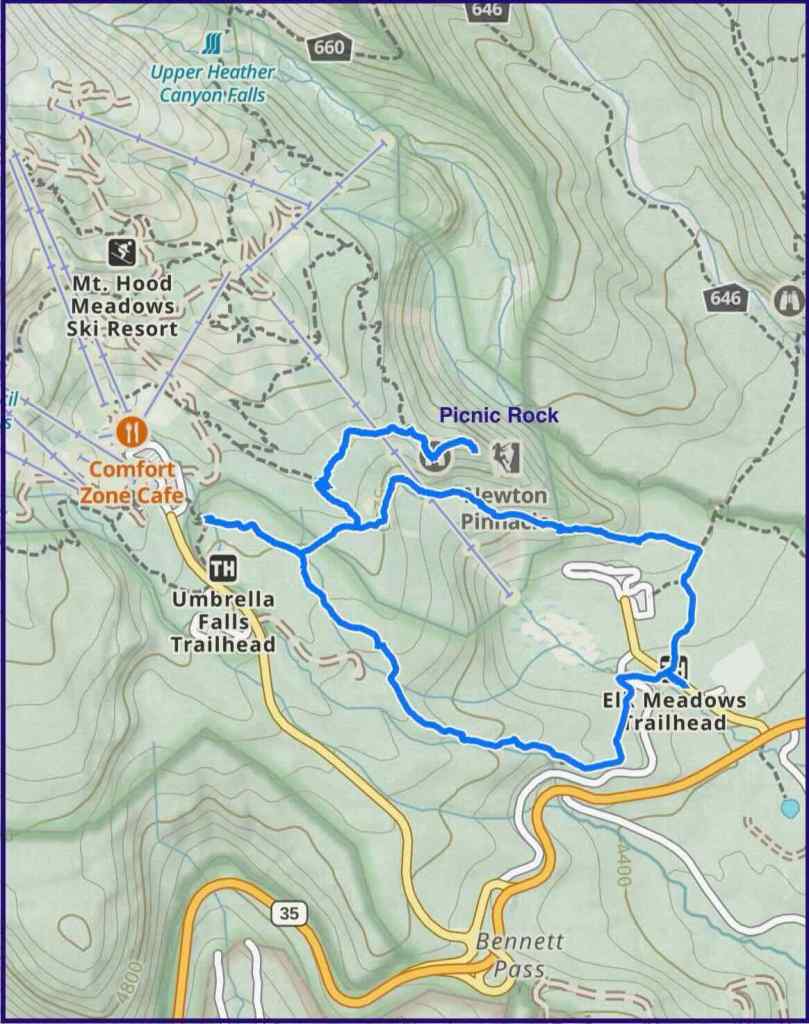
This hike begins at the Elk Meadows trailhead. We walked uphill along flower-filled ski runs of Mt Hood Meadows, and across to the knob called Picnic Rock. We visited Umbrella Falls, then circled downhill through flower-filled forest to complete the loop.
Trail map, about 6 miles, 1000 feet elevation.
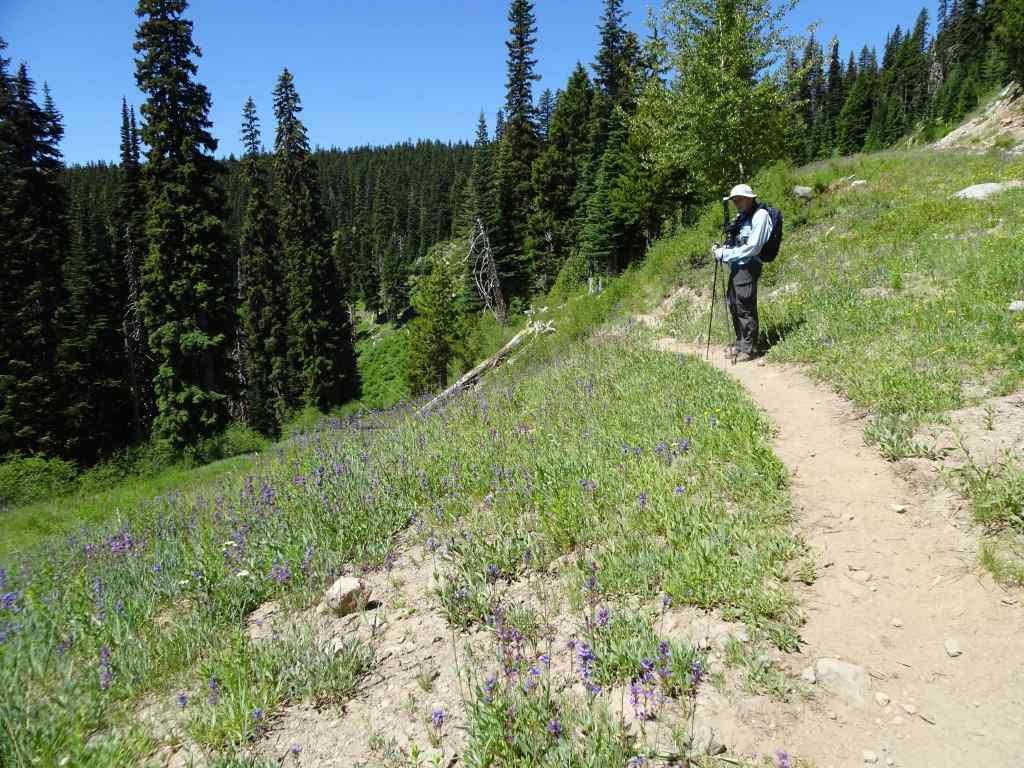
Flowers along the uphill trail…
Uphill meadows – penstemon and lupineWashington liliesBead lilies and Solomon sealLupine and tiger liliesMarsh marigoldTrillium and violetsPaintbrush and Elephant’s head
This was a blooming bear grass year in the ski run slopes, with a view of Mt Hood
Bear grass, Mt HoodMt Hood close up.
At Picnic Rock we had great views…
Ascending Picnic Rock – Mt Jefferson off to the right.Closer look at Mt Jefferson and more Cascade Peaks to the south.Looking east toward Bluegrass Ridge (burned in 2006), above Elk Meadows.West toward Mt Hood and Clark Creek.Clark Creek.Stonecrop on Picnic Rock.Penstemon clinging to the face of Picnic Rock.
We passed back through the bear grass meadows on our way to Umbrella Falls.
Bear grass meadows and Mt Hood.Umbrella Falls
On the downhill trail, we passed through meadows full of sitka valerian, and swampy areas full of shooting stars and buttercups. Once in the forest, the Oregon anemones were sparkling up in abundance.
This was only my second time doing this hike, but it has become a favorite! Especially at this particular time in the bloom season. I hope to be back to explore some of the other trails in the Mt Hood Meadows area.
7/10 – Lookout Mountain
The next week, we hiked the short, sweet (3 miles, 550 feet) loop to Lookout Mountain from High Prairie trailhead. We have done this one many times, and it never gets old! The lower part of the trail crosses a couple of large meadows.
Shooting stars, buttercups and bistort at the High Prairie Trailhead.Subalpine fleabaneElephant’s head, buttercups and astersAnd a view to Mt Adams.
Eventually, we ascended to the ridge where views opened up…
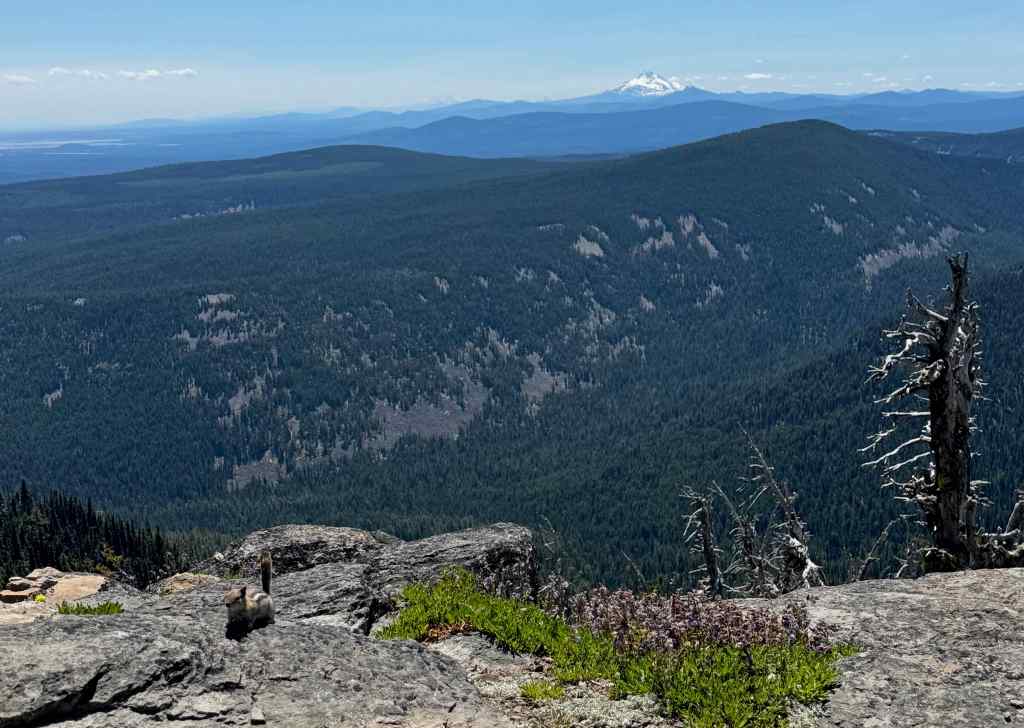
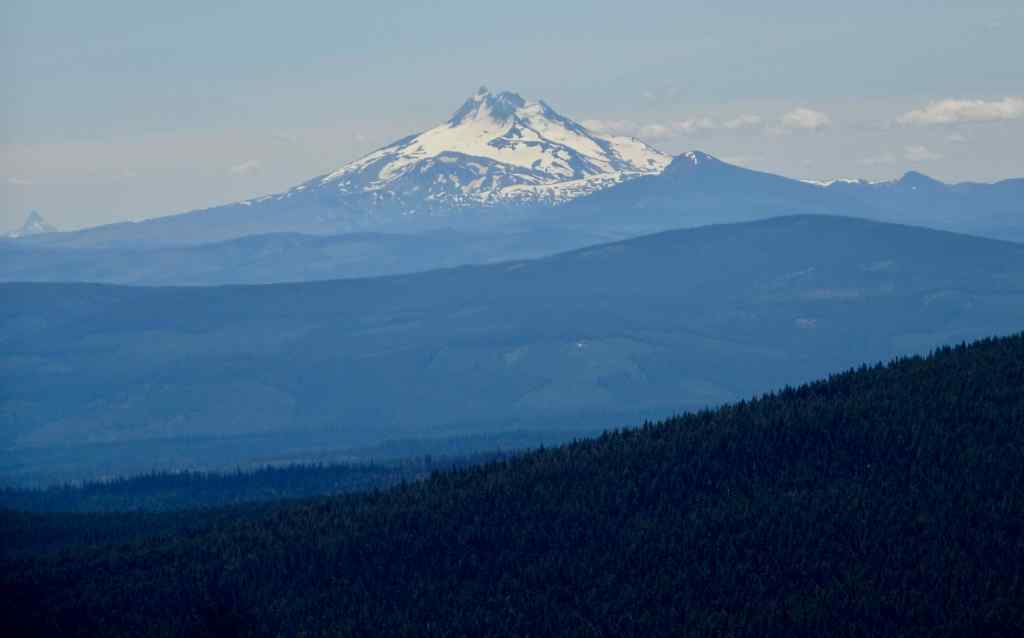
Mt Hood ahead, with paintbrush, scarlet gillia, and lupine.Full view of the mountainClose up of the southern flank, where we were hiking last week near Mt Hood Meadows.The summitCooper Spur, and the Eliot Glacier, near where we will hike at the end of the month.A last snow bank on the approach trail.Mt Hood from the top of Lookout Mountain.Mt Jefferson and the other Cascade Mountains to the south, with ground squirrel.Mt Jefferson and Mt Washington
Lots of wildflowers to look at here, as well…
The summit slope has tufts of wildflowers.Sulphurous buckwheat, transitioning from red-orange to yellow.Penstemon and buckwheatDusty maidenAnd a rock wren
More views on the return trail…
The iconic volcanic spire, with Mt Hood beyond,And back through the lower meadows.
The main challenge for this hike is the slow bumpy road up to the 6000 foot trailhead.
7/10 – Cloud Cap Shelter and Timberline Trail High Point via the East Eliot Moraine.
This long favorite hike also begins with a long bumpy drive up gravel switchbacks, and through a burned ghost forest. From the Cloud Cap Saddle Campground we hiked about up along the crest of the East Eliot Moraine to the Cloud Cap Shelter for lunch. Then we continued south along the Timberline Trail, the high point, about 7300′, for a total of about 5 miles, 1500 feet.
From the crest of East Eliot Moraine, our trail goes up hill toward the Eliot Glacier.Eliot Glacier Glacier close upCrevasses
We crossed south toward the Cloud Cap Shelter for our lunch break.
Approaching the Cloud Cap Shelter.Lunch view of Mt St Helens through the haze.Also, Mt Adams to the north, beyond the Hood River Valley; and Cloud Cap Inn, near our trailhead, on lower near right.Cloud Cap Shelter; Cooper Spur and Mt Hood beyond.
After enjoying a good rest rest in the shade at the shelter, as it was a hot day, and I was having trouble with the uphillness of it all, we decided to continue on to the trail high point.
We crossed a few snow banks in the shaded wrinkles of the mountain.Timberline Trail High Point.
Then we retraced our steps, back along the seemingly barren slopes, with lots of subalpine flowers blooming amid the rocks.
Our trail carved out of the edge of the sky.Tufts of yarrow and buckwheat on the slopes.Yarrow and lupineA last look back at the snow banksPussypawsPenstemon and astersPartridgefoot and Mt Hood.
As we walked the Timberline Trail beneath the Eliot Moraine, I spotted the giant teetering boulder that I have noticed in previous years. It’s still there…
Teetering boulder on the edge of the Eliot MoraineTeetering boulderLewis monkey flowers, asters, and lupine in Tilly Jane Creek, almost back to the trailhead.
Another enjoyable day on Mt Hood. I was really out of shape this year – life circumstances have interrupted my spring hike season. This hike, which I have done easily before, was hard! I hope I will be in better shape for the next time!
Next..
Our other July hikes were on Mt Adams, and at the Oregon Coast – to be reported in the next posts.
Having been out of town for two weeks in southern Utah where it was too hot to walk outside or exercise, and I was otherwise engaged in helping a family member with a health care situation; Having returned, exhausted, and happy to be in my own home quietly for a couple of days; Having successfully taken a couple of slow neighborhood walks in the flatlands…
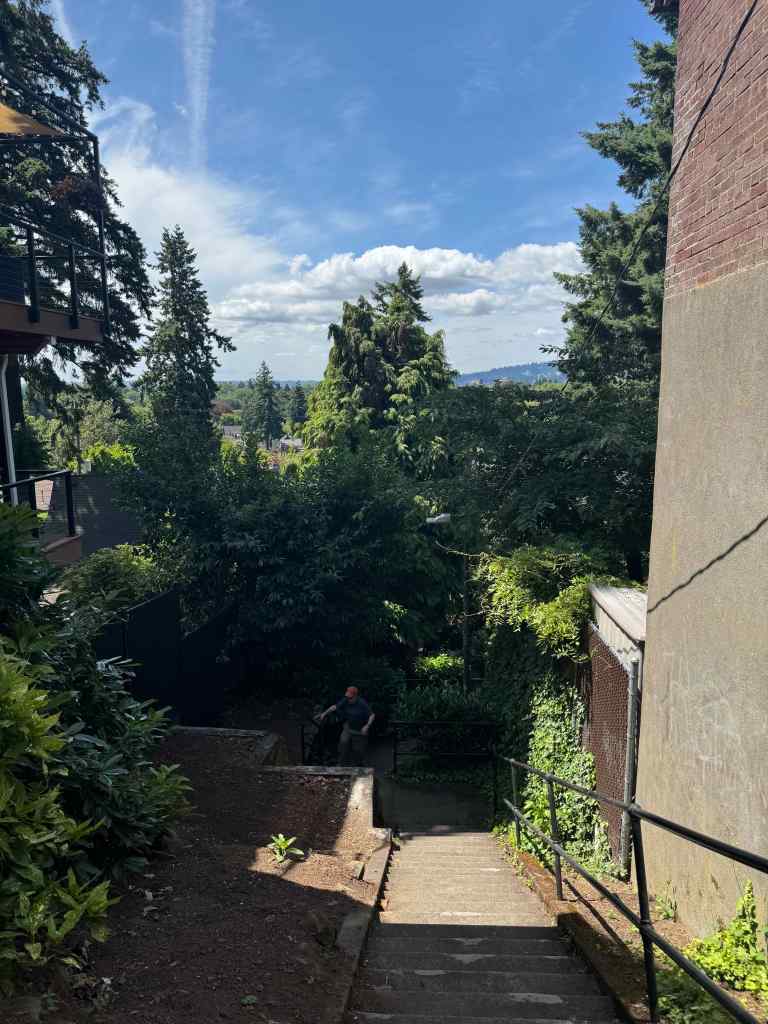
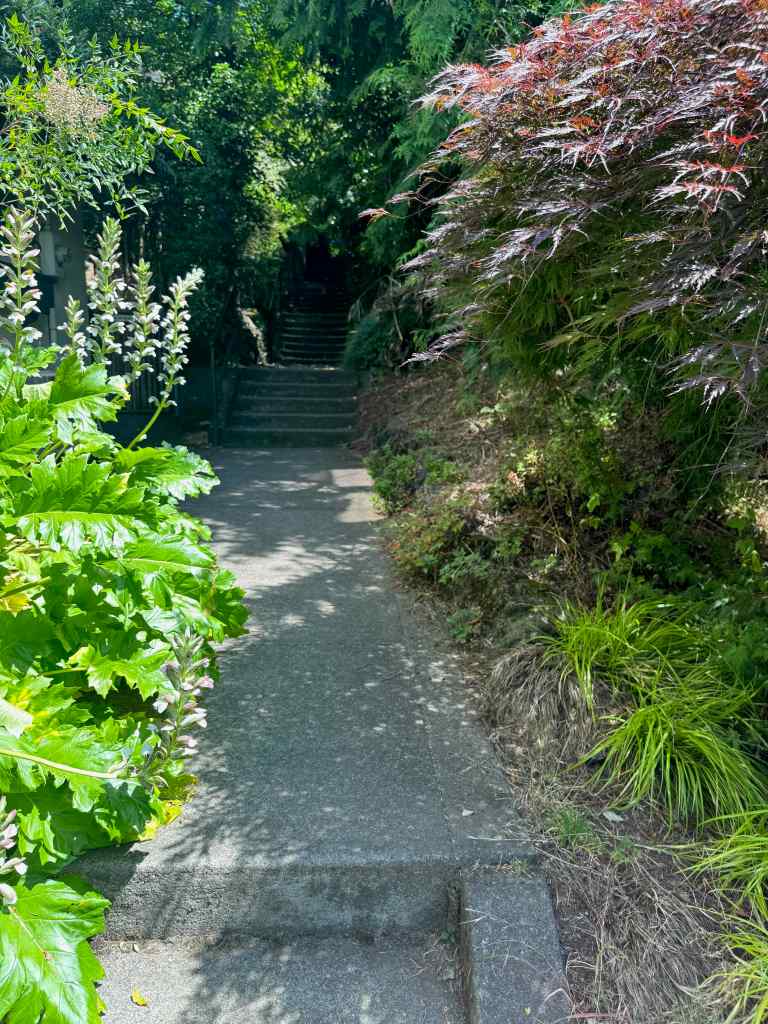
Today I felt I had the energy to walk up to Alameda Ridge and do a few stair repeats. Success! And once again, I am charmed by my neighborhood where I am so lucky to live. Front yards are in bloom and colorful; and today it is only in the mid60s; how lovely to be able to walk outside without being dried and desiccated by the sun. I lived seven years in Tucson, I know dry heat; I knew my survival strategies then. The two weeks of abrupt immersion in the heat and aridity in Utah were exhausting; but now I am recovering. Soon I will be walking in mountains again.
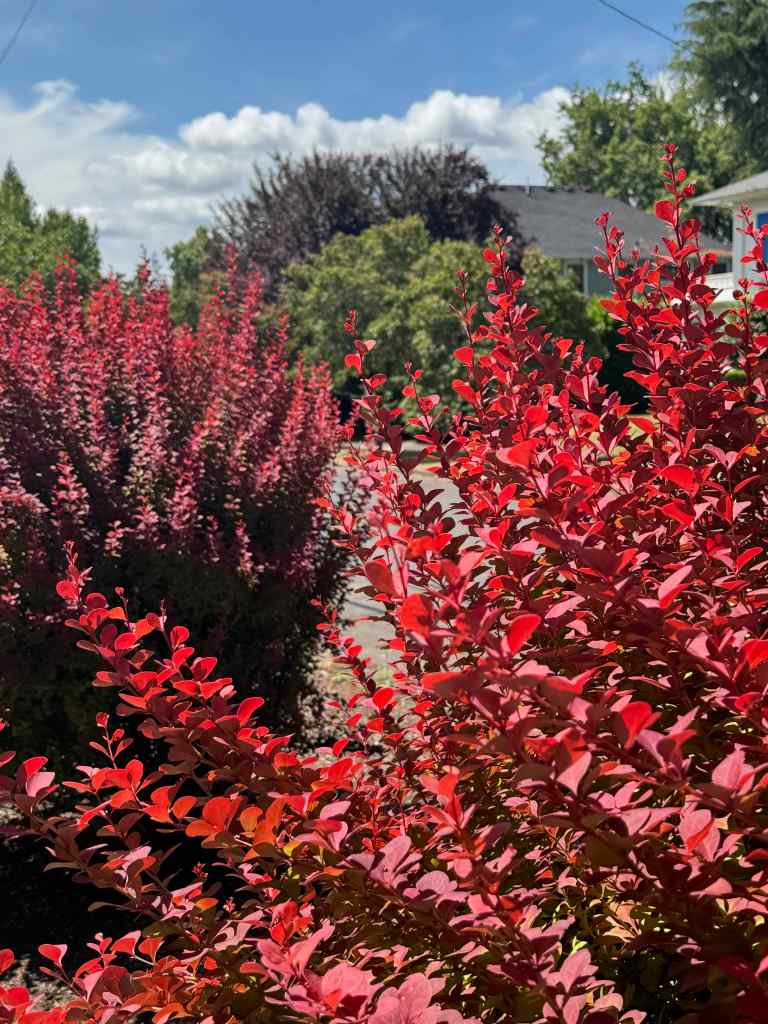
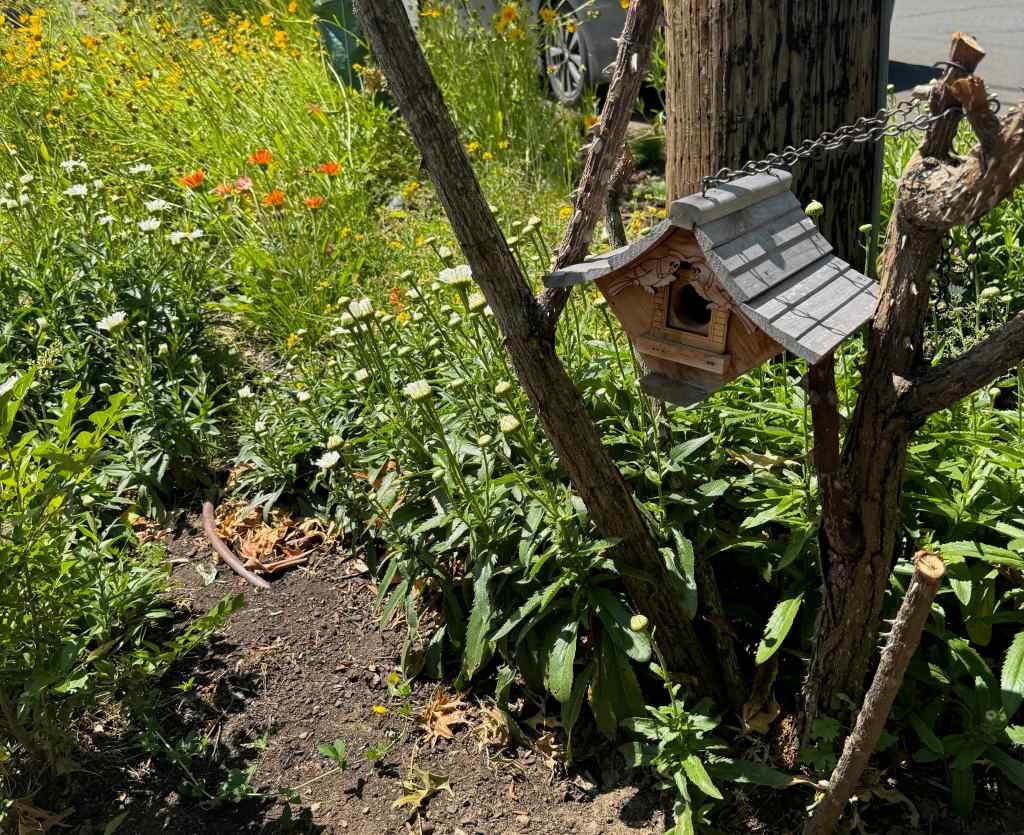
Today I walked my way up the hill, and noticed all the whimsy throughout my neighborhood. It is part of the keep Portland weird vibe. Little doors on trees, little houses under bushes, interesting little signs painted on the sidewalk stair cases of Alameda. Little free libraries throughout my neighborhood.
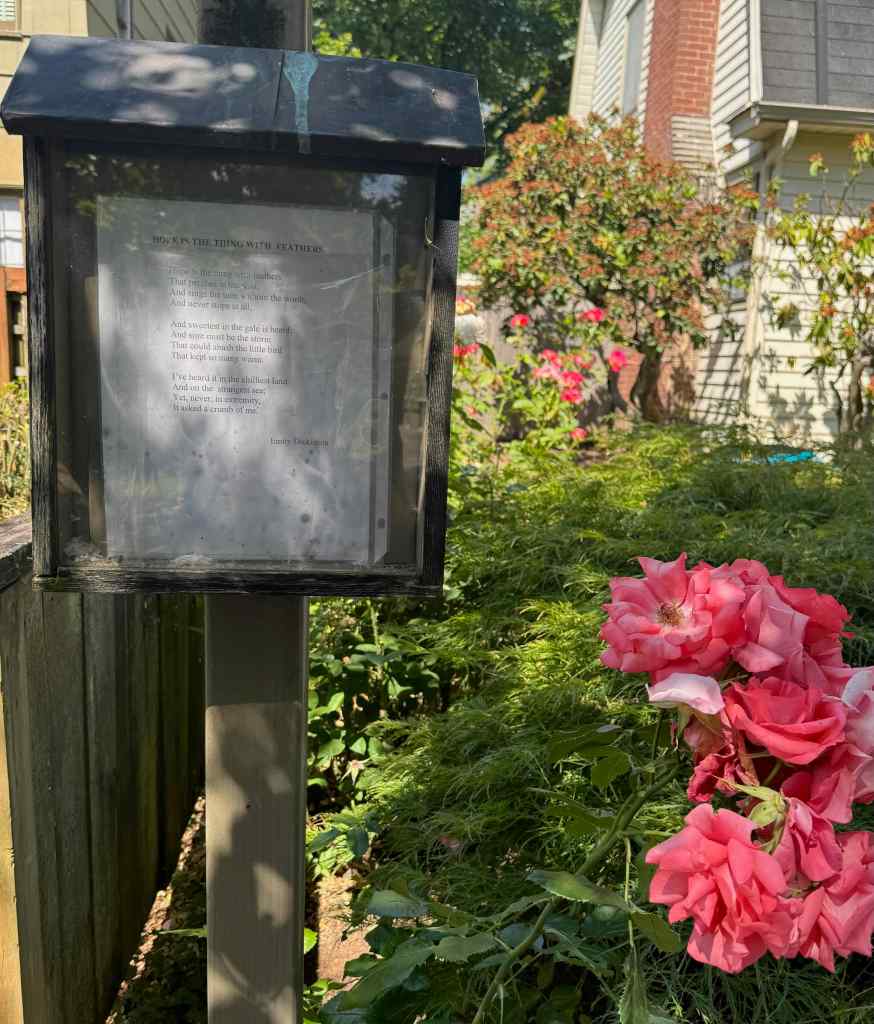
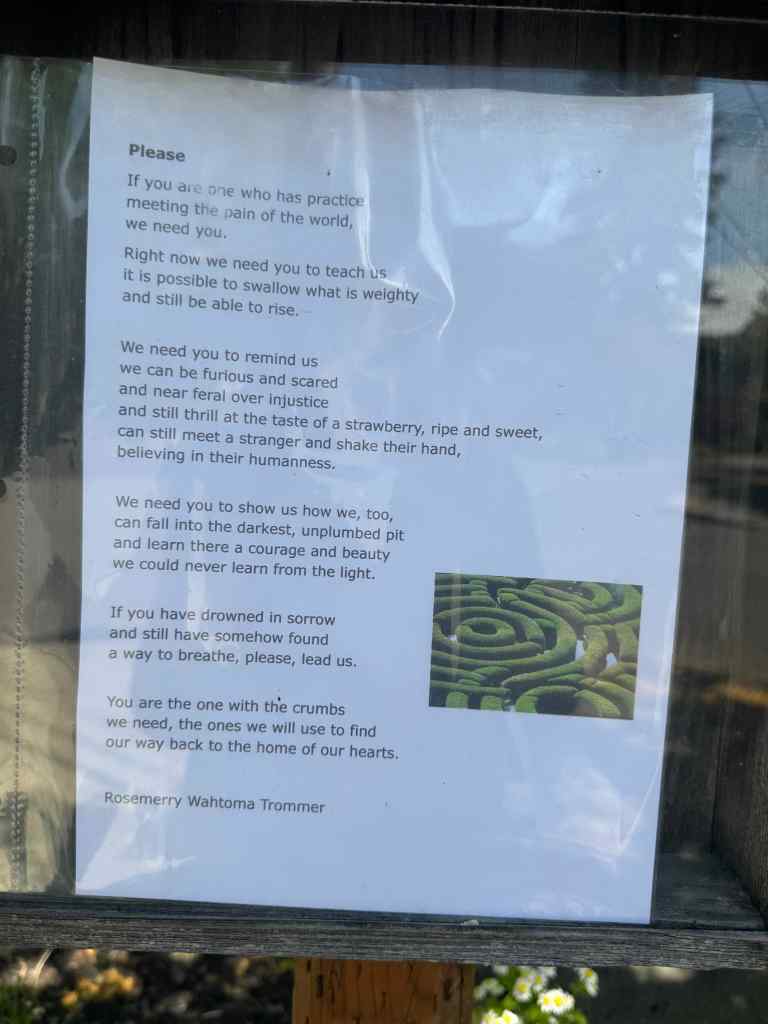
I also looked at each poetry post – today there was Emily Dickinson‘s, ‘Hope is a thing with feathers’, on one signpost. My favorite poetry post, the one I never miss if I am up in that neighborhood, had a very hopeful, expressive poem today for these terrible times we are living in, with the authoritarian effort to crush anything progressive, kind, diverse, multicultural, and human in our country.
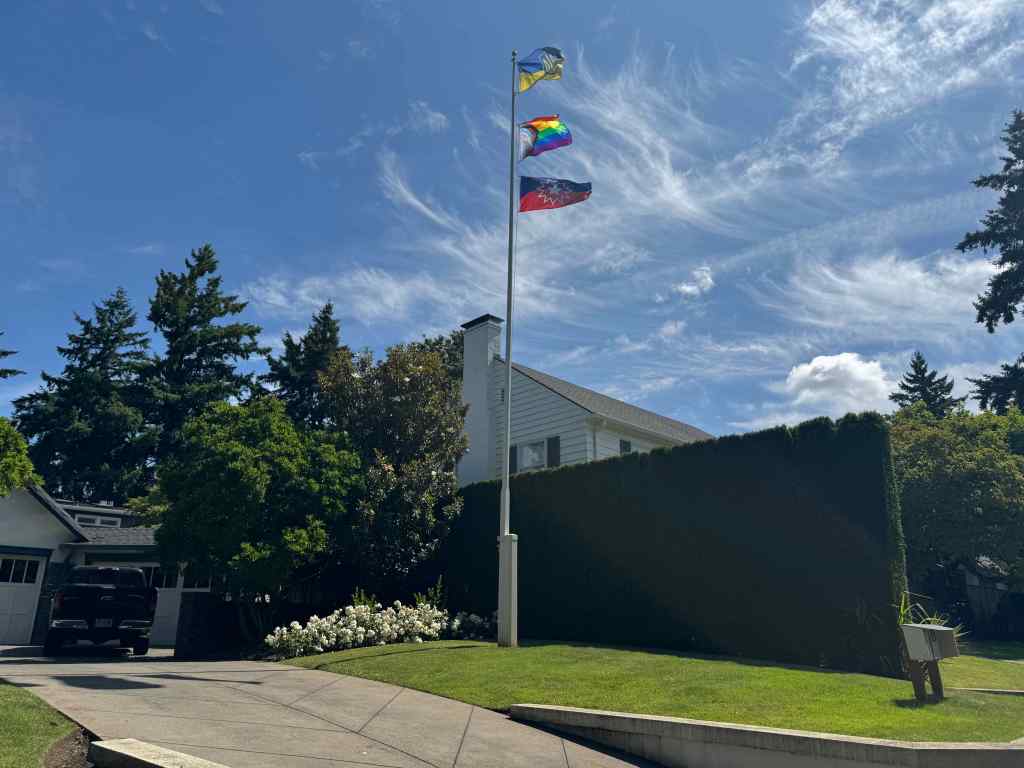
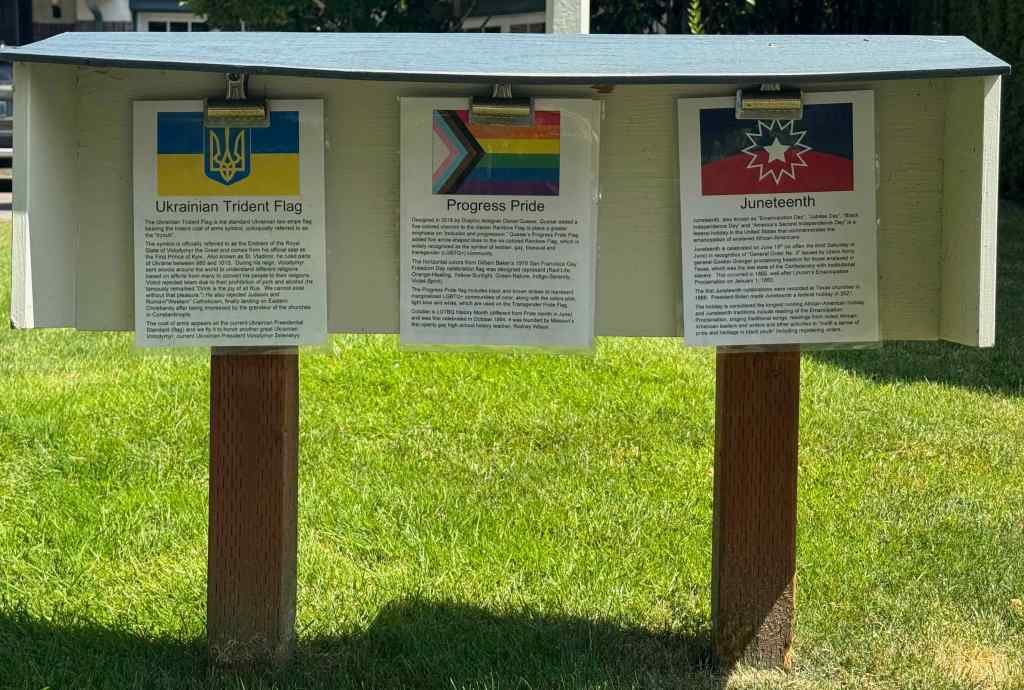
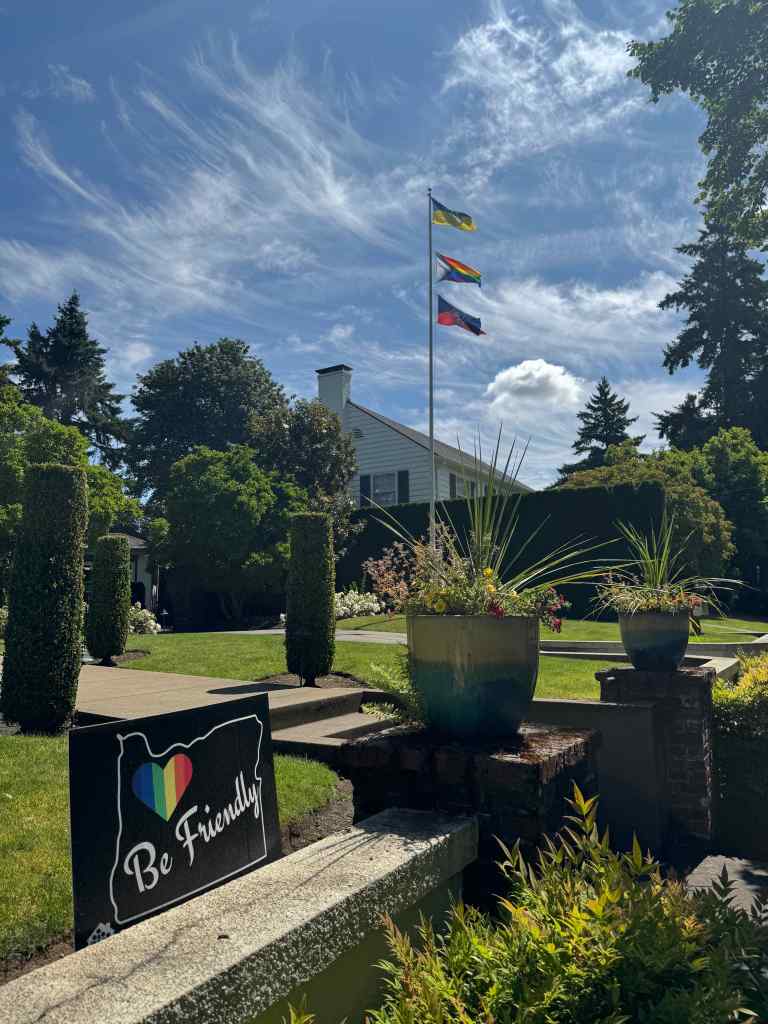
Also up on the ridge today, there is that one house with a flagpole – today they were flying three flags, the Pride flag, the Juneteenth flag, which I had never seen before, and the Ukrainian flag.
How positive those signs are to me just wandering my way through the neighborhood on a beautiful early summer day with flowers blooming everywhere. Birdfeeders and gnome doors and buckets of water on offer for the dogs; signs and flags and symbols of inclusion and acceptance and community. Our quiet mostly white, mostly financially stable neighborhood is not in the firing line of ICE raids, but I have seen my neighbors going to the demonstrations and standing in the space to support the resistance.
I did a few stairway repeats on the ridge today – and now I am ready for our next hike of the week in the mountains.
June 24, 2025 – Anthill, Herman Creek and Pacific Crest Trails near Wahtum Lake, Oregon
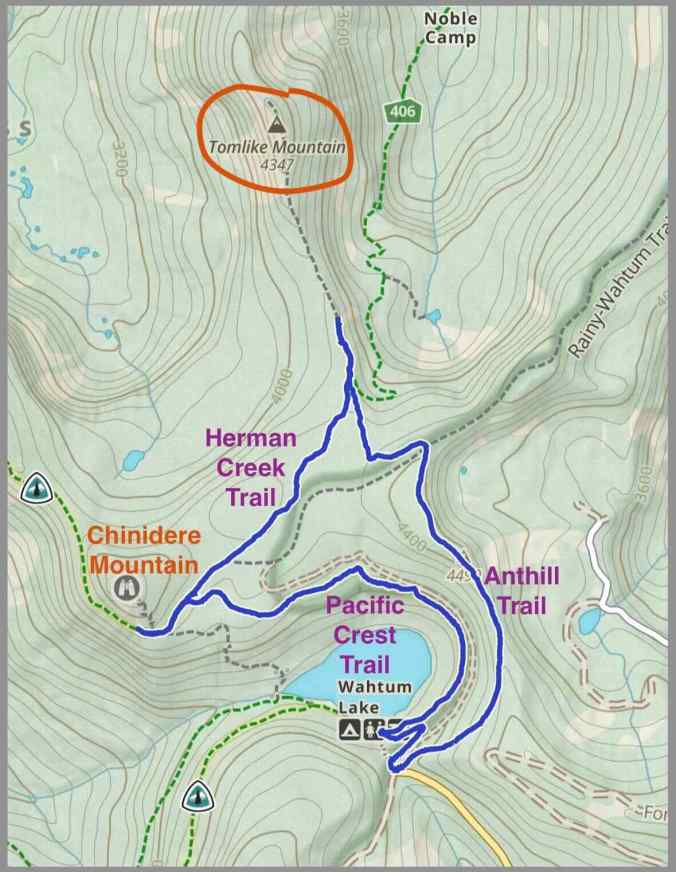
We usually hike to Chinidere Mountain from this trailhead near Wahtum Lake, but I was curious to try the Anthill Trail toward Tomlike Mountain, which is another rocky peak in the area.
Trail map – about 6 miles and 800 feet elevation gain.
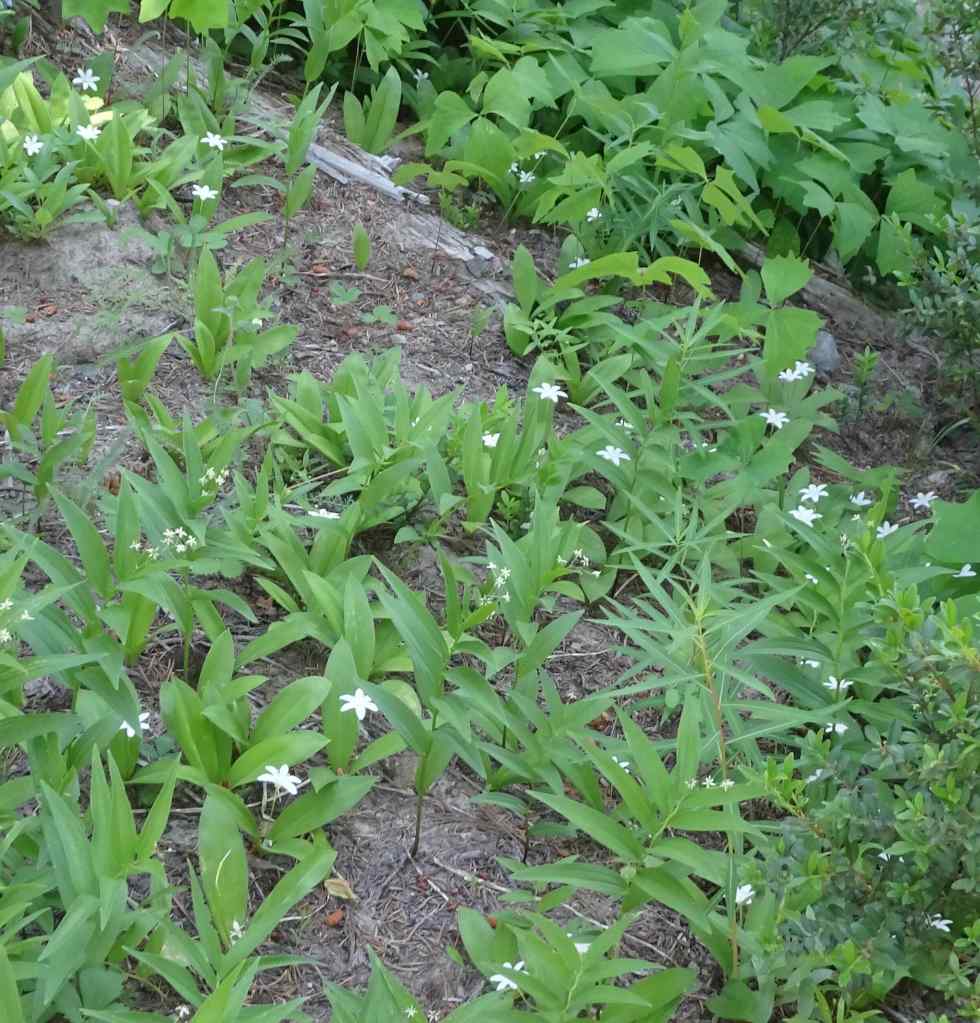
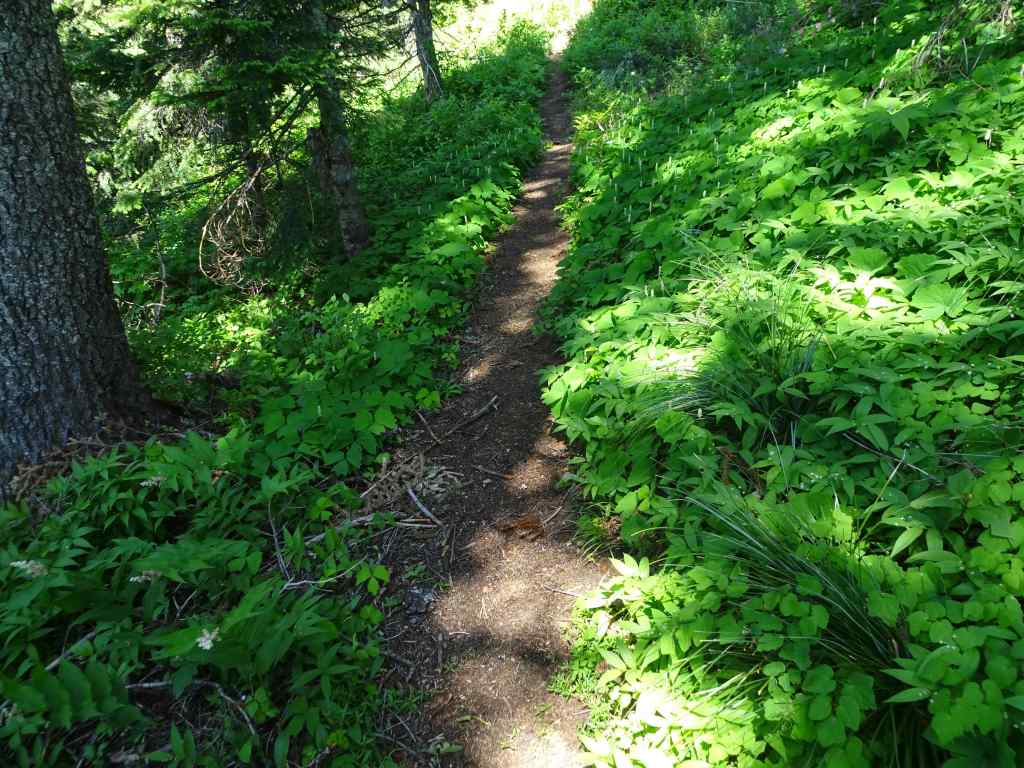
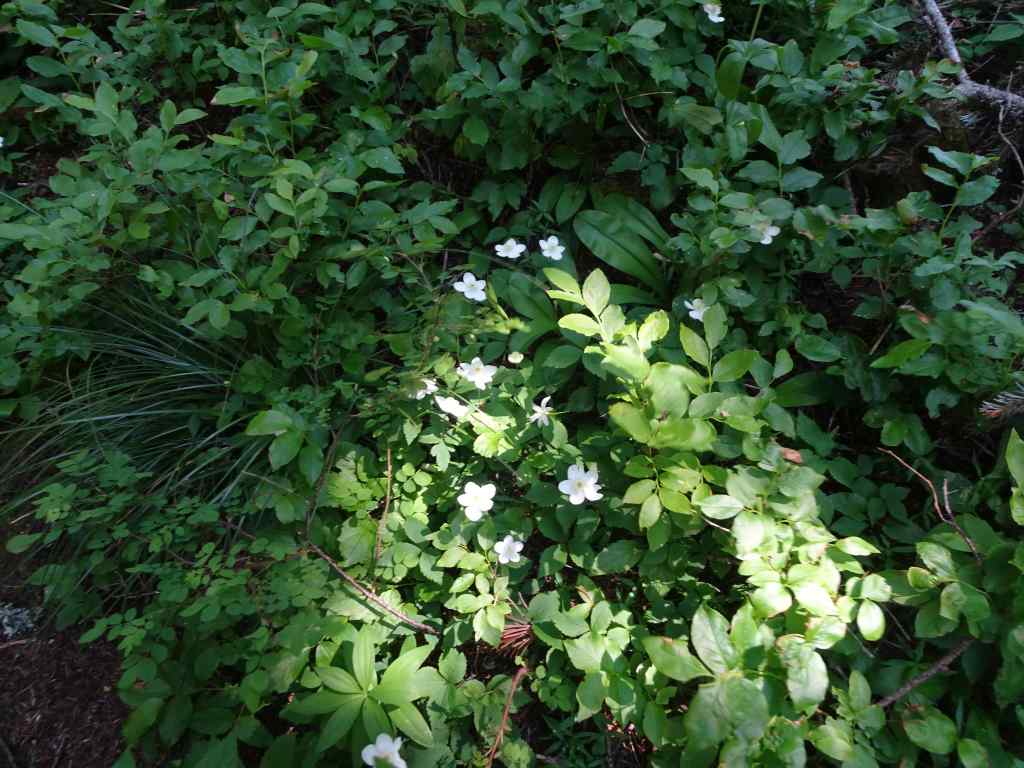
The Anthill Trail begins above the parking area, and continues upward at a gentle gradient along the ridge above the lake. It is beautifully shaded, and on this June day, all the white flowers of the forest floor were sparkling up at us. This is a new addition to my list of favorite trails.
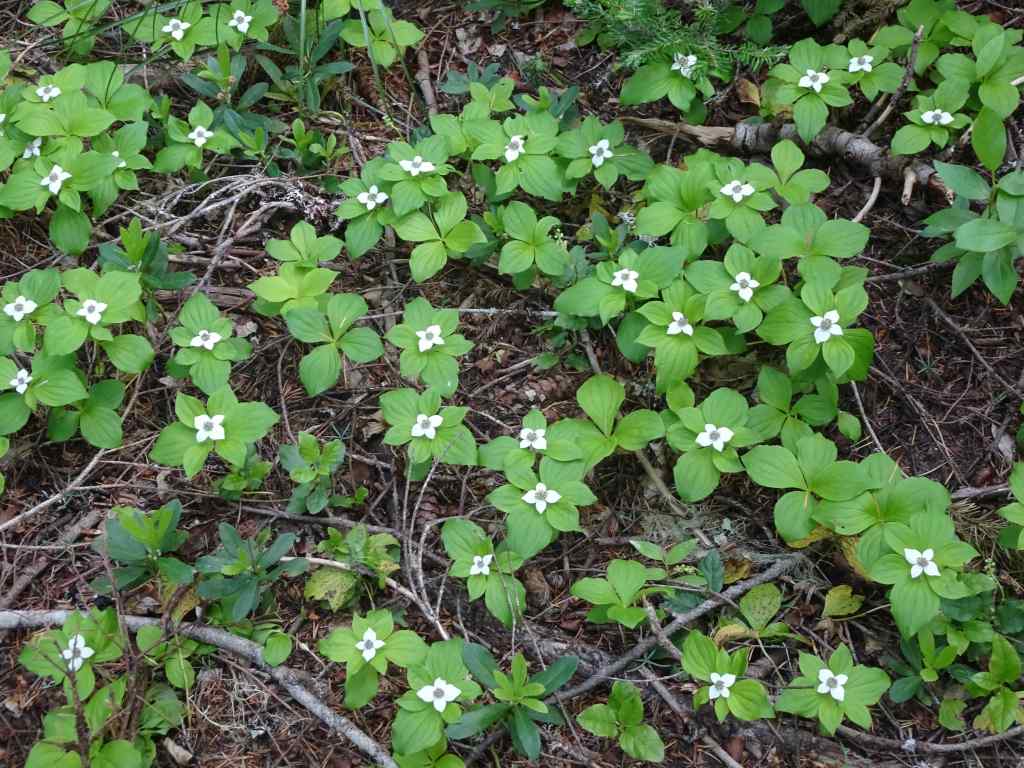
Beargrass along the trail as we start uphill.Green forest floor with so many flowers the entire way. Lots of vanilla leaf in this section.BunchberryStarry solomon sealBleeding heartAvalanche liliesBeargrassRosy twisted stalkContinuing shaded trail with prolific Sitka valerianQueen cup lilies just beginning to openSitka ValerianWindflowers
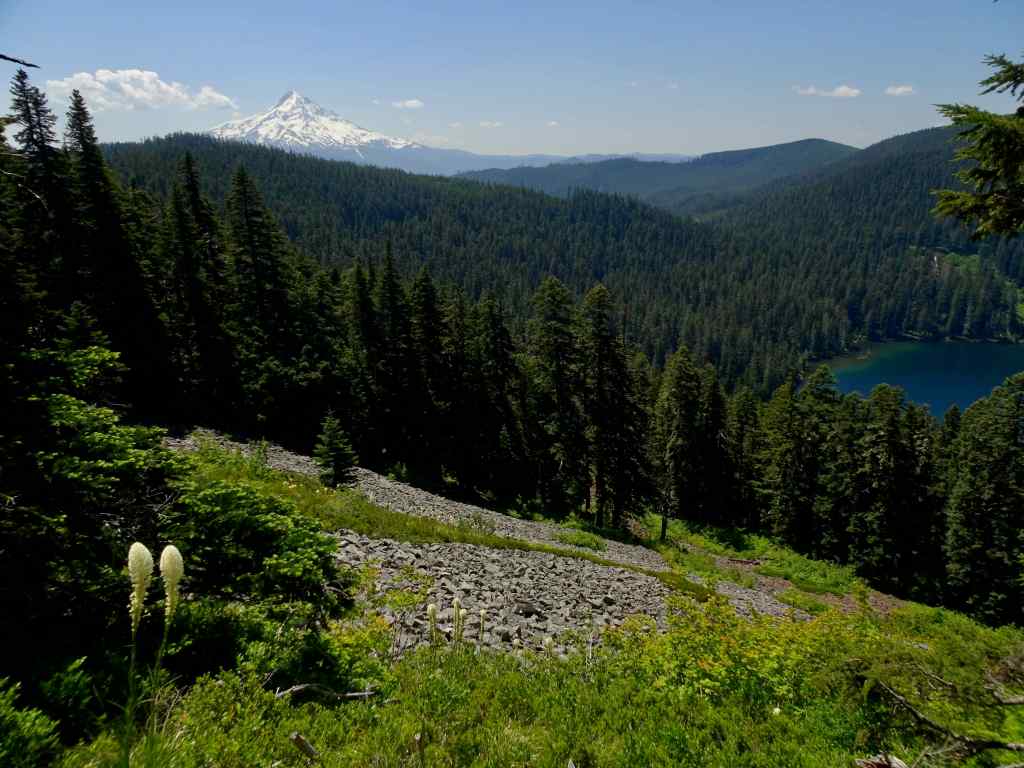
Near the ridge crest, a rocky view opened up, back to Mt Hood and Wahtum Lake.
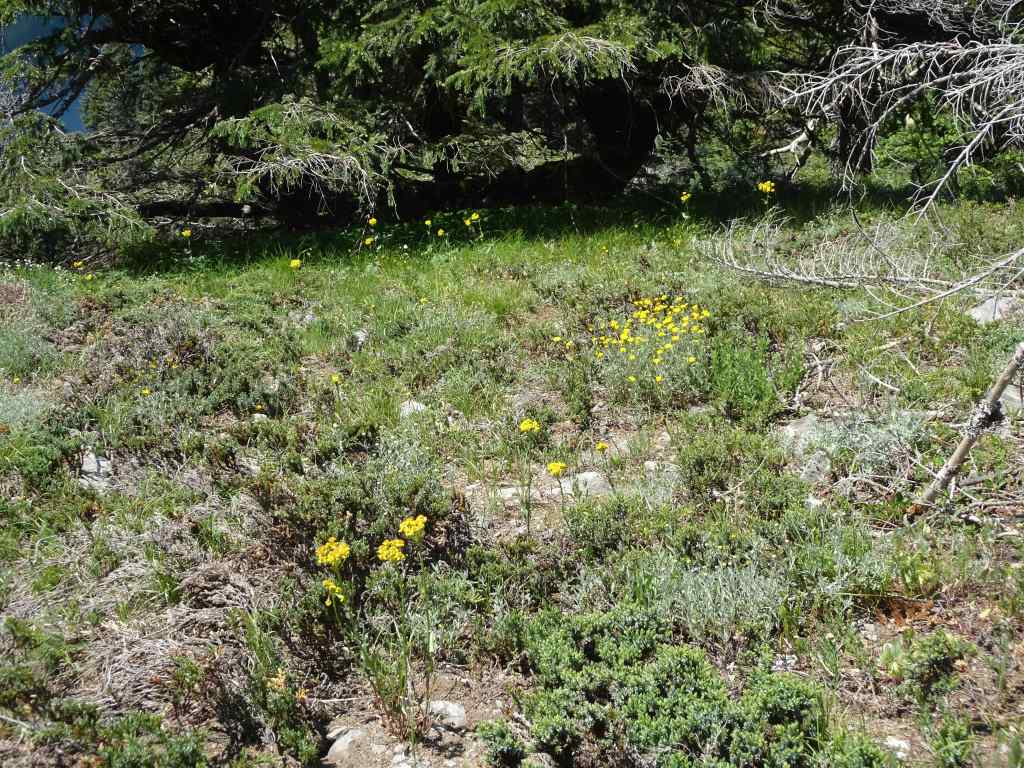
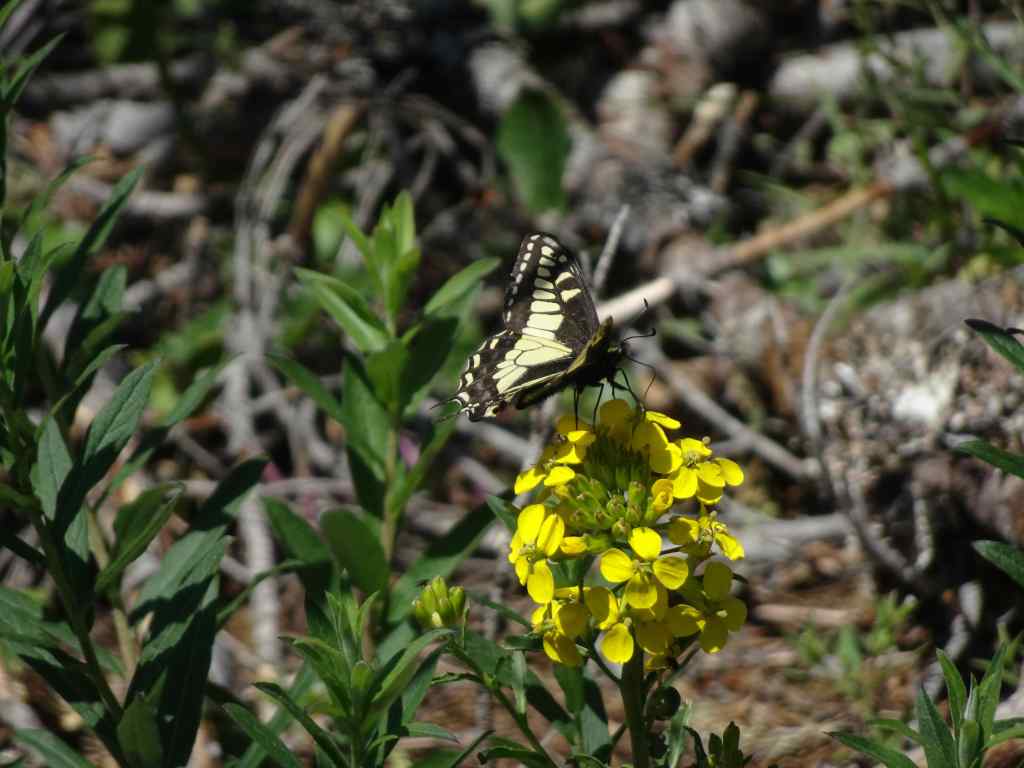
View to Mt Hood and Wahtum Lake, with beargrassYellow flowers on the sunny open slope – arnica, groundsel, Oregon sunshine and wallflowersSwallowtail butterfly on a wallflower
We continued along the Anthill Trail, to the spur that ascends Tomlike Mountain. This is a less well maintained trail, a little rockier. After eating lunch at a rocky viewpoint and admiring the view, we decided begin our return hike. It was another rocky mile to the top – I wasn’t quite ready for that today.
Rocky outcrop, and view to the top of Tomlike Mountain.Glimpse of Mt Adams to the northPenstemon on Tomlike Ridge
We decided to walk along the Herman Creek Trail toward Chinidere Mountain before returning to the trailhead. We walked through shady forest for least a half mile of blooming avalanche lilies, as far as one could see, across the forest floor. And a few beargrass as well.
Avalanche liliesAs far as the eye can seeShady forest with liliesAnd beargrass
My husband took the side trail to the top of Chinidere Mountain, while I continued a very short distance along the Pacific Crest Trail to the rocky open slope below Chinidere’s cliff side. From here I could see many of the sunny blooming cliff flowers above me, and a view back to Mt Hood the other way. Then I rested in the shade near the trail junction – it was beautiful and quiet in the forest!
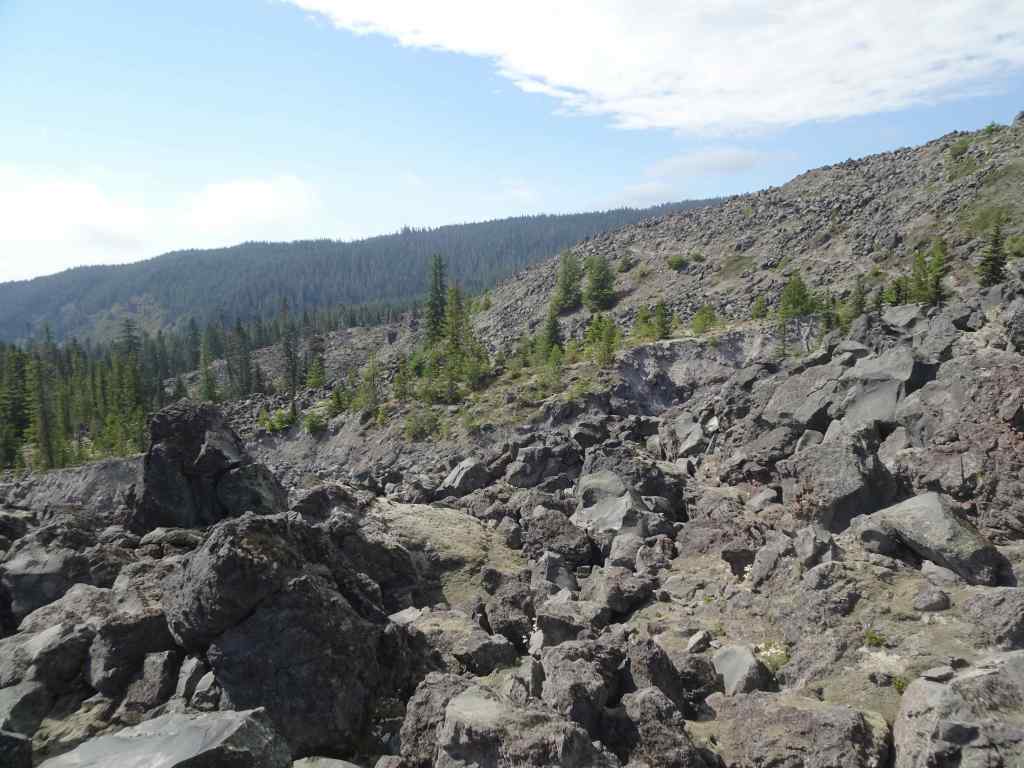
Looking up at the cliff side of Chinidere MountainMariposa lilyPaintbrushBuckwheat and columbineChickweed and phloxMt Hood
We completed our circuit by descending along the Pacific Crest Trail above the lake.
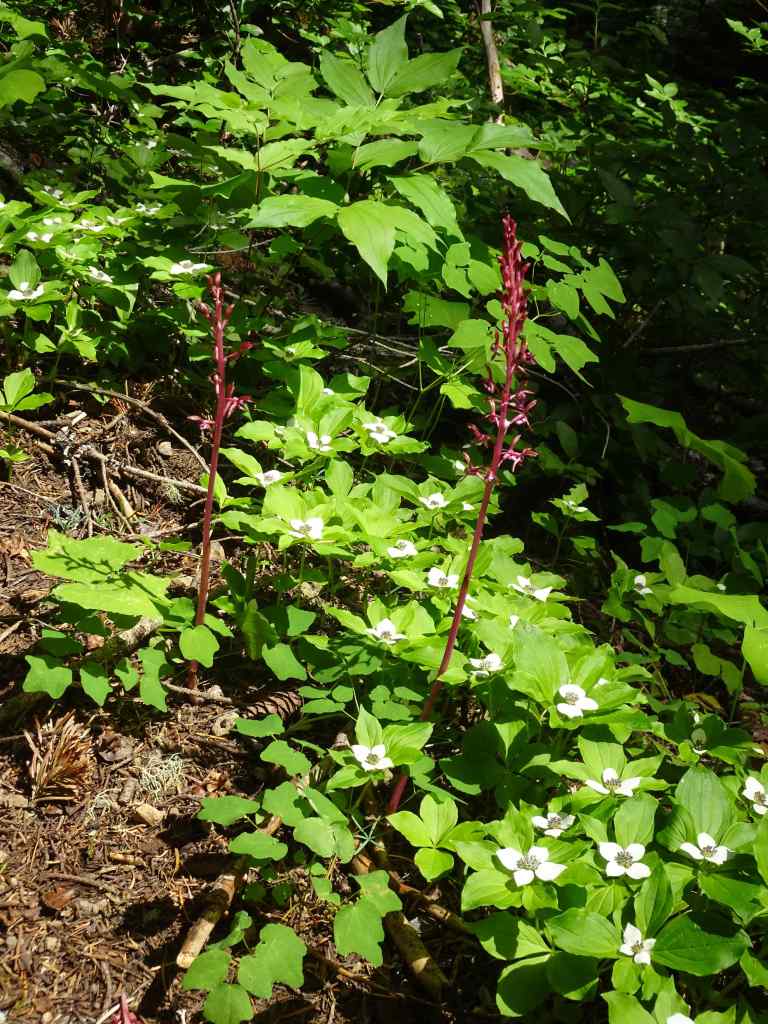
Bunchberry and coral root were prolific along our return trail.
This had been a thoroughly enjoyable hike. We had seen some of the wildflowers blooms at their best, though there are more to come. It was lovely to be back in the woods!
I spent the first half of June in St George, Utah, helping a family member with a health care situation. I was extremely grateful to return to the lovely pacific Northwest for the rest of the month, enjoying our more temperate climate and the lovely flowers blooming in the neighborhood. I finished knitting a pair of socks, and cheered on the No Kings Day Protests from afar.
Southern Utah, June 4 to 15th.
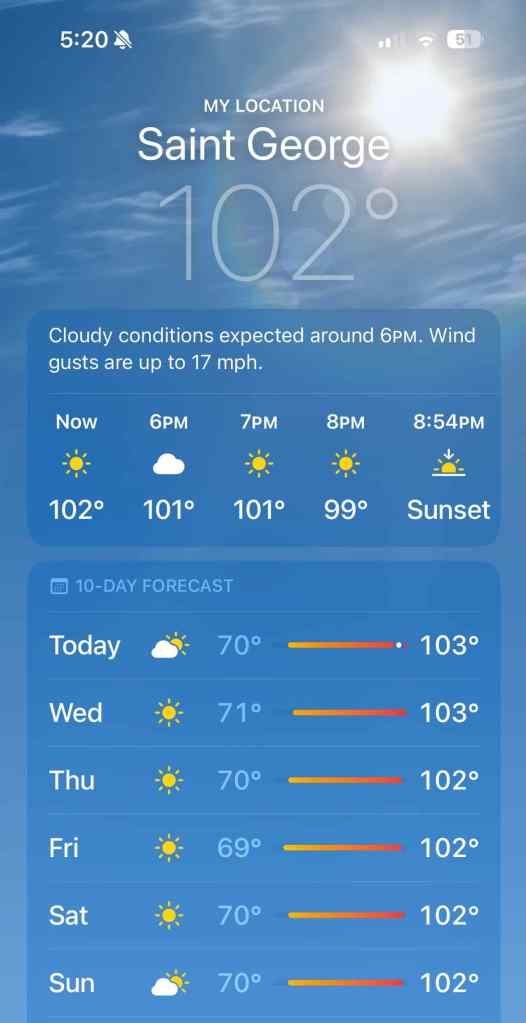
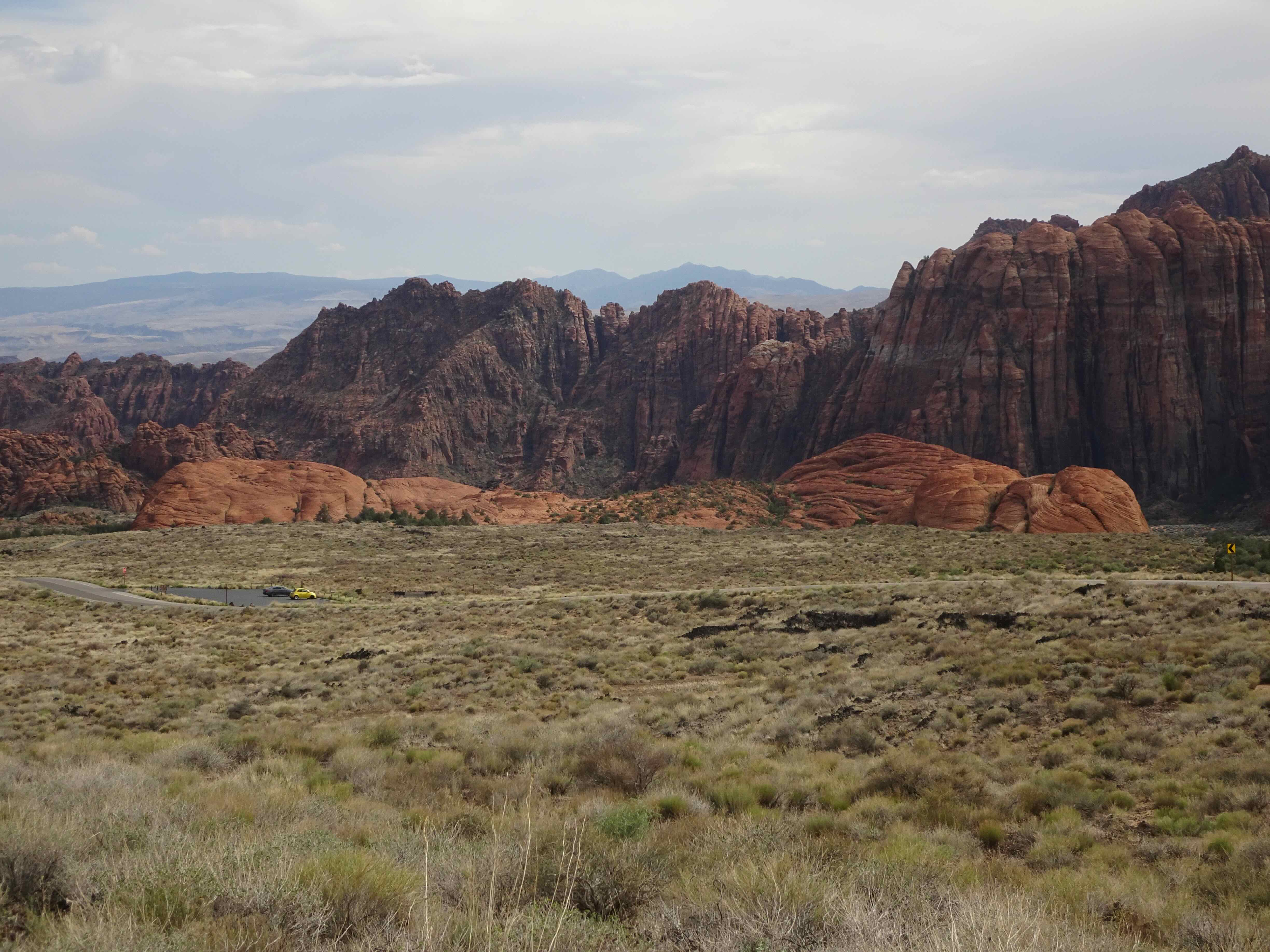
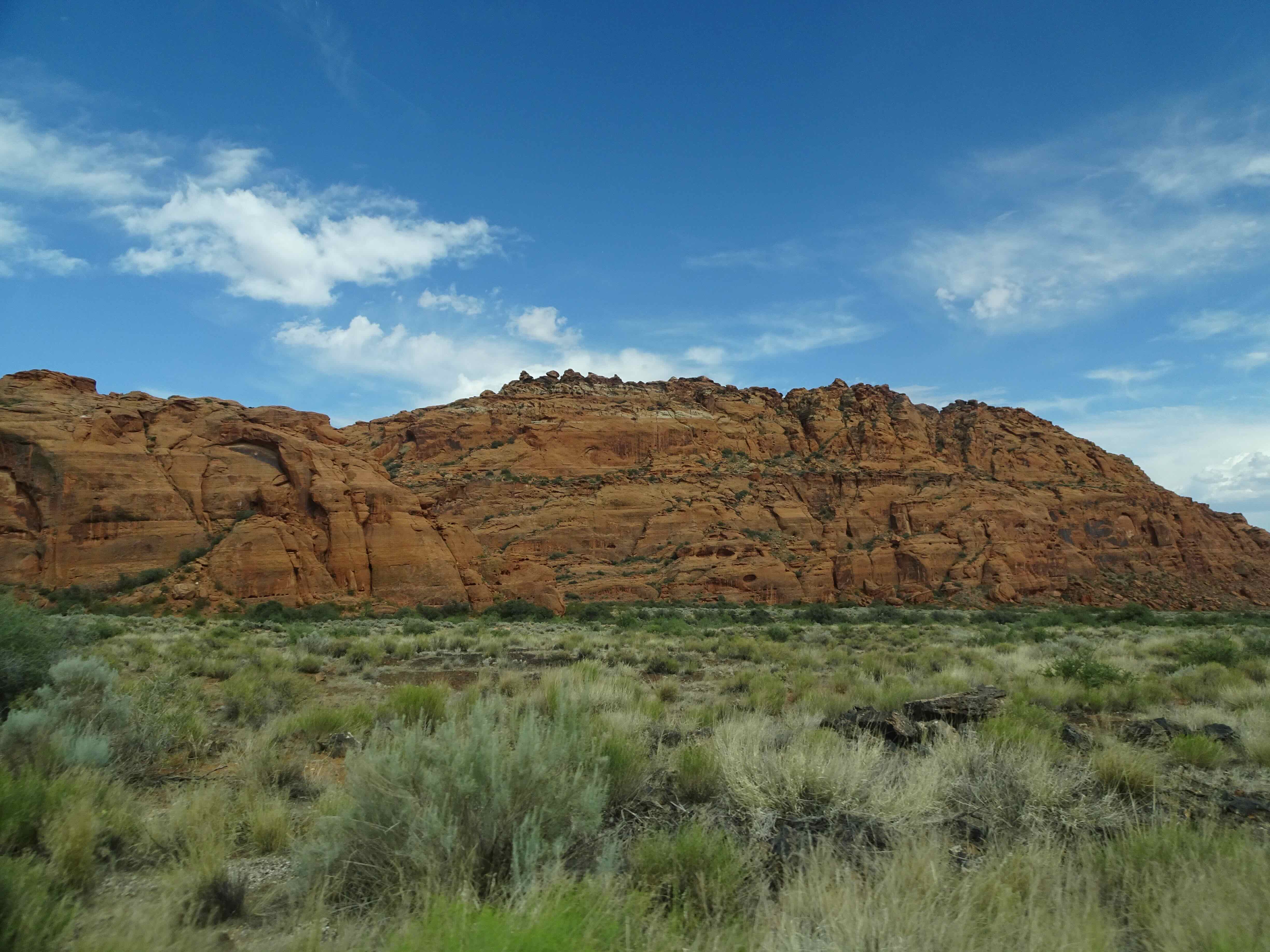
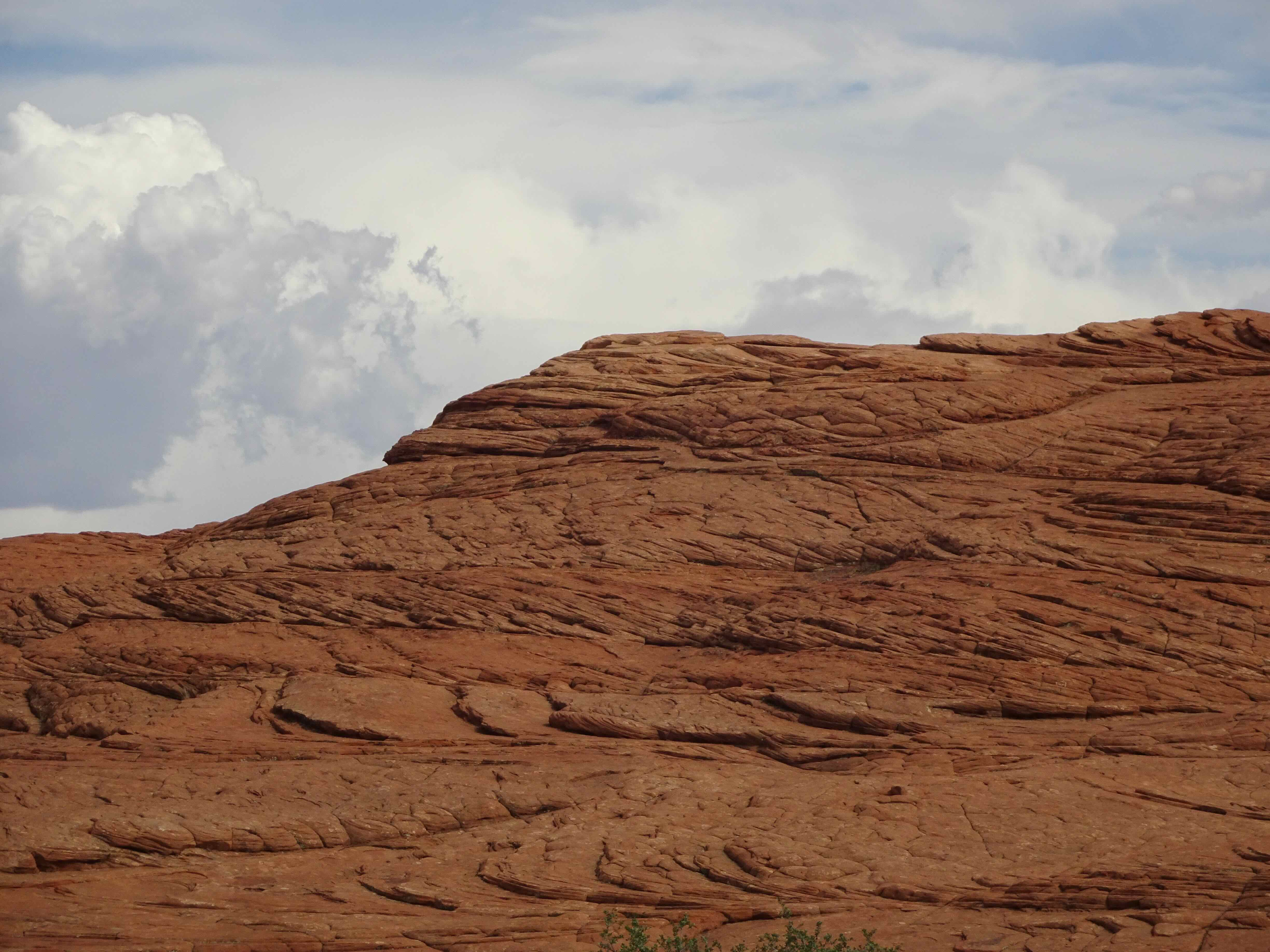
It was too hot in Utah to do much more than scurry from one air conditioned space to the next. We drove through nearby Snow Canyon State Park one evening, to admire the Navajo Sandstone landscape from the car window. I paid homage to the air conditioning gods and the electric grid, praying that it didn’t go down while I was there.
The weather…
Snow Canyon State Park –
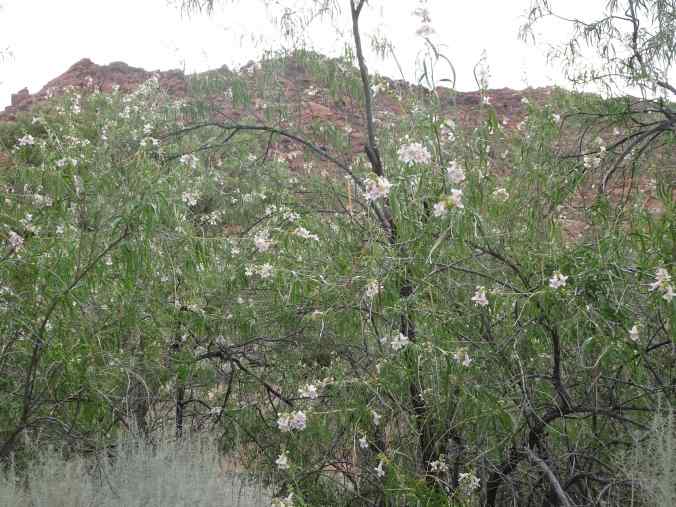
Willow trees in bloom
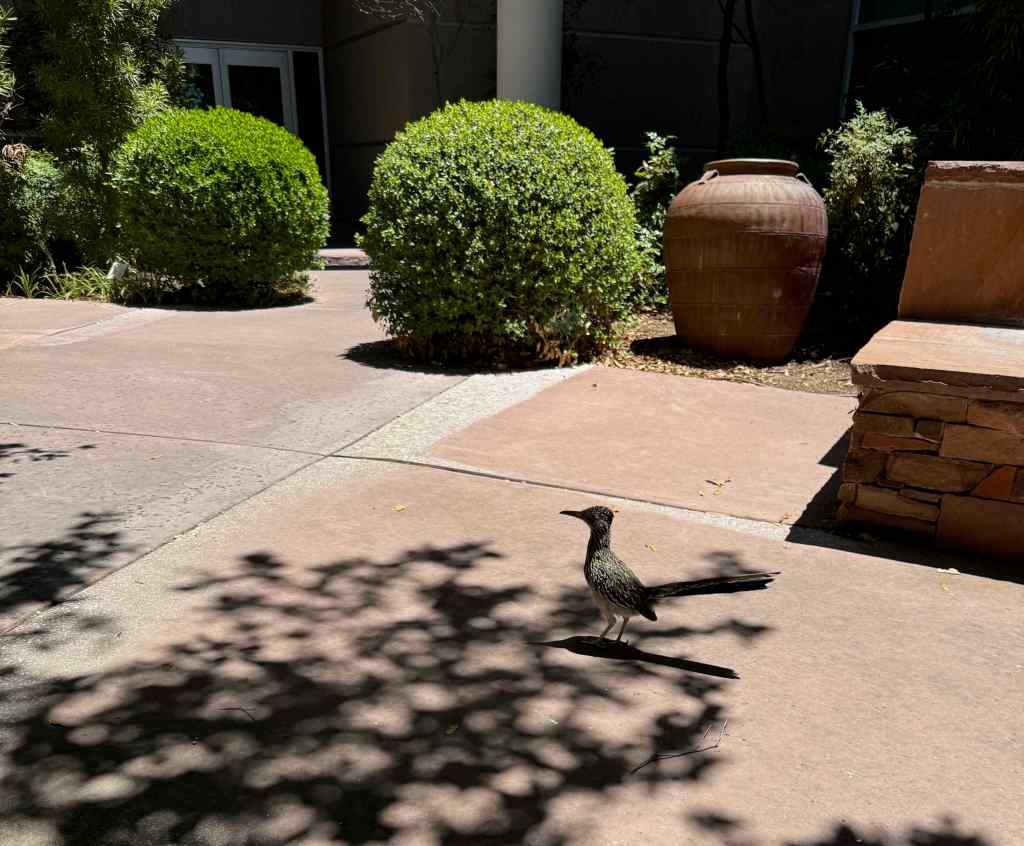
Birds of St George…
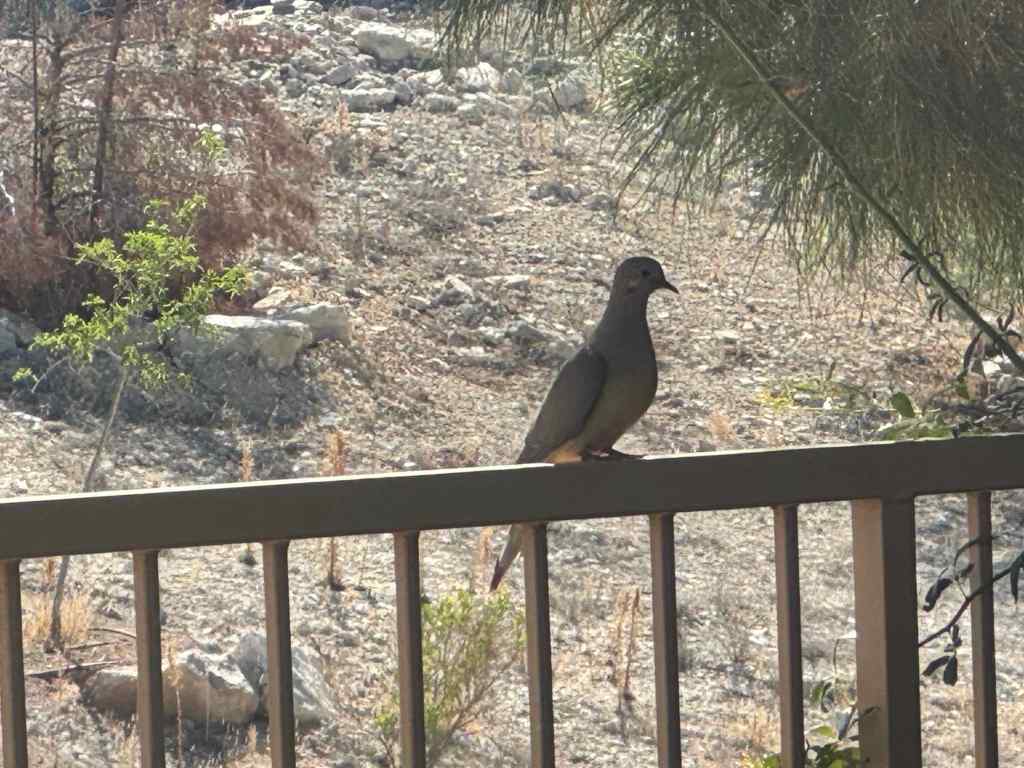
Roadrunner in the hospital gardenDove in the back yard
Flying home through Salt Lake City:
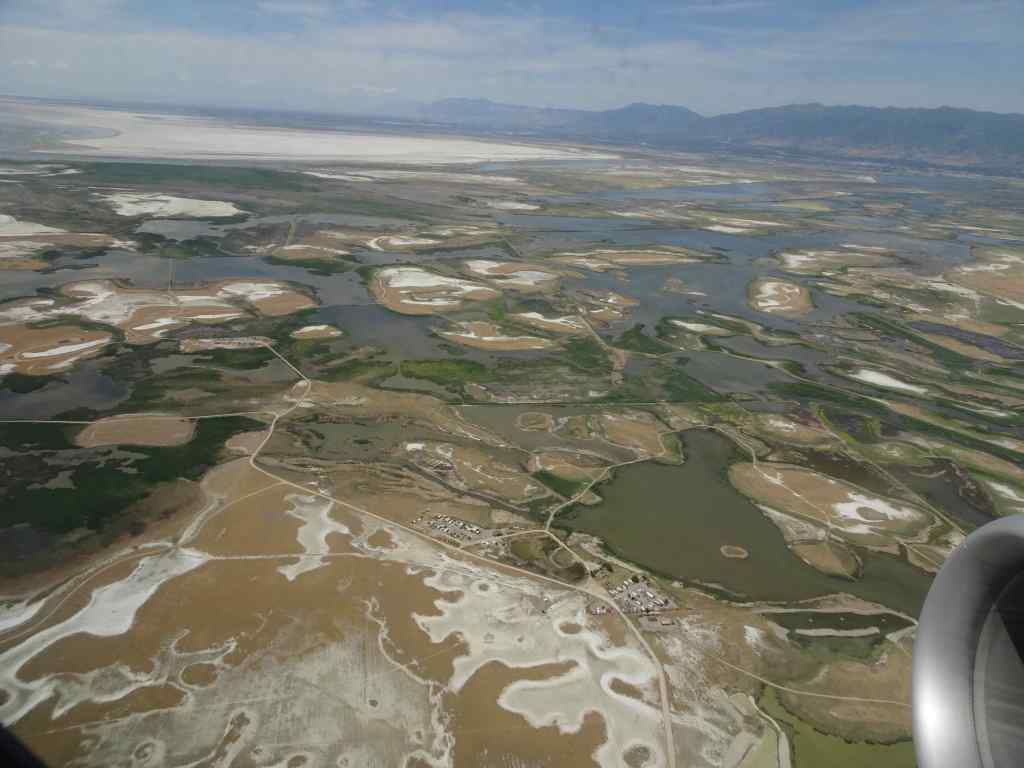
Great Salt Lake from the airplane windowTerminal Tunnel in Salt Lake City, inspired by the salt flatsTerminal tunnel art panelThe Columbia River, Cape Horn, and Mt St Helens; welcome views on the return flight to Portland…
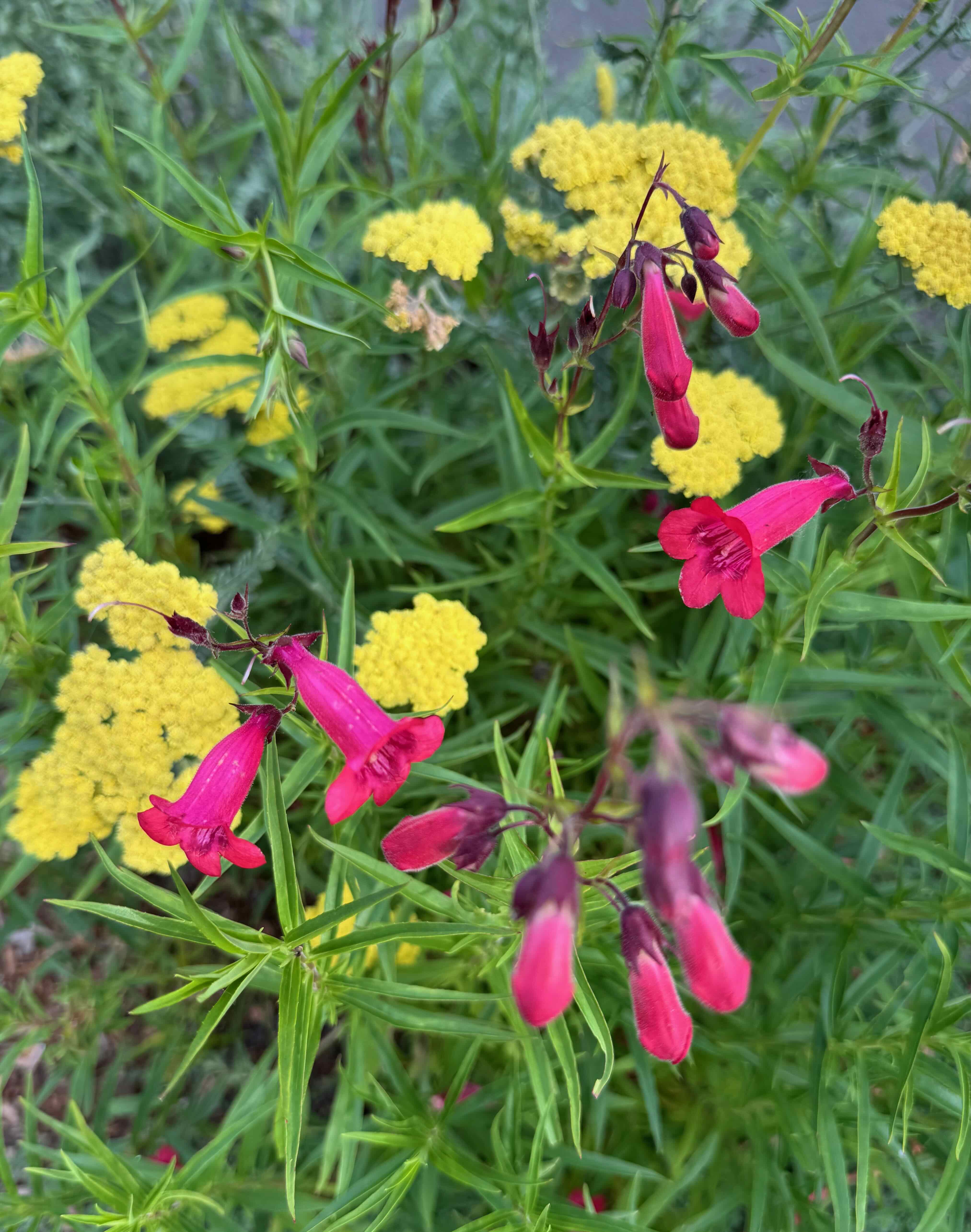
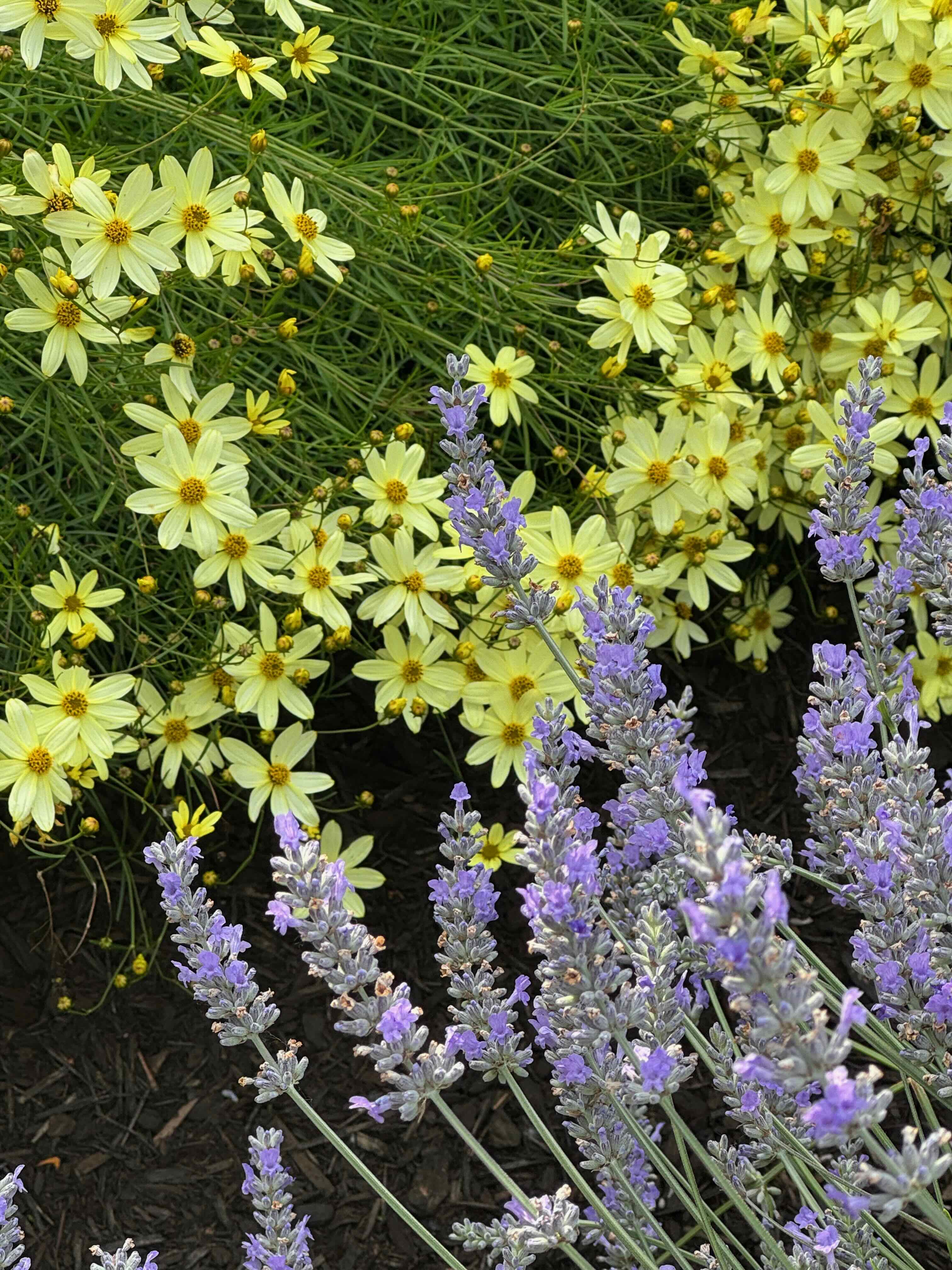
Flowers in the neighborhood –
Knitting
I knit not a single stitch while in Utah, but I finished one pair of socks after I returned. I cast on a new pair of socks, and made some progress on a scarf and a cardigan.
Finished socksThree works in progress – cardigan, scarf, socks
Books
Nine books read in June
Of the nine books I completed in June, by far the most compelling was Figuring, by Maria Popova. It is a long and interwoven biographical tale of several women artists and scientists who made major contributions within their fields, yet have gone somewhat unrecognized. The women include astronomer Maria Mitchell, poet Emily Dickinson, sculptor Harriet Hosmer, writer Margaret Fuller, and biologist Rachel Carson. She includes many intersecting peripheral people, who interacted with her selected historical figures. I found it fascinating to listen to.
I also enjoyed a trip down memory lane as I read Sandstone Spine by David Roberts, a description of hiking across Comb Ridge in southern Utah, a place I did field work 40 years ago.
The rest of the world:
June 14th – While I was roasting away in St George in a care-giver role, millions of people all over the world were marching in No Kings Day protests. I am grateful that so many were able to show up!
(Instagram screenshot)
Back in Portland, I took a long neighborhood walk on Juneteenth, and a real hike near Mt Hood on June 24th – to be described in the next post…
We went on five hikes in May, all in the Columbia River Gorge, following the wildflower bloom…
May 6 – Lyle Cherry Orchard, WA
Warm and a bit windy today – we got a chance to see the waning balsam root – everyone’s favorite!
Purple ookow blooming on the Convict Road.Ookow and the seedpods of Columbia desert parsleySwales of lupine on the middle plateauThe last of the yellow balsam rootA poppy patch.
On our drive home, we stopped briefly at the Catherine Creek Trailhead so I could get a peek at the bitterroot that blooms there – probably my only chance this season.
And there it was, on the rocky outcrop just above the parking lot.Lewisia rediviva, bitterroot – one of my all time favorites!
May 10 – Cape Horn, WA
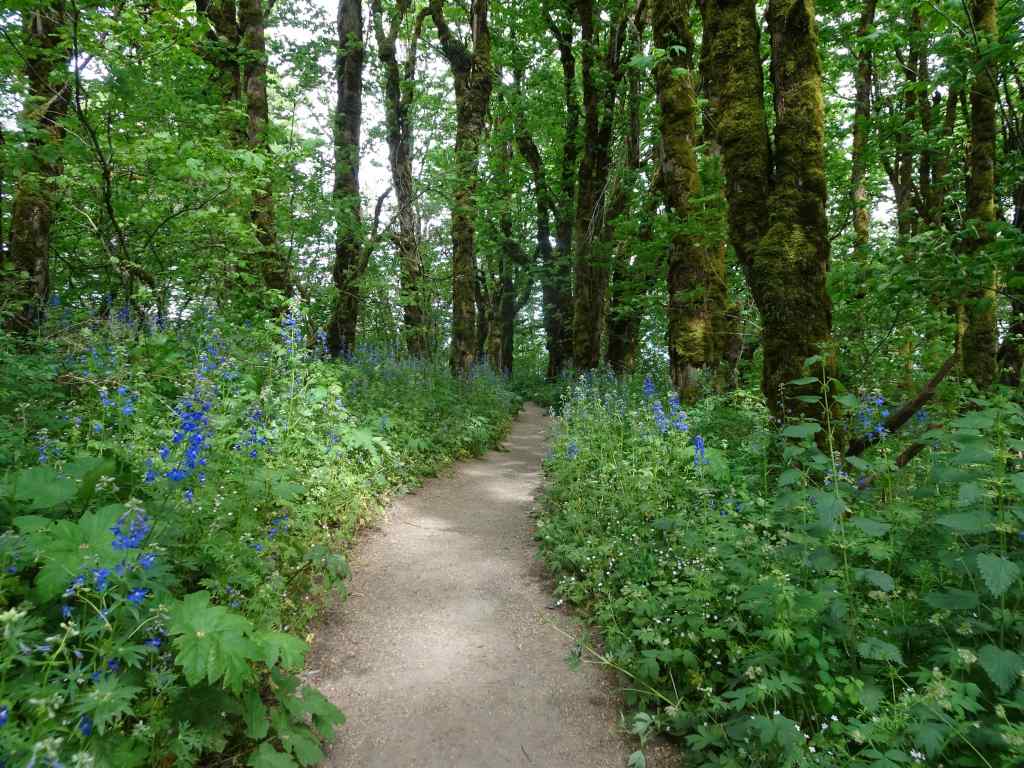
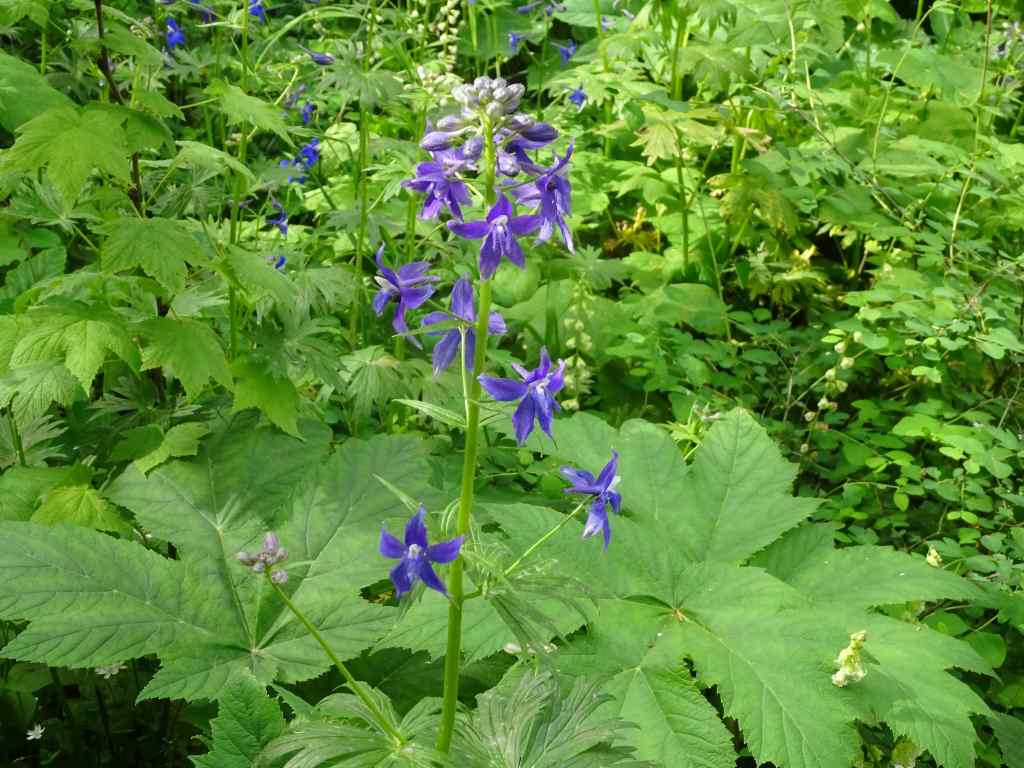
Tall larkspur season at Cape Horn – it is always a treat to walk on the neatly groomed trails here. Today we started at Strunk Road, and walked to one of the lower overlooks – less than two miles, but with rain in the forecast for the next few days, we took our opportunity.
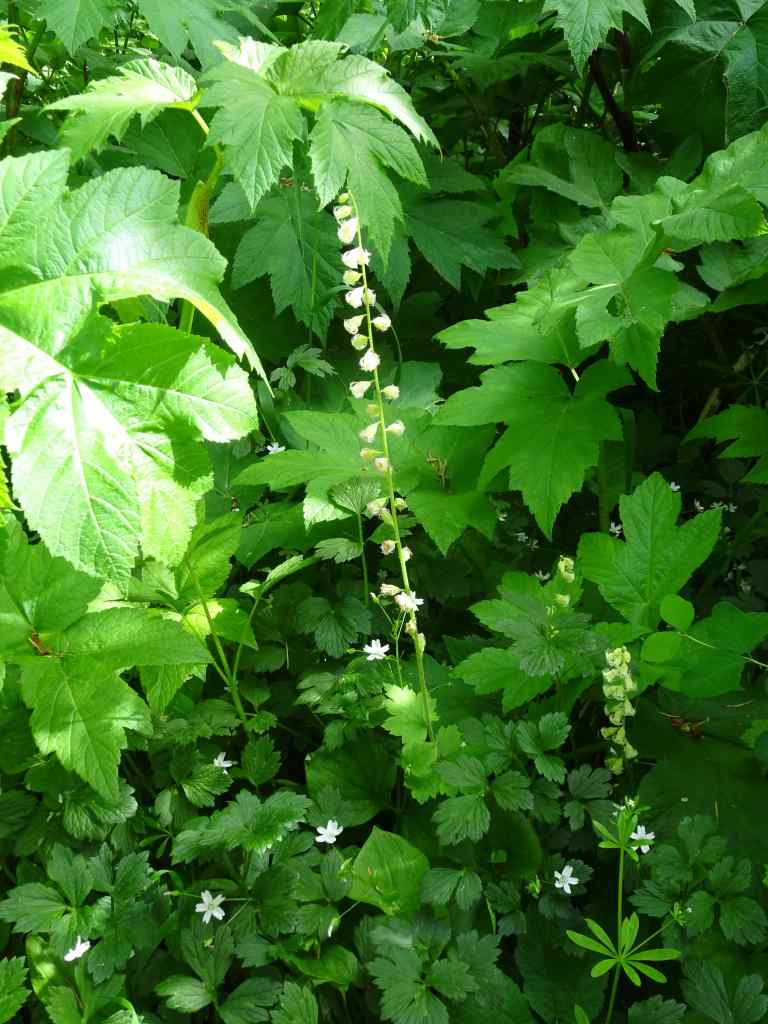
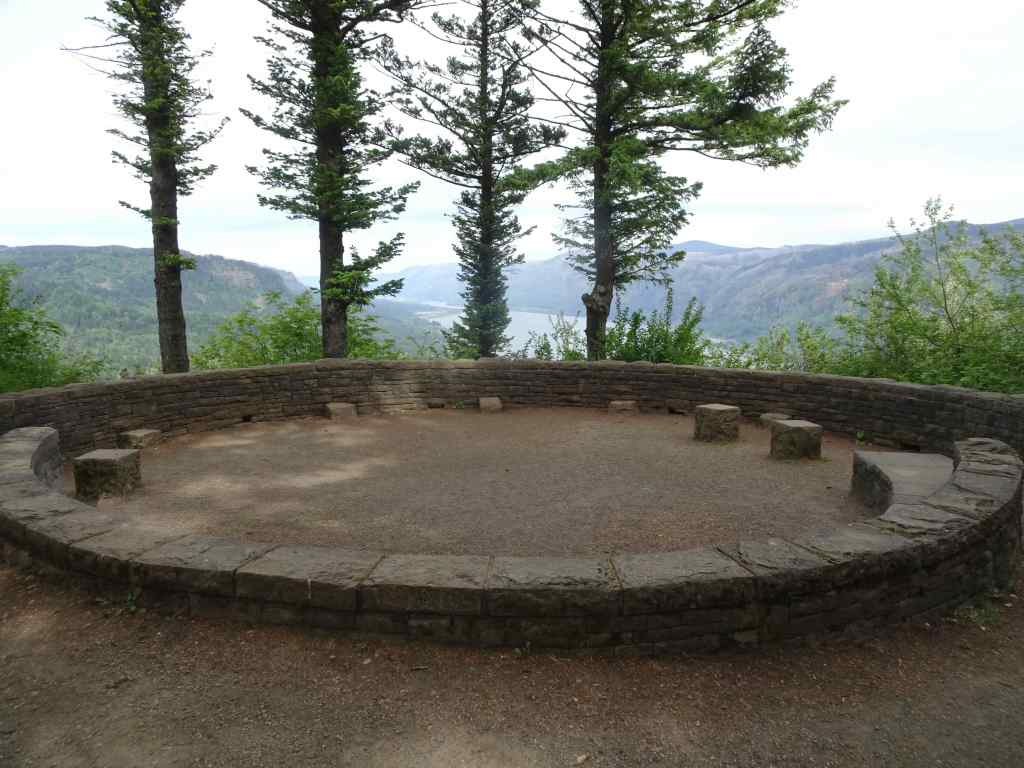
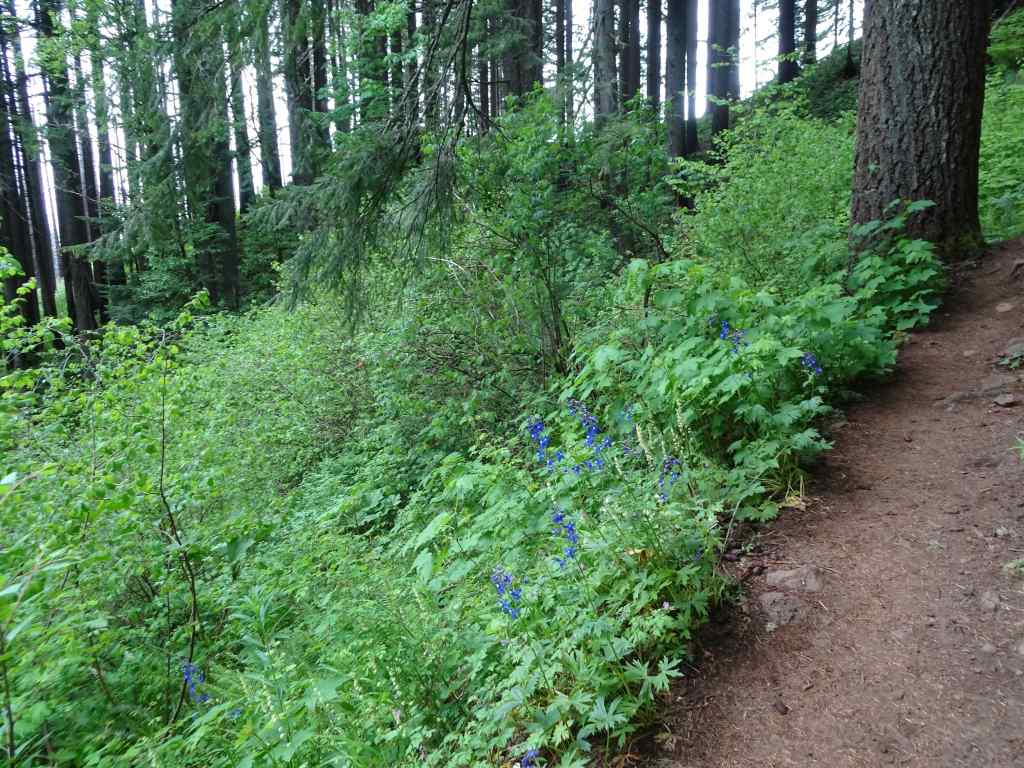
Tall larkspur along the pathCloser viewWhite fringe cup and candy flower also prolific today.Nancy Russell Overlook – we stop to look at the view and say, “Thank you!” to Nancy Russell for her conservation work.Up river view toward Beacon Rock.Continuing downward, the purple path continues…And the fringe cup…A few other flowers tucked in – Hooker’s fairy bells,Fern leaf biscuitroot,and vanilla leaf.
May 13 – Wahkeena-Multnomah Loop, OR
Back again to this five mile long, 1500 foot loop.
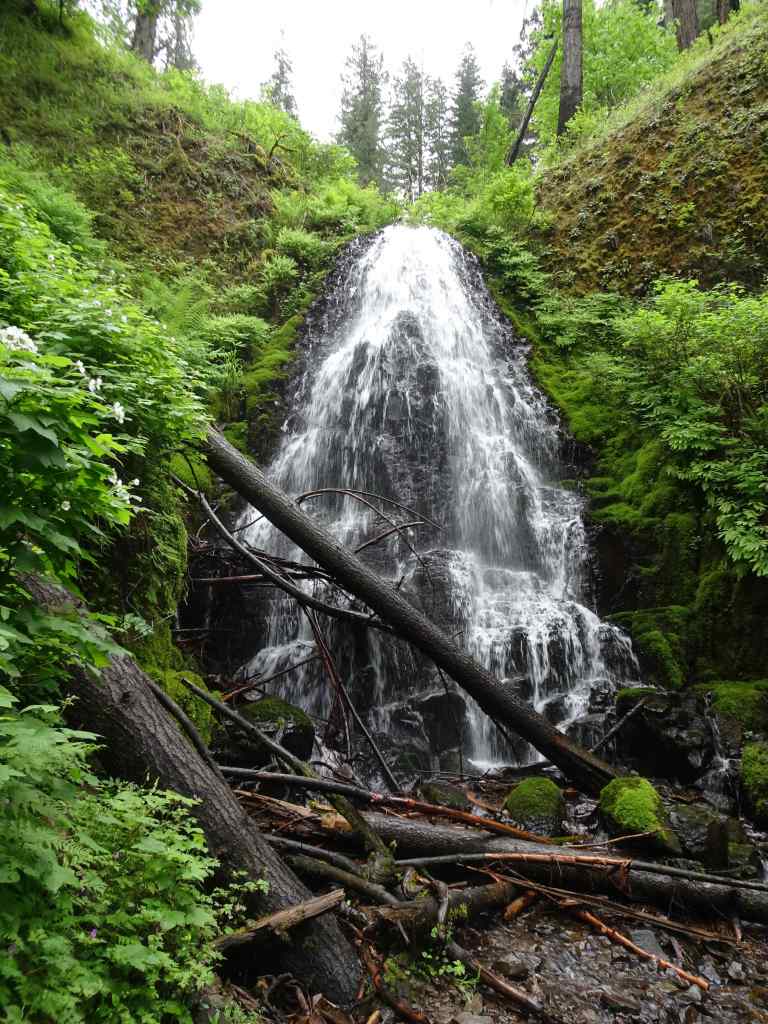
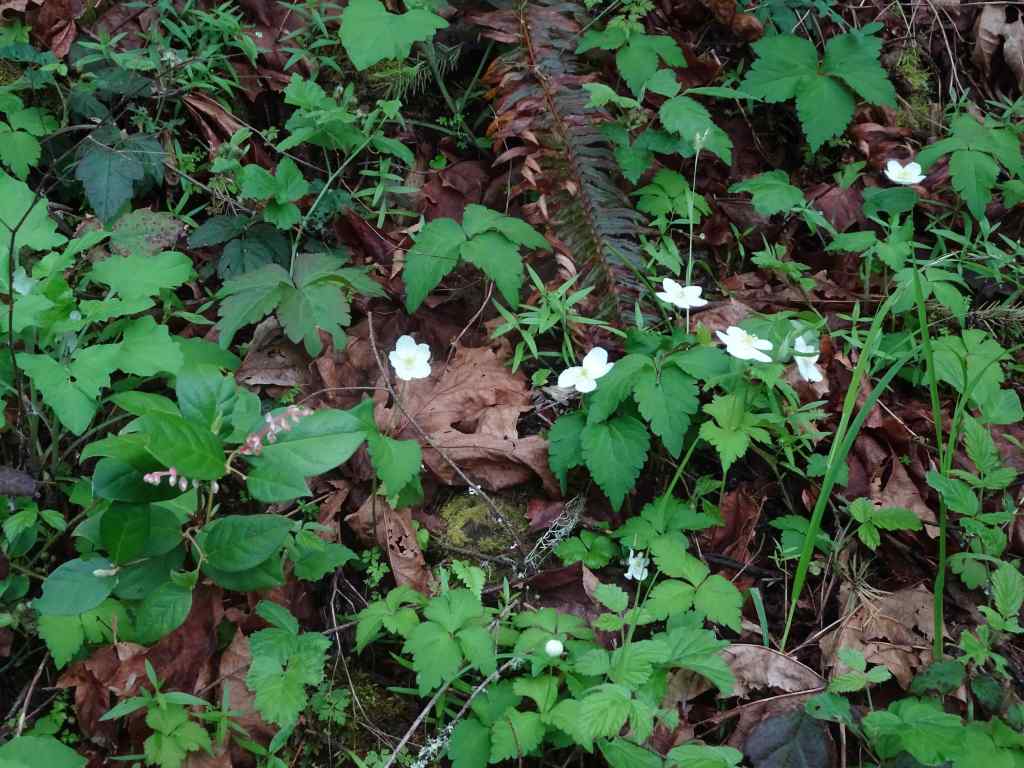
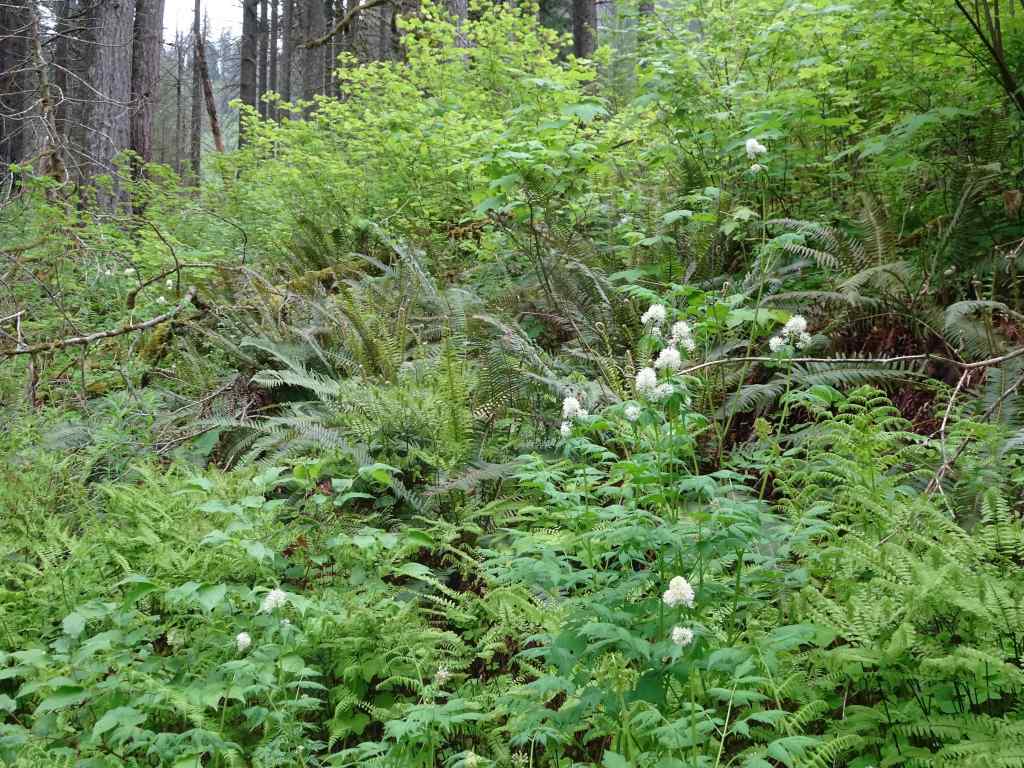
We began at Multnomah Falls, and started west along the old highway toward Wahkeena Falls.After passing Wahkeena Falls, the trail ascends up many wildflower-filled switchbacks,to Lemmon’s Viewpoint, overlooking the Columbia River.Continuing up Wahkeena Creek, past Fairy Falls,passing more wildflowers along the way. Columbia windflowers, and salalBaneberryA few fading trilliumLarkspur and fringe cup
After a lunch break at the trail junction, we walked eastward toward Multnomah Creek. This part of the trail has always felt rather magical to me – mostly flat, through a forest of tall firs. The undergrowth has changed a bit since the 2017 fire, but it is still one of my favorite places.
2013 Lookback – Magical trail before the fire.May 2025, Lots of redstem ceanothus filling the forest floor under the burned trees.Still very pretty, and with a view to the river…More wildflowers along the trail as it descends into Multnomah Creek – thimbleberry, columbine, arnica.CorydalisWiesendanger FallsHoneysuckle and inside out flowerBack to the trailhead at the bottom of Multnomah Falls.
May 22 – Cape Horn, WA, again
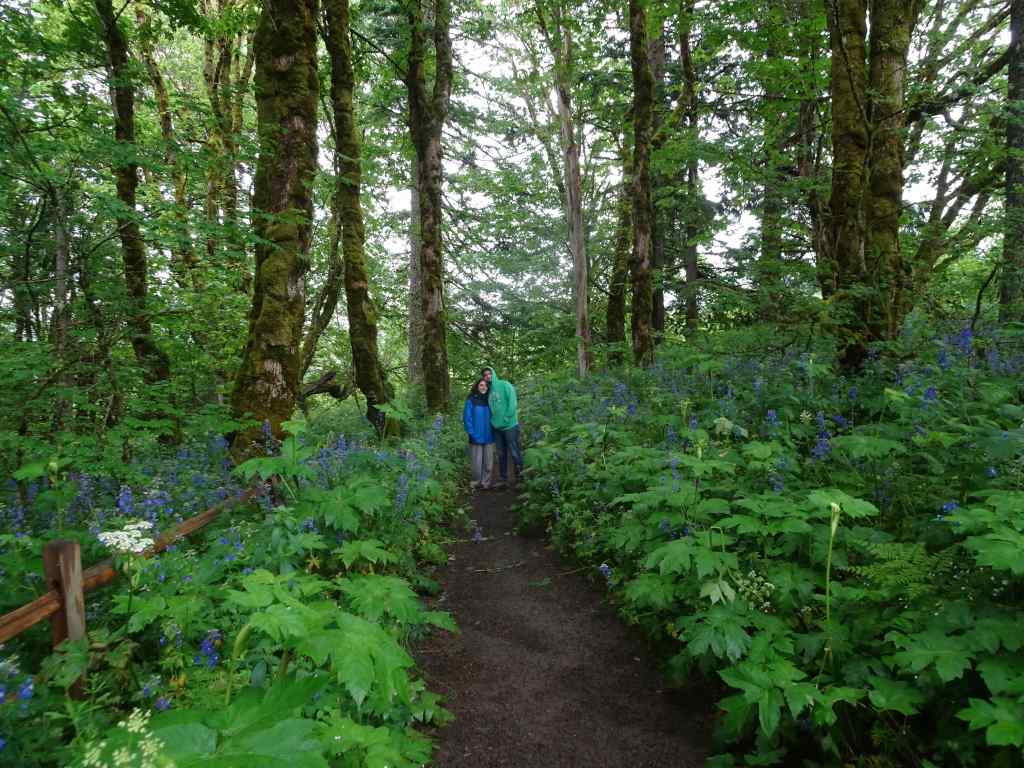
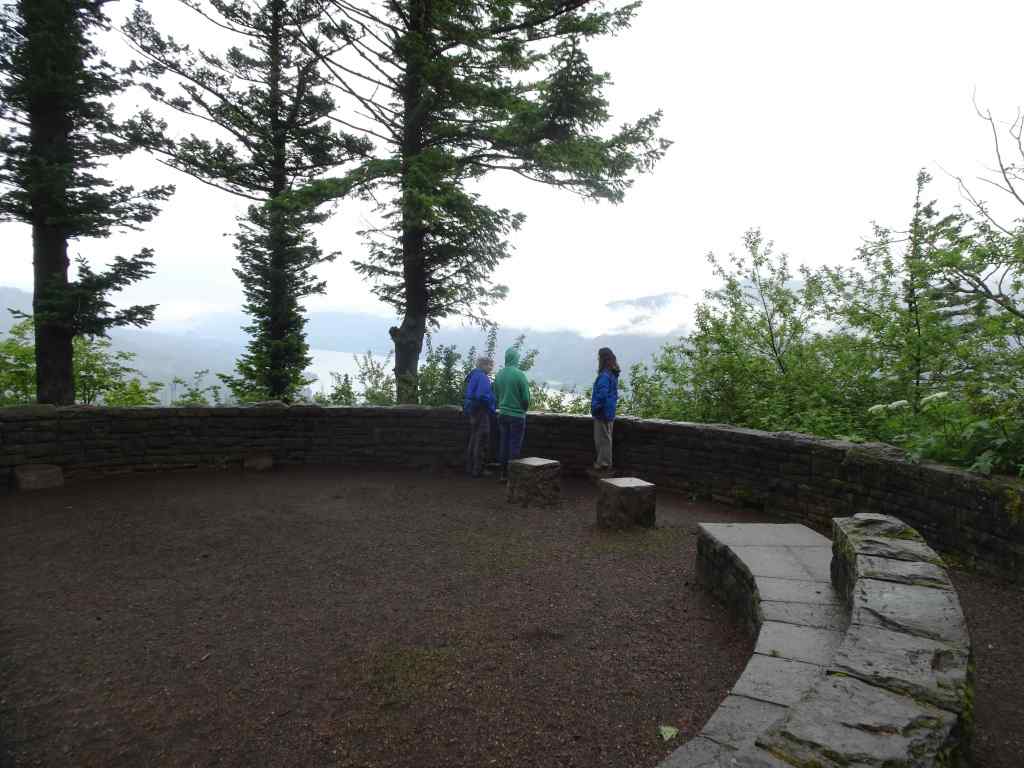
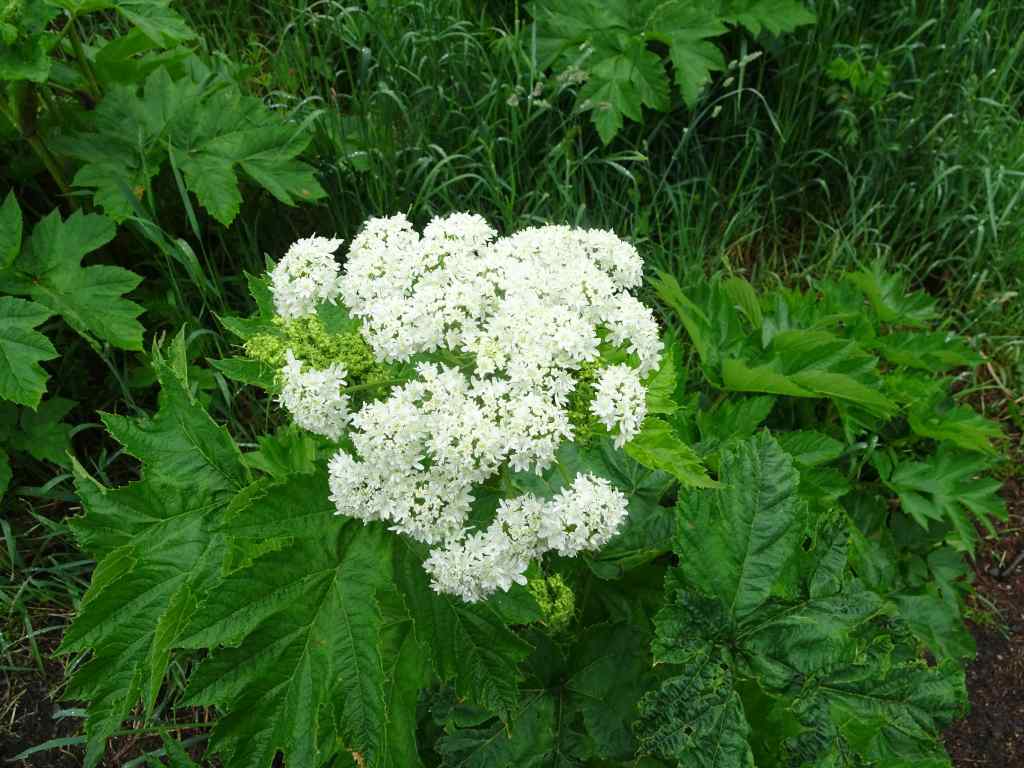
We wanted to take our son and his fiancee for a hike – though they didn’t bring proper shoes, and it was a bit rainy. We settled for going back to the tall larkspur-lined path from Strunk Road to the Nancy Russell Overlook at Cape Horn. It was less than two weeks since our previous visit, the tall larkspur were even more profuse, and the cow parsley were starting to spread their umbrella heads. Lovely, even with a bit of our Oregon sunshine misting us.
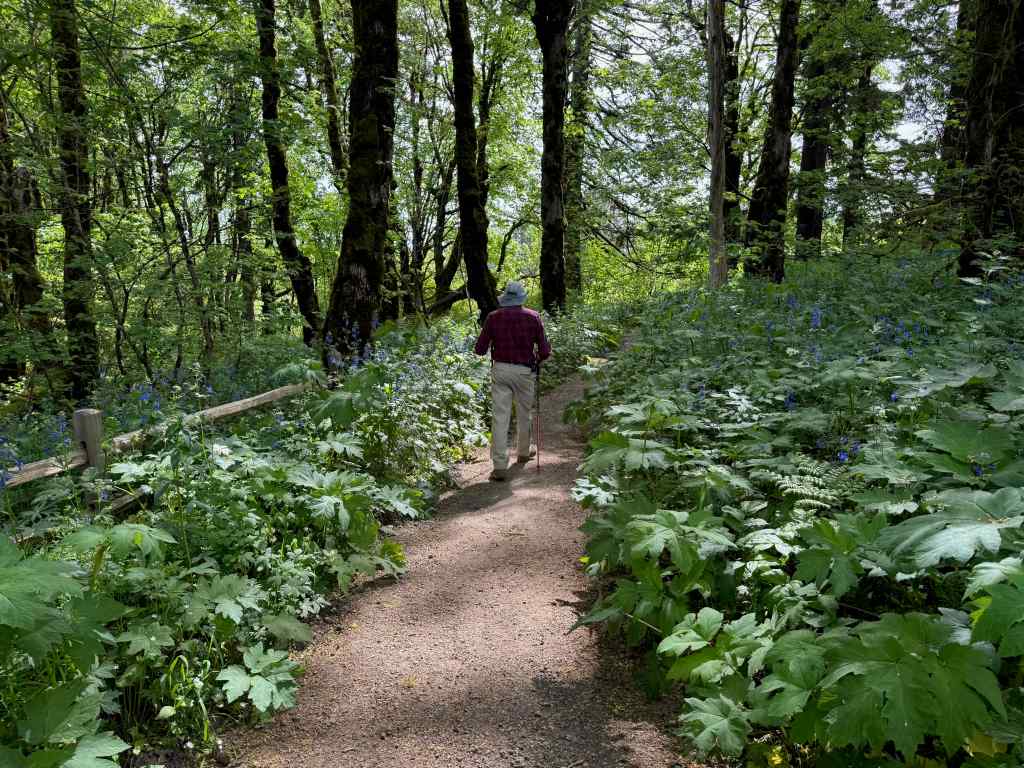
Previous week, May 10, with older hiking gentleman.Same path, May 22nd, with cow parsley and a cute young couple.Misty view from the overlook.Cow parsley
May 27 – The Labyrinth, WA
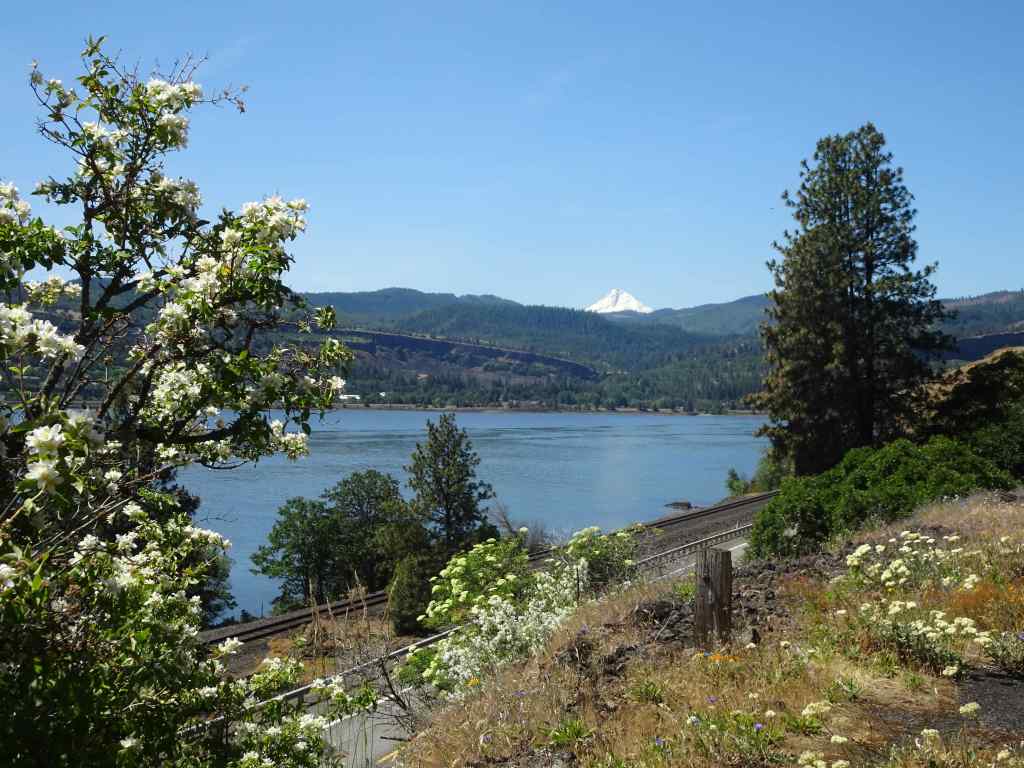
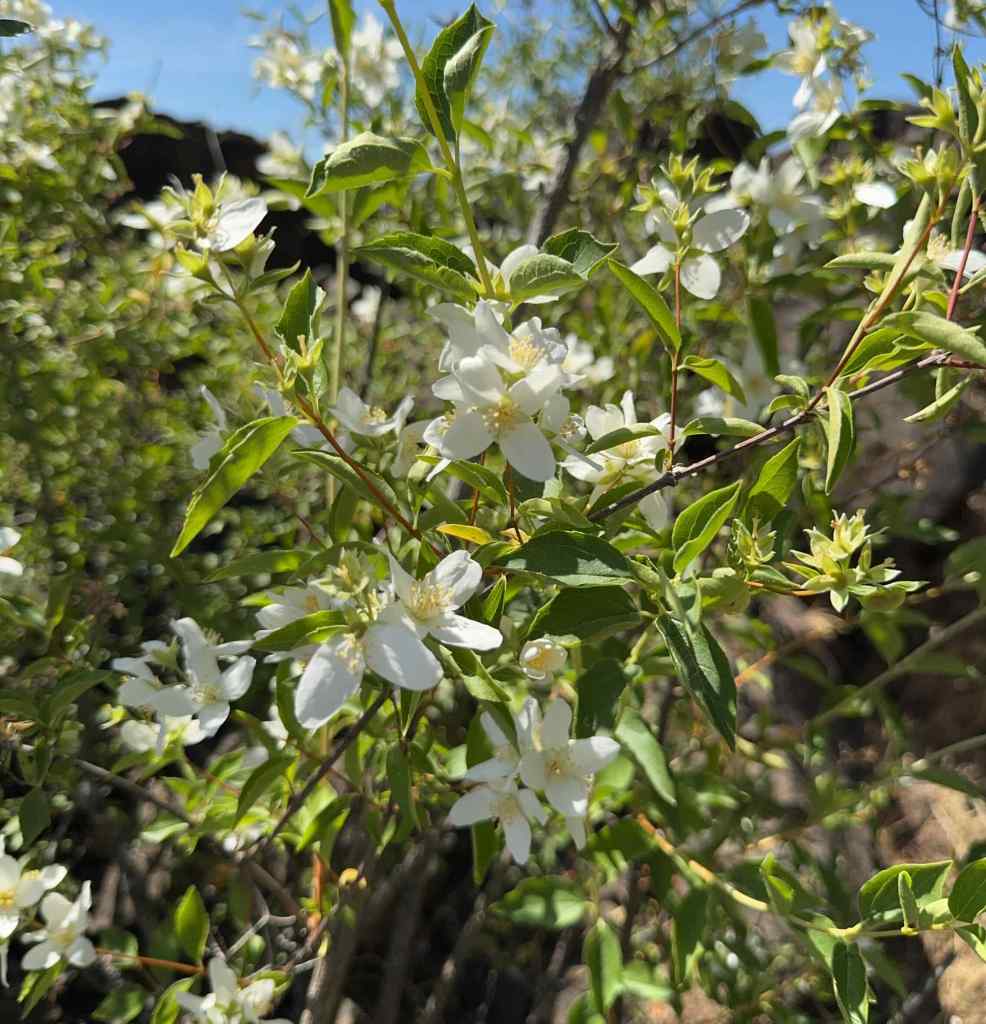
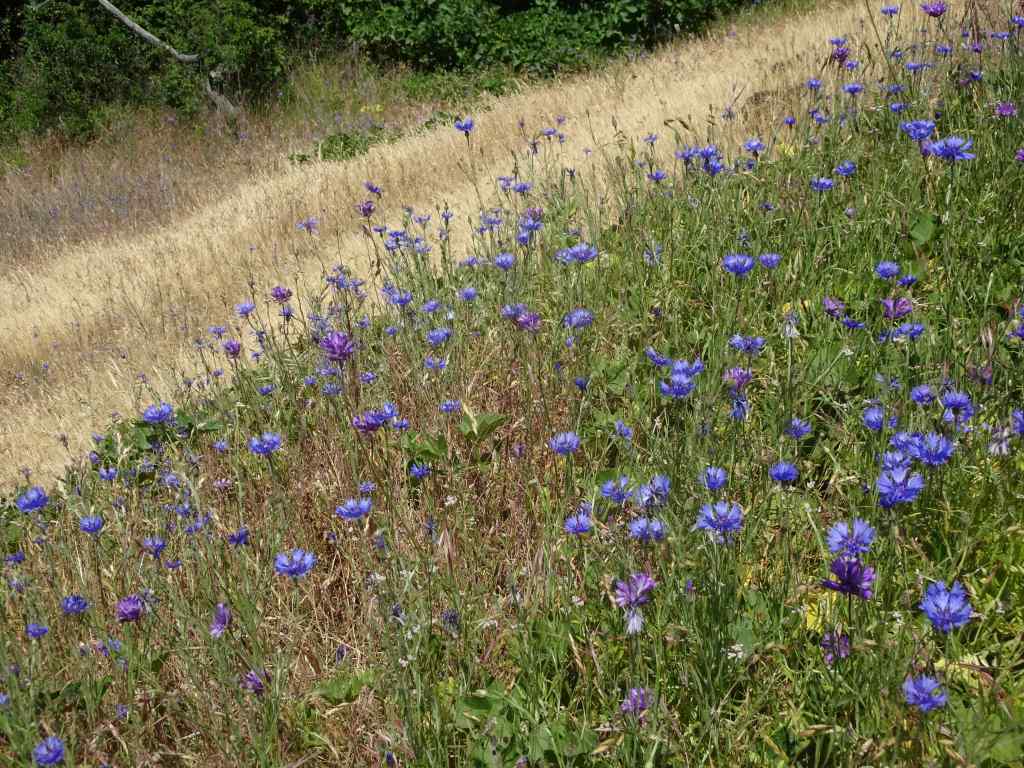
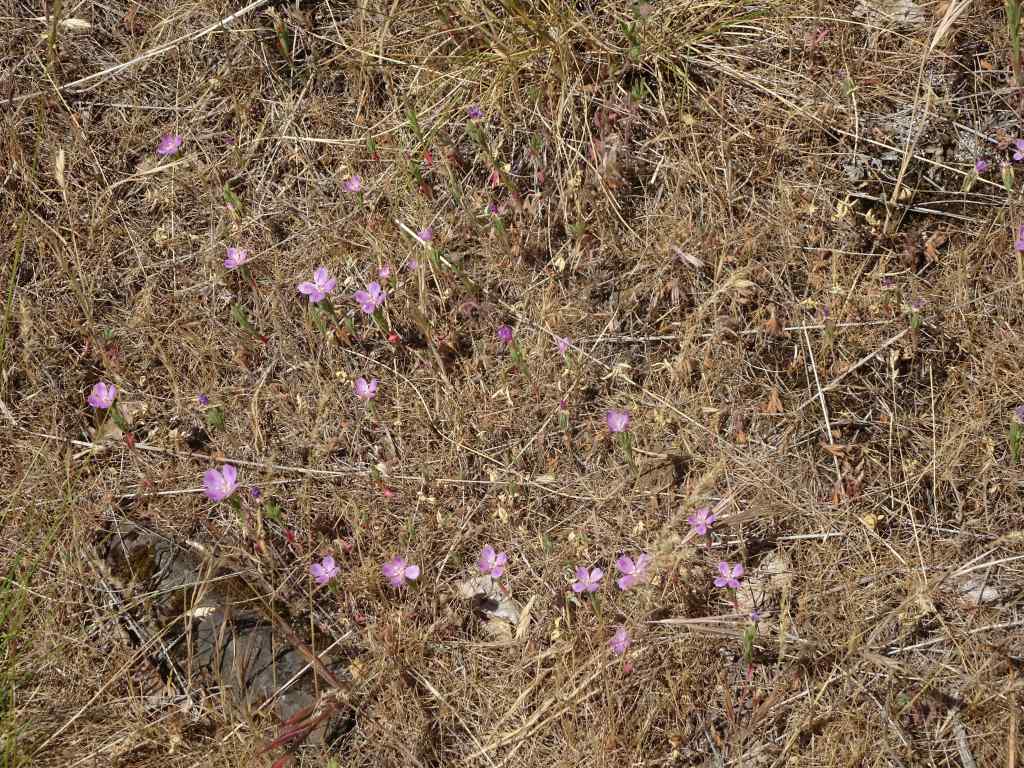
The Labyrinth was one of the first trails we ever hiked in the eastern gorge, and we have returned many times. The path winds through piles of columnar basalt that provide some protection from the wind, and the views are great! Wildflowers change throughout the bloom season. Today was the first time I have seen this particular suite of flowers – blue and purple bachelor buttons and ookow; white buckwheat, yarrow, and mock orange; pink clarkia and onions; all accompanied by a full gauntlet of poison oak.
The first surprise – abundant wildflowers surrounding the Lower Labyrinth Waterfall on the old highway approach trail – mock orange, bachelor button, ookow, buckwheat, and monkeyflowersMore mock orange, poppies and buckwheat, the Columbia River, and Mt Hood.Mock orange
Starting up the trail along Labyrinth Creek –
Buckwheat, golden grass with late season flowers. YarrowOokow, and bachelor buttons. The bachelor buttons are considered disturbed, but they do add a pretty color to the late season wildflower suite.Winecup clarkiaSwales of flowers in the drying grass
Continuing up along Labyrinth Creek –
Monkey flowers surrounding the upper waterfallHomage to the poison oak gauntlet that we carefully walked through today.Colorful slopes beneath one of the volcanic buttes.My favorite oak grove, with a lush poison oak understory.
Lunch views, with mule deer…
Westward, mule deer on the next ridgeMule deerEastward – Columbia River shimmeringHooker’s onions
It was getting warm, and I was losing my uphill motivation, but I wanted to go a little higher, to the rocky bluff where bitterroot blooms.
Mt Hood and buckwheatAs I expected, the bitterroot is shriveled up – I’ll have to wait until next year.Looking farther uphill, toward the slopes that lead to Coyote Wall – green grass turning to gold.Another look at Mt Hood, then we begin the return hike…I didn’t notice these White Brodiaea on the way up.Ceanothus blooming in the oak groveAnd past the waterfall again on our return to the trailhead.
It was beautiful day in the Labyrinth. But it is getting too hot for me in the eastern gorge – we may not be back until fall! I am going to southern Utah in June, where it is already very HOT, to help a family member. I may not hike much in the next month, but there will be red rocks and possibly some dinosaur tracks…
We enjoyed three wildflower hikes in the eastern Columbia River Gorge in March, all trails we have been to many times in different seasons. I love tracking the phases of wildflower bloom each time we go.
March 3 – Catherine Creek and Lower Labyrinth, WA
Early March is grass widow season at the lower elevations of the Catherine Creek and Labyrinth trail systems. My camera doesn’t do them justice, but the swaths of purple grass widows are so very pretty!
Fields of purple grass widows carpeted the lower meadows along the ADA Trail at Catherine Creek.Grass widowsLooking eastward…Early yellow parsleys in the woodland.More grass widows on the rocky outcrops.There was nothing blooming at the slightly higher elevation fairy ponds, so we went to the nearby Labyrinth/Old Highway 8 Trail to see what was happening there.The Lower Labyrinth Falls along Old Hwy 8 was full.The Upper Labyrinth Falls was also full, but there were no flowers up here.The flowers were concentrated in the lower elevation areas…Grass widows, gold stars, pink woodland stars.
March 11 – Rowena Crest, OR
The next week, on the Oregon side of the river, we saw more swaths of purple grass widows along Rowena Crest – both in the lower part of the Tom McCall Trail, and the Rowena Crest Trail.
We started by walking toward Tom McCall Point, where grass widows filled the meadows.Grass widows and tiny white spring whitlow grass bloomsWe walked through the oak tree lined Parsley Alley, and saw purple Columbia Desert Parsley beginning to bloom.Columbia Desert ParsleyLooking east toward Lyle Cherry Orchard and the Rowena curvesYellow bells popping up in places.
We went back down, and walked all the way to the end of the Rowena Plateau Trail.
Grass widow meadows along Rowena Plateau TrailYellow parsleyWhite salt and pepper parsleyGold Stars in the meadows at the west end of the trail
Reflections in the ponds along the way provided some abstraction distractions…
Pondwith ripplesZooming inCloserand closerand back out.Another pond.
We walked back along a side trail near the cliff edges – so many flowers!
Looking toward Lyle, WA.And back toward Tom McCall Point.
March 18 – Rowland Wall/Stringbean Loop, WA
By mid-March in the Catherine Creek area, grass widows were joined by other flowers – saxifrage, gold stars, yellow bells, more of the parsleys, and the first balsam roots.
At the trailhead, white saxifrage were speckling the meadows along with grass widows.Gold stars becoming abundant in the rocky areas overlooking the arch.Plenty of grass widows, looking toward the orchards of Mosier.The burn areas from last fall’s Top Of The World Fire are prominent around the trees, but the slopes have turned green.There were many robins hopping along today. We watched these two playing in some puddles while we ate our lunch.RobinWe continued uphill on the burned, but now green, slope of Sunflower Hill.Two robins in the top of the oak tree.Looking east from our high point. We dropped down over Rowland Wall, then decided to walk the inside-out switchbacks of the String Bean Trail. We didn’t find many flowers in the woodlands.Looking back toward Rowland Wall, and the Needle.We crossed the lava flows, then went back up over the wall at the lower trail.We saw the first of the balsam roots blooming along the wayRowland Wall scree slope and NeedlePlenty of yellow parsleys blooming along these west-facing slopes,And pockets of yellow bells.Grass widows and gold stars.
It was a beautiful day, and I am looking forward to the next phase of wildflower bloom in the eastern gorge!
Preview of Coming Attractions –
Driving home westward on Interstate 84, we passed under the base of Mitchell Point. The tunnel on the old highway was destroyed when I-84 was built, but has recently been reconstructed and reopened as part of the bike path through the gorge. I grabbed a photo as we passed – and we hope to walk there sometime soon. The views are supposed to be amazing!
Mitchell Point Tunnel, above the highway on the left.
We made our way to the spring equinox with a lunar eclipse, a St Patrick’s Day parade in the neighborhood; more knitting, quilting, home improvement, and reading; blooming plants in the neighborhood; three wildflower hikes in the Columbia River Gorge (next post), and a lot of rain…
Lunar Eclipse, March 13th
My photo, with camera set to fireworks…The sky is light because of the time delay, but the stars are out.My husband’s photo, with fancy zoom lens on tripod.
March 16th – Neighborhood St Patricks Day annual parade…
Knitting:
Hats for the Guild Service ProjectSock progressAnd a new scarf
Quilting –
I sewed together these quilt blocks. They may become pillows – I’m still trying to decide.
Home Improvement –
New dining room blinds and patched wallpaper
Reading –
I read six books in March.Nancy Russell and John Yeon, Columbia River Gorge
I learned so much in the two books about Nancy Russell and John Yeon, two conservationists who worked indefatigably for many years to create the Columbia River Gorge National Scenic Area, and then to implement the plan. It was a huge political and fundraising challenge to cobble together all the different government and formerly private lands, preserving the ecosystems and creating many of the trail systems we hike regularly. I think grateful thoughts every time we drive through or hike in the gorge!
Neighborhood blooms –
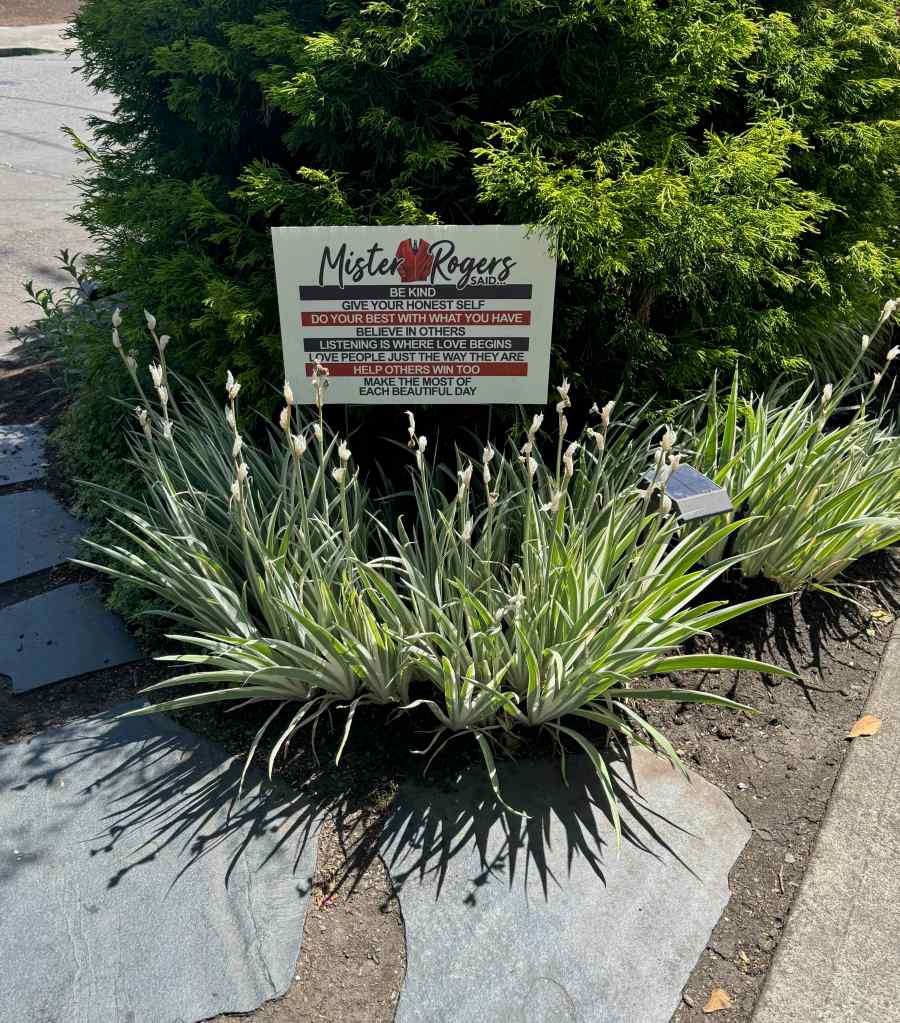
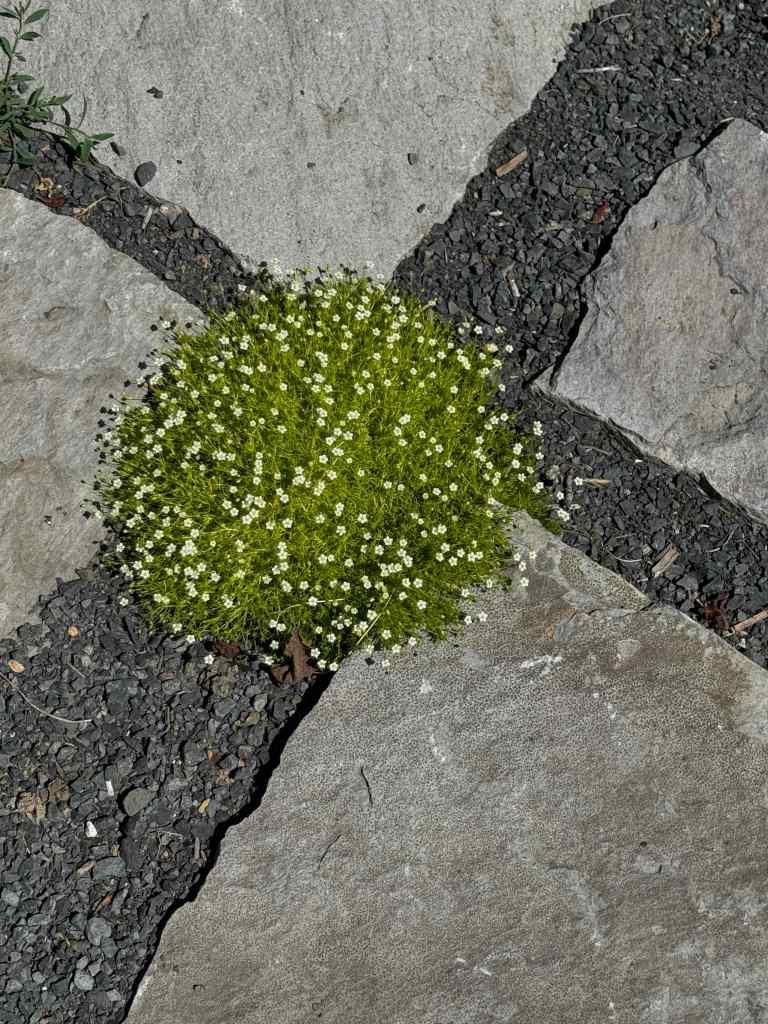
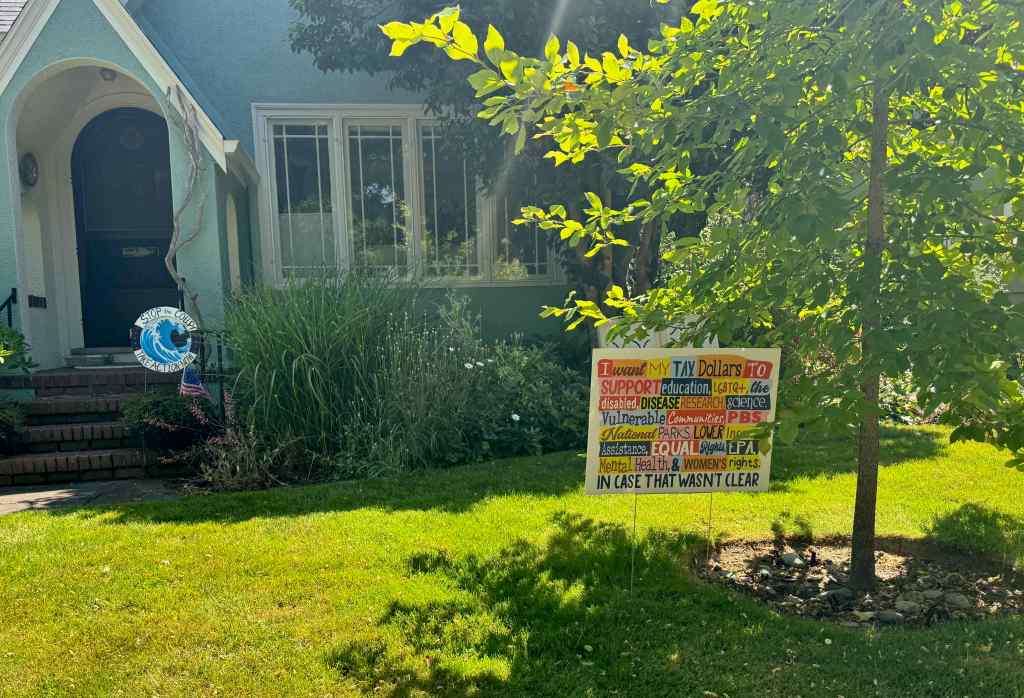
Flowering plumHyacinthDaffodilsCamilliaRain, in puddlesCherry treesTulipsSidewalk of the monthYard sign of the month
A change of plans…
At the end of the month we cancelled our planned trip to the east coast to visit family in Connecticut and Pennsylvania, so that my husband could get surgery on his neck, where a bone spur on the C3 vertebra was causing neurological symptoms and weakness. The procedure will be during the first week of April. More on the outcome next month… ( Update – it went well, he is recovering as expected.)
Two final notes –
1) I still have not gotten the hang of blog editing in the block mode on this site, so it is taking me a long time to create posts.
2) We are trying our best to stay positive in a constantly chaotic, hateful regime, so I am posting a couple of positive internet memes here at the end, to remind me to stay hopeful…
The shortest month seemed very long. I went from skiing the neighborhood snow to admiring the early spring blooms. I knit, quilted, and read as productive activities to counter the political upheaval. We honored the boycots. I made progress on the recycle/repair/upcycle four-year home improvement project. And we went on two hikes.
Crafting/Home Improvement:
Another pair of socks completedHat for the Guild service projectI started sewing these quilt blocks togetherBack hall carpet installed, almost the last step in that project.
Reading – I read nine books last month, many by or about women: writers, artists, a river guide, a Supreme Court Justice. After watching the Bob Dylan movie last month (A Complete Unknown), I was very interested to read Suze Rotolo’s side of the story. She was a politically active artist. She made a lasting impression on Dylan and his music, but she wanted to pursue her own artistic and life goals, not be just another string on his guitar, his ‘chick’, who would wait for him while he did whatever, wherever in the world. I really admire her for that. There are many great, less celebrated women out there, and I plan to read more of their stories. Meanwhile, I have been listening to the early Bob Dylan music – it fits the mood of this time in the world.
March 2025 Books
The neighborhood:
February 14th – I always love a chance to get out my 35 year old cross country skis, and kick-glide for a couple of miles down the quiet, flat streets of Irvington. The snow was perfect this day! And almost completely gone the next day.
Skiing out the front doorJust enough snow…Sunny and calmNice flat streetsJapanese Maple
Meanwhile, in Philadelphia, our son and his fiancee were attending the Super Bowl Victory Parade! Wearing hats that I knit for them last year.
Around town – flowers and rainbows…
Yellow crocus are earlyDaffodilsPurple crocusLavender crocusWindflowersRainbow seen while driving north on I-5 in Portland
Hiking –
We hiked out in the eastern Columbia River Gorge twice in February –
February 20th – Crawford Oaks, WA – We hiked about 5 miles on the Lower Vista Loop, past the full Eight Mile Creek Falls, and around the lower plateau. We saw very few early flowers and just a bit too much wind that day.
February 27th – Memaloose Hills, OR – A beautiful, perfectly calm day. We could see the blue heron rookery on yonder cliff top and a few flowers. It was an easy, enjoyable 3.5 mile hike with dear friends.
Eastward view from the Memaloose OverlookView to the north, with a peek at Mt AdamsWestward view, heron rookery circled in redFuzzy zoomed-in heron rookeryTrail up the south approach to Chatfield HillView to Mt Adams from the topA few grass widows up thereColumbia Desert ParsleySpring Whitlow grassLunch at the top, and a view to Mt Hood (photo credit to my husband).
Meanwhile, the news is worse every day – we are doing what we can, and trying to hold on to the glimmers and small victories. The daily reports of the shredding of the constitution by anti-empathic billionaires is trying every nerve, but I try to stay positive…
We celebrated our 40th wedding anniversary with a trip to the southern Oregon Coast. We stayed just south of Bandon, in a room with a view.
View southView north
We had easy access to the wide sand beach south of Face Rock, and took several long walks north and south over the next few days. We also drove south to Cape Blanco, and north to Cape Arago. Other than a bit of rain the day we arrived, we had fabulous weather – sunny and calm.
Locations of hikes and beach walks on the southern Oregon Coast near Bandon.
1/6 – Bandon Beach and Cape Blanco
We walked north to Face Rock in the morning.
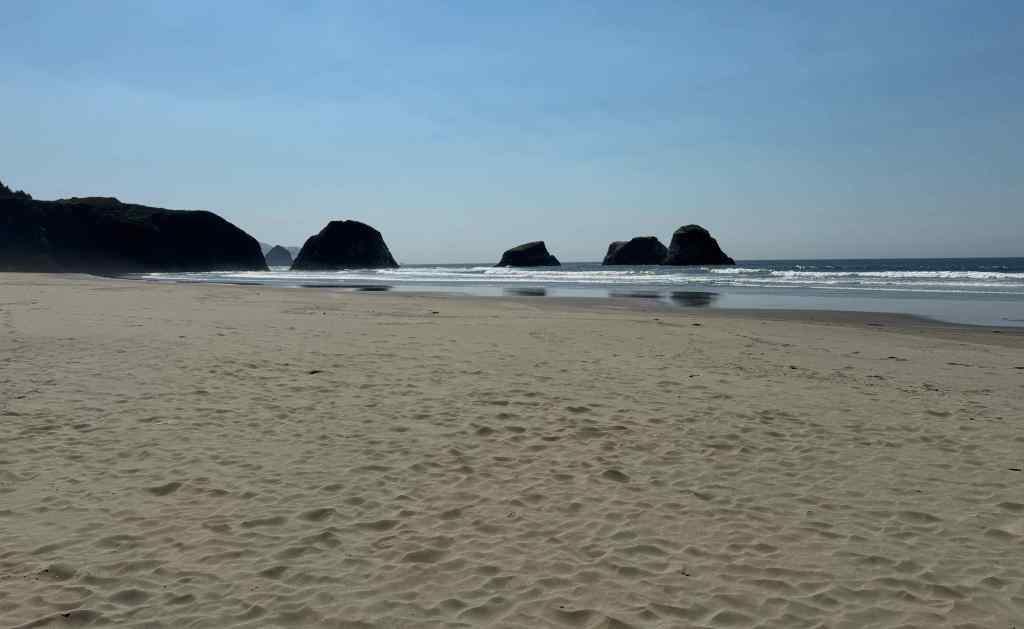
South view, Bandon BeachNorth toward Face RockOyster catcher Rock pillars off shoreThe tunnel near Face RockLooking south from the Face Rock overlookLooking north from the Face Rock overlook
After lunch, we drove south to Cape Blanco. We walked down to the beach, then along the strand line to the north, at approximately low tide.
Looking west toward the Cape Blanco Lighthouse,and northward from the bluff above the beach.Cape Blanco beachLots of wave action in the rock garden,Tide going out…And another view of the beach on the north side of Cape Blanco.
Later that evening I watched the sun set from our room…
Sunset
1/7 – Beaches to the north – Sunset Bay, Yoakam Point, Blastendorff Beach, Seven Devils Beach
We drove north to Cape Arago, but a recent washout closed the road, so we could only go as far as Sunset Bay. We started with a short walk there, then explored a few locations to the north.
Sunset Bay at low tide
We walked about a mile around Yoakam Point, looking at the view from various cliff overlooks:
Looking east toward Blastendorff BeachYoakam PointCape AragoCape Arago LighthouseNatural arch
We ate lunch and then took a walk at Blastendorff Beach.
Blastendorff Beach, and jetty to the Coos Bay inlet
Driving back south, we took a side trip to the Seven Devils Wayside, and walked on the beach there. We even saw someone panning for gold.
Historical uses of this area…Looking south from Merchants BeachPainterly sky and water
Back in Brandon, we took a walk along the pier. It was mostly deserted, with most shops closed. I was fascinated by the mosaic installation on the boardwalk.
Bandon pier
Spiral Mosaic
Mosaic center
Mosaic detail
So many great little details – I looked at it for a long time!
Later, we walked out onto Coquille Point again, to watch the sunset. We met a large puffin sculpture there.
Coquille Point overlookLooking southPuffin made of flotsamAnother view of the Puffin sculpture
1/8 – Low tide near Bandon – Face Rock and Coquille Point
With low tide in the afternoon, this was a perfect day to walk north toward Face Rock and then beyond Coquille Point and look at tide pools, water, sky, and all the reflected permutations.
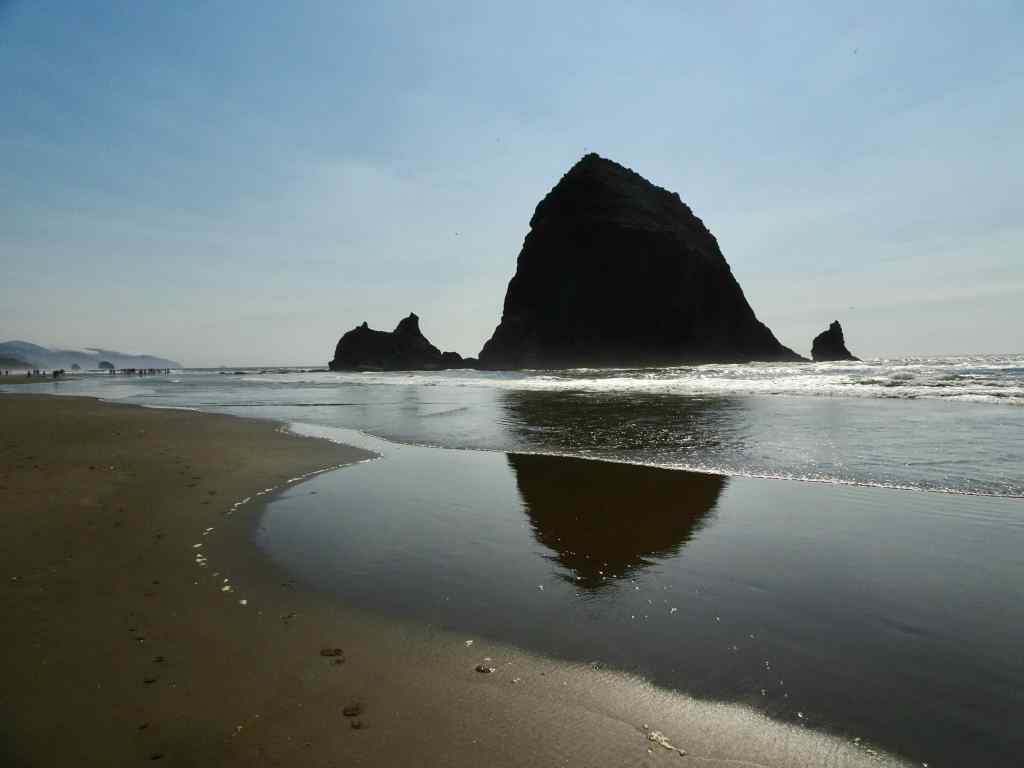
Bandon Beach, looking north…Looking south – reflections – water – skySea stacksLogs north of Coquille PointMore reflectionsLow tide beachBlue sand and skySea stars and anemonesCloser viewMore reflectionsFace Rock tunnelTide poolsSky and water…
Later, we enjoyed another sunset from the Coquille Point Overlook…
South viewSun just dipping below the horizonThe flotsam Puffin glowing in the sunset.
We enjoyed our few days of calm weather and beach walks, a break from the ‘real’ world, and what was to come next in January.