12. Ridgefield Wildlife Refuge

Kiwa Trail   7/4/2017  (#36)

We celebrated 4th of July with a midday stroll along the Kiwa Trail at Ridgefield National Wildlife Refuge, Washington. The  one and a half mile loop trail crosses through treed areas, open fields and wetlands.

Birders love this trail – we were surrounded by much birdsong and glimpsed a few, including redwing blackbird sentinels.  The trail is closed during winter nesting season, and I can easily imagine the fields full of swans and geese. Today was warm and dry with only a few clouds, so not much wildlife viewing.  We appreciated the vistas, the quiet,  the ambient sounds, and the splash of color from the midsummer wildflowers.

Sounds:

  • bullfrog – a deep bass mooing,
  • birds – higher pitched tweets, warbles, pips and chirps,
  • train – periodic horn blast and thrum of wheels on rails,
  • breeze in trees – intermittent light percussive ruffling,
  • country band – occaisional wafts from the Ridgefield 4th of July celebration, less than a mile away as the crow flies,

Critters: tree frog, turtle, butterfly, redwing blackbird, other birds.

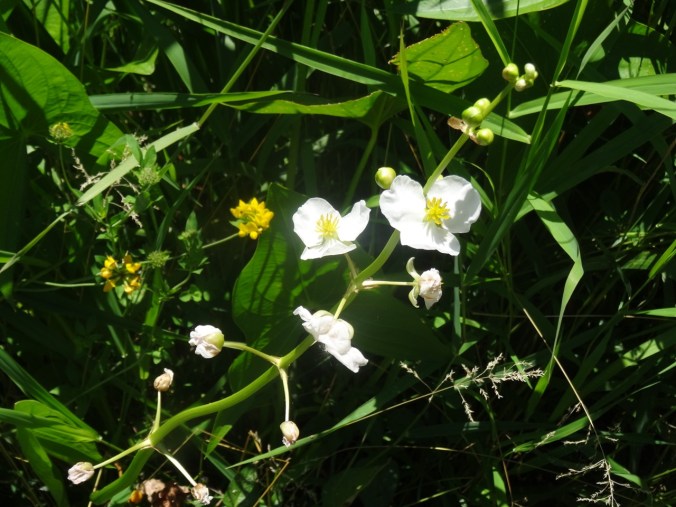
I noticed wapato plants with acute triangular leaves and three petaled white flowers growing in one of the wetlands.  The bright green leaves reflect the sunlight in an array of pointed spaceships, ready for takeoff, and also shadowed transparency with interesting intersecting shapes in the bright sunlight.

The wapato blooms are  bright white with three petals.
DSC06265

Other blooming wildflowers/weeds were mostly dry season holdovers – many noted for growing in disturbed areas.  The refuge is a reclaimed pastureland, after all.

Preserving time by catching shadows behind leaves and light on grass, on water, and on a butterfly in a freeze frame photo.

11. Avalanche Lilies and Haunted Trees of Vista Ridge

Vista Ridge Hike   6/30/2017   (#35)

The Vista Ridge trail, trailhead at 4500′, is one of my favorite ways to hike to the summer alpine meadows along the Timberline Trail on the north side of Mt. Hood.  The area suffered a large forest fire in 2011, so much of the lower part of the trail is through a burned forest.  Each year the undergrowth in the burn zone has increased, and there are many huckleberry bushes now filling in the ashy ground, but there is little shade in the scorched forest.  We see glimpses of the stark white peak of Mt. Hood through the screen of burned trees, and each year we notice more fallen trees.  Usually we wait to hike until the snow has melted out up to the Timberline Trail at about 6000′, and we have noticed  abundant lily seed heads lining the trail through the burn zone.  We have also seen the social media posts about the incredible avalanche lily display that follows the snowline up the mountain. We have previously seen swathes of lilies in the upper trail area, but this year we went early enough to see the lower trail in full bloom.  With the heavy snowpack this year, it may be a while before the Timberline trail is snow free.

DSC06074

Dan hiking toward Mt. Hood in the lower lily fields, flowers fading to pink.

There were millions of lilies along the trail and throughout the forest floor. The lilies in the first patches we encountered were fading and turning pink, petals tips curling up. But soon enough we were surrounded by fresh blooming flowers with crisp white points and yellow centers. They were beautiful and amazing and the pictures speak for themselves.  It was lovely to be able to walk through them.  We hiked to about 5300′, where snow obscured the trail and the lily plants in the patches of snow free ground had not yet bloomed.

Meanwhile, we were walking among  the ghosts of a forest past – trees reduced to spiky trunks, sloughed black bark, chalky curled branches and ashen soil.   Trees with haunted sad faces, gaping mouths, and twisted empty eye sockets occasionally loomed above, watching us walk by. The contrast between blue sky and bare trees creates a starkly beautiful if tragic setting.

Two photos from previous year’s hikes show one of the tree faces that I couldn’t find this year, so it must have fallen.  The August 2014 photo shows abundant lily seed heads.  In March of 2015, a low snow year, I saw the same face with a snowy ground.

Returning down the trail, Mt. Adams seems to float  on the skyline, reminding me of Carl Sandburg’s Village of Cream Puffs.

There were only a few other wildflowers blooming on this day, including some seen along the road to the trailhead.  Our hiking mileage for the day was 4.2/800 feet.